
Hamburg State Opera
June 25, 2026
What is there left to say about George Balanchine’s Serenade? Created 92 years ago, and 72 years since the famous Karinska costumes made their debut, it remains a marvellous ballet. Old but not showing its age in the least. Classical through and through but feeling modern too. It says much for it that it felt the freshest of the four ballets on Hamburg Ballet’s Fast Forward programme.
The opening scene is iconic. I’ve seen the ballet countless times but that, and the closing promenade, still both bring a shiver to the spine, and even a tear to the eye. The cast were uniformly excellent, showing a fine sense of musicality coupled with precision and speed. And Serenade is a ballet that should not be taken too slowly, something clearly appreciated by young Austrian conductor Katharina Müllner, who took the Tchaikovsky at a suitably snappy pace.
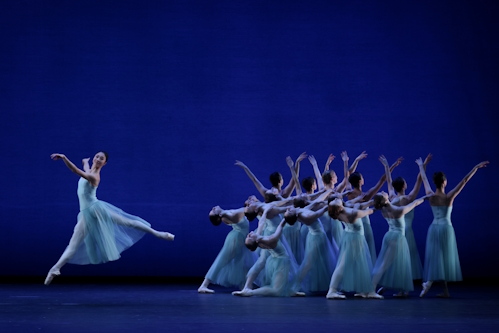
Photo Kiran West
Among the soloists, Futaba Ishizaki was wonderfully bright, jumping with lovely lightness. Ida Praetorius, the woman who arrives late and who had a lovely partnership with Matias Oberlin, and Hayley Page both shone in the middle section. Elsewhere, a special mention for Oliva Betteridge, fresh from her success in Wunderland.
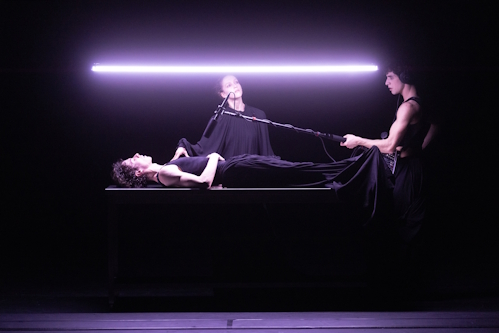
Catalan choreographer Marcos Morau’s Totentanz (Dance of Death) received a very enthusiastic reception but left me decidedly cool. It opened with Francesco Cortese walking down an aisle, then along the front row with a microphone on a boom, I think trying to pick up the sound of people breathing, being alive. It doesn’t really succeed in doing anything, except making one ask, ‘Why?’ The clop of his shoes on the stage is rather eerie, though.
in Totentanz by Marcos Morau
Photo Kiran West
The stage is black and bare save for a table that looks a bit like a mortuary slab complete with body, lit only by a strip light above. When Cortese and Charlotte Larzelere, both now in black cowls, gather around the table, it looks a little like a seance. Their movement is sharp, precise, jerky, as if they are possessed. Sure enough, the body, Daniele Bonelli awakens.
The three performers are clearly a symbol of death; and what a dark place Morau imagines it to be. The link with medieval tradition is a little tenuous, however. Even more so as things get rather clichéd towards the end with a lot of thunder and lightning. I half expected a howling creature and the sight of Dracula.
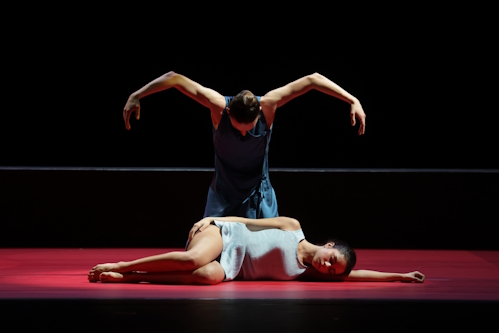
Angelin Preljocaj’s Annonciation is better. As the title suggests, it traces the moment when the Angel Gabriel informs the Virgin Mary that she would conceive a son by the power of the Holy Spirit. Preljocaj depicts the scene concisely and with clarity. Charlotte Kragh as the Angel and Almudena Izquierdo both performed with great emotion and expression. Kragh’s Angel was powerful and dominating, Izquierdo’s Maria fearful, then serenely calm as the pair come together. The combination of Antonio Vivaldi’s Magnificat with the modern electroacoustic sound of Stéphane Roy’s Crystal Music works well too.
in Annonciation by Angelin Preljocaj
Photo Kiran West
Created for Hamburg Ballet, The Moon in the Ocean by Chinese choreographer, Xie Xin (謝欣) was premiered only in February. It’s the polar opposite of Serenade in that here, the two moons aside, the men are front and centre.
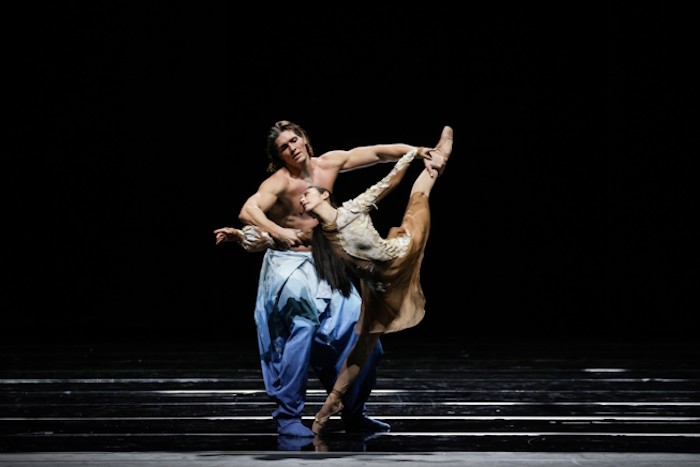
It cannot be denied that is beautiful. The choreographer’s trademark soft but strong fluid movement, together with the mirror-like black floor that reflects everything that happens, Gao Jie’s (高捷) fabulous lighting and Li Kun’s (李昆) costumes in the blues and greys of the sea come together to paint some handsome pictures. The opening especially really does look like the moon shining on the ocean, the gentle swell slow and languid.
The dreamlike and calming work uses the moon and the ocean as a common metaphor for the human heart, for our relationships with others and the world around us. The music by Sylvian Wang (王宇波) emphasises those connections, and comes with a sense of yearning and other-worldliness.
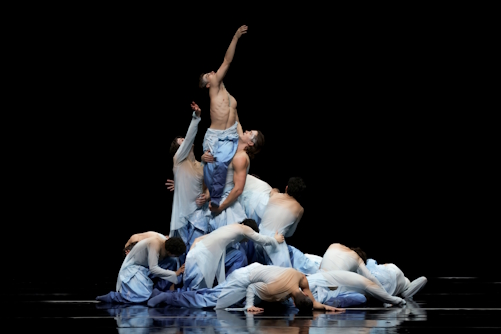
Photo Kiran West
In her choreography, Xie Xin makes great use of canon. The dance for the all-male ensemble resembles waves spreading from a single point. Bodies often appear as chain, but then sometime come together in moving sculptures. Two women on pointe, Ana Torrequebrada as the Moon of the Oceans and Xue Lin (林雪) as the Moon of the Sky appear far upstage. As they increasingly become the focus, they seem to be playing with the sea, pulling it in various directions, which is precisely what the Moon’s gravity does in reality, of course.
Lin, dressed in glittering gold, and Florian Pohl later dance a duet full of breath and expansive long lines. It cannot be denied that The Moon in the Ocean is very poetic, very soothing. Hypnotic even. But perhaps too much so. Too soothing. It is quite one-paced and does start to get a little soporific. Ditto the music. A faster section comes as a relief, but it is relative.
The Moon in the Ocean is a fine idea. And the finished ballet does make you want to sigh with pleasure a lot of the time. It’s also interesting to see a male-ensemble moving so smoothly and gracefully. Choreographers can have too many ideas, and all credit Xie Xin to sticking with one, but I would have liked a few stronger moments or variation in dynamic here and there.