
Hamburg State Opera
June 24, 2026
Over his lifetime, John Neumeier has accumulated a huge collection of art, documents, photographs and memorabilia that portray the history of ballet and dance. Although the collection covers all periods of dance history, the central focus is on the Serge Diaghilev era and one person in particular: Vaslav Nijinsky.
So, it was not wholly unexpected when, in 2000, Neuemier created a ballet about the dancer-choreographer’s life and work. The ballet is not a documentary. It is not a narrative account of his life. Neumeier still refers to it as a biography, however, but one of the soul, of the “feelings and states of the human condition.” It’s a perfect description.
Nijinsky is a ballet that evokes with a great deal of empathy, affection even, for its central character. It’s also complex and occasionally difficult to follow. But it is a remarkable and quite extraordinary creation.
Right from his first appearance, a realistic depiction of his last public appearance as a dancer in the ballroom of the Suvretta House Hotel in St. Moritz on January 19, 1919 (there’s a number to play with!), just seven years after Rite of Spring caused a near riot in Paris, Aleix Martinez was Nijinsky.
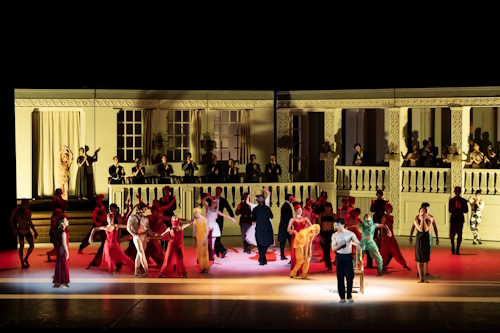
Photo Kiran West
Entering swaddled in a lot of fabric, the dancer’s condition is immediately apparent. Shortly after, he would be diagnosed with schizophrenia and institutionalised, spending much of the rest of his life in institutions and treatment centres until his death in 1950.
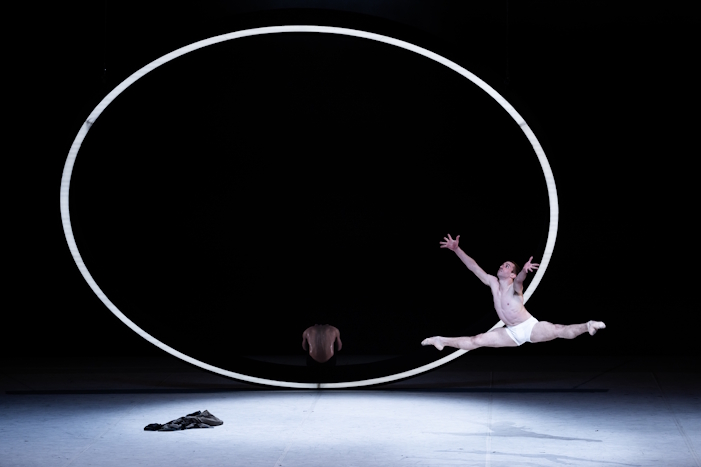
Neumeier shows how Nijinsky stood still for a long time before launching into his improvised solo performance, titled Wedding with God. Full of angular, somewhat strange movement, it was hardly surprising that the audience appear unsettled. But Martinez’ dance was also full of emotions that reached out and demanded to touch. He made you immediately feel for the man.
Thereafter, as the stage fills with people and images from Nijinsky’s past, Neumeier delves into the man’s memories including those of his first meeting with his wife, Romola, his patron Serge Diaghlev, his career with the Ballets Russes and his most famous ballets.
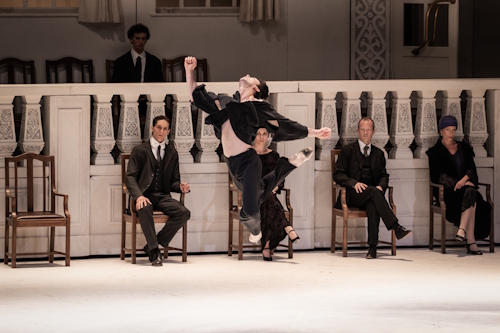
(pictured: Alexandr Trusch as Nijinsky)
Photo Kiran West
To music by Frédéric Chopin, Robert Schumann, Nikolai Rimsky-Korsakov and Dmitry Shostakovich, figures and scenes from famous ballets in which Nijinsky appeared come and go. There’s Harlequin from Carnaval and the Spirit in Spectre de la Rose (both danced by Louis Musin), the Golden Slave from Scheherazade and the Faun in L’Après midi d’un faune (both Artem Prokopchuk, bursting with energy and power as the former, erotic as the latter), the Young Man from Jeux (Illis Zakrevskyi) and Petrushka (Javier Montreal). The Faun is especially to the fore. Fine performances were given by all. The characters, the images painted, are reassuring in one sense. And yet, simultaneously what we see is anything but normal.
Act One ends with the arrival of World War One but, right from the start of Act Two, performed to Shostakovich’s Symphony No.11, the real world, the world at war, intrudes more and more. It just adds to Nijinsky’s struggle. Immediately, there’s the contrasting imagery of soldiers marching forebodingly across the back while Martinez’ Nijinsky dances with Xue Lin’s Sylphide., the war is never far away. One scene the graphically depicts the chaos of the conflict and death particularly brings it to the fore. But Nijinsky’s madness is equally an ever-present as roles from the past continue to return.
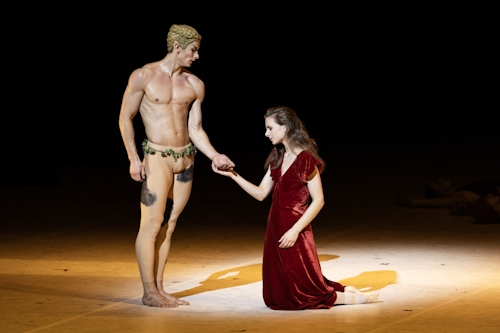
(pictured: Ida Praetorius as Romola
and Artem Propokchuk as the Spirit of the Rose)
Photo Kiran West
This was very much Martinez’ evening. On stage for most of the ballet and inhabiting his role fully, his presence was remarkable. His body seemed so full of tension, except that is for his memory of his first meeting with his wife-to-be, Romola on a ship to South America. The only time the couple have the stage to themselves, their dance against a ship’s rail was sensual and soft.
As impressive as the supporting cast were, as Romola, the serene Charlotte Larzelere stood tall. Always wearing a striking red dress, the way she appears in almost all her husband’s confused recollections indicates just how important she was to him. Their first encounter stands out. You could see and one of the few times the tension eased from his character.
One senses she is very much a woman who knew not only how to deal with her husband, but also with Diaghilev, who is often present, even if as a figure at the back watching. Upright and looking very tall in his top hat, Pepijn Gelderman gave a striking performance as the impresario. He came across as superior and detached; cool almost to the point of being cold. It was Romola, of course, who was the reason for Nijinsky’s final break with his patron. The sled scene, towards the end, showed just how much her relationship with her husband still meant.
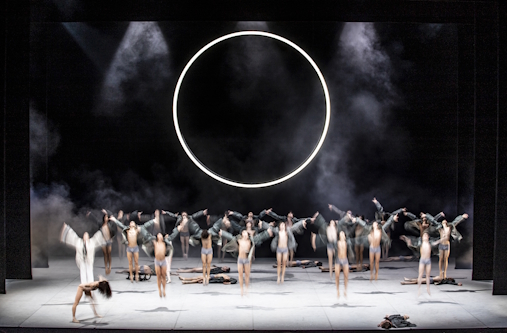
Photo Kiran West
The sets, costumes and lighting, all designed by Neumeier, are all of the highest order. Much of the ballet takes place under two lit circles that fill the air above the stage. It’s a nod to the central importance of the shape for Nijinsky, who drew it time and again in his diaries, and who had a vision of a circular stage.
The end is again dominated by war. Now, Wehrmacht soldiers walk repeatedly across the stage. The ballet ends in madness, although in reality, Nijinsky’s final days came peacefully.
Nijinsky is a little overwhelming. It’s certainly a long way from Alexei Ratmanksy’s Wunderland, premiered four days earlier. Could there have been more time, indeed any time, spent acclaiming the man as a performer and choreographer. For sure, although I think what he once was does come through in those scenes that come from his memory. Some prior knowledge of Nijinsky, the man and his life, is definitely an advantage, though.