
Royal Albert Hall, London
June 25, 2026
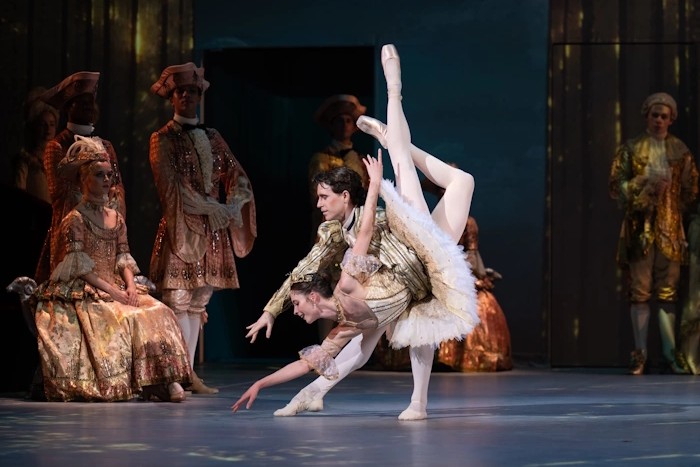
English National Ballet’s The Sleeping Beauty at the Royal Albert Hall is spectacular in the most literal sense: grand, glittering, musically full-blooded and, at its best, gloriously alive to the fairytale world it inhabits. While the staging of Kenneth MacMillan’s reimagined production does not solve every problem posed by the vast venue, the ballet delivers an evening of considerable splendour, crowned by an outstanding Aurora from Emma Hawes.
The first surprise is that the peorduction is less ‘in the round’ than one might have expected. It plays more like an extended apron staging, with the dancers working into the space rather than being fully surrounded by it. Whether a complete in-the-round version would have demanded a greater number of dancers is open to question, but the arrangement here works well enough, allowing the choreography room to breathe, and the big ensemble moments enough space.
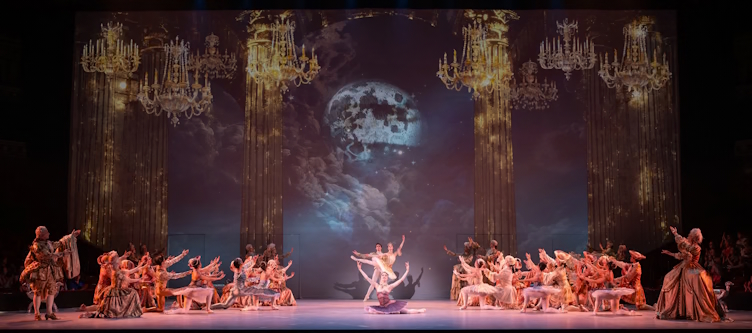
Photo ASH
Instead of traditional scenery, the production relies largely on a digital backdrop, with only minimal furniture on stage: the royal chairs for the King and Queen. The approach is unmistakably modern, but not coldly so. Much of the time, it proves effective. The shifting colours, changing skies and architectural images give the production atmosphere while leaving the stage uncluttered for the dancers. In a ballet where space, pattern and ceremonial movement matter, that openness is a real advantage.
The problem comes in the transitions. In the first half especially, the pauses between scenes are too long. The orchestra continues, but the stage is empty, while the screen displays scene titles that write themselves on, disappear, and then repeat. What may have seemed an elegant visual device in design becomes irritating in practice. Put the title up once and leave it there; or dim the lights slightly and let us listen to Tchaikovsky; or, better still, give us some modest stage action. Courtiers, attendants, Aurora’s friends, anything to carry the drama across the gap. As it stands, these interludes repeatedly stall the theatrical momentum.
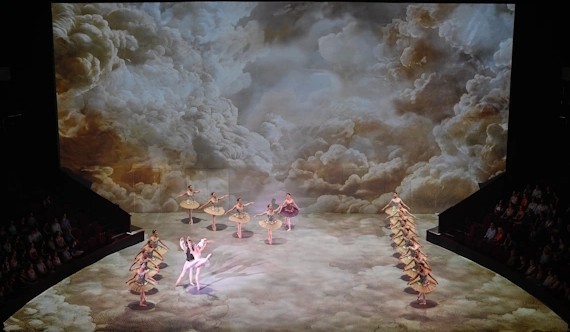
Photo ASH
The second half handles the idea better. The long digital transformation after Aurora’s awakening, as the overgrown castle repairs itself and the fairytale world blooms back into life, is imaginative and more dramatically justified. Even so, it too feels overextended. It is a pity also that the awakening of the court is not shown physically, even if briefly. One of the charms of the story is precisely that suspended world returning to motion. There is a further oddity: when the King and Queen reappear, they seem visibly aged, which sits awkwardly with the fairytale logic that everyone has slept unchanged for a hundred years.
Such reservations are set against much that is beautiful. Nicholas Georgiadis’s costumes are magnificent: rich, detailed, sparkling and entirely suited to the storybook world. Golds, silvers and blues catch the eye without becoming gaudy, while the dream sequence, with its greys and golds, conjures a fine sense of distance and enchantment. In a production where physical scenery is so reduced, the costumes do much of the visual storytelling.
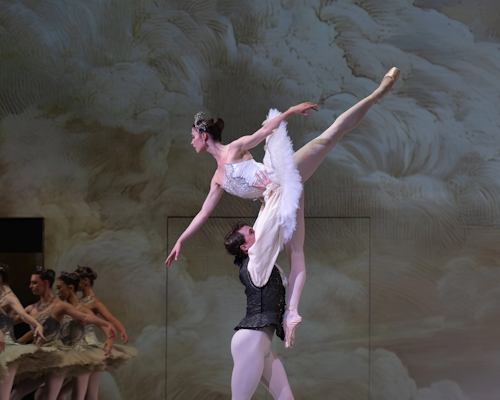
Photo ASH
At the centre of it all is Emma Hawes. Her Aurora is a performance of exceptional clarity and authority. Technically, she appears entirely secure, but what impresses just as much is the dramatic intelligence. Her mime is clean, expressive and meaningful; her musicality is refined; and she gives each phase of Aurora’s journey its own colour: the brightness of the birthday celebration, the otherworldliness of the sleep-dream sequence, the radiance of the wedding. It is a genuine tour-de-force, and further confirmation that Hawes is now one of the leading ballerinas not only in this country, but on any stage.
Aitor Arrieta’s Prince Désiré does not always quite match Hawes’ level, but he has many fine moments. His solos are danced with elegance and bravura, his jumps landing with impressive softness, and his turns are tightly controlled, with secure finishes. In the pas de deux, he partners with care and presence, even if she remains the greater dramatic and technical force.
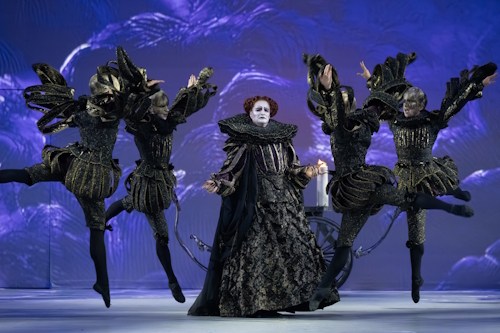
Photo ASH
Anri Sugiura’s Lilac Fairy brings a calm authority to the stage, while James Streeter’s Carabosse provides a necessary bite of darkness. The ballet needs that threat; without it, the ceremonial beauty can become merely decorative. Streeter gives the role theatrical weight and makes Carabosse more than a pantomime interruption.
There was an unfortunate moment in the final act. During the Princess Florine and Bluebird pas de deux, danced by Katja Khaniukova and Rentaro Nakaaki, a lift appeared to go wrong, or at least to be mistimed, and was wisely abandoned before it became dangerous. It was one of those moments that reminds us how physically precarious ballet can be, especially when bodies are moving at such technical extremes. What mattered most was that both dancers were unhurt. To their credit, they recovered quickly and completed the duet with admirable composure, earning warm and deserved applause.
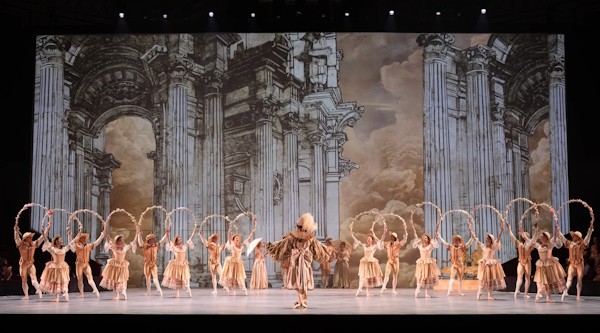
Photo ASH
Elsewhere, some of the smaller ensemble work was less polished. The dancers in Aurora’s Friends and the Lilac Fairy’s attendants were individually pleasing, but as groups they were not always together. Footwork, timing and placing occasionally looked untidy, and in a production of this scale, small inaccuracies become more visible rather than less. The principal performances may soar, but the surrounding classical framework must be just as exact.
The ENB Philharmonic, conducted by Maria Seletskaja, is superb. Tchaikovsky’s score rises magnificently in the Albert Hall, and the orchestra gives the evening much of its emotional sweep. During the overlong scenic pauses, the music almost rescues the situation by itself; elsewhere, it lifts the dancing into the realm of true fairytale grandeur.
A practical word should also be said for the Royal Albert Hall itself. On a sweltering June evening, the auditorium’s air-conditioning was not merely welcome but essential. It was cool enough for the audience to sit comfortably and, more importantly, for the dancers to perform safely. In those conditions, that is no small achievement.
This Sleeping Beauty is not flawless. But the production’s strengths are considerable: the splendour of its costumes, the sweep of the music, the scale of the occasion, and above all Emma Hawes’ luminous Aurora. At its finest, English National Ballet gives us exactly what The Sleeping Beauty should offer: a vision of classical ballet as ceremony, fantasy and enchantment.