
Linbury Theatre, Royal Ballet & Opera, London
June 23, 2026
It was definitely an evening of contrasts with three contemporary dance works from Rambert School and five shorter neo-classical pieces from the Junior Company of the Polish National Ballet. One thing they have in common is the need for employment as a dancer in a shrinking jobs market, though.
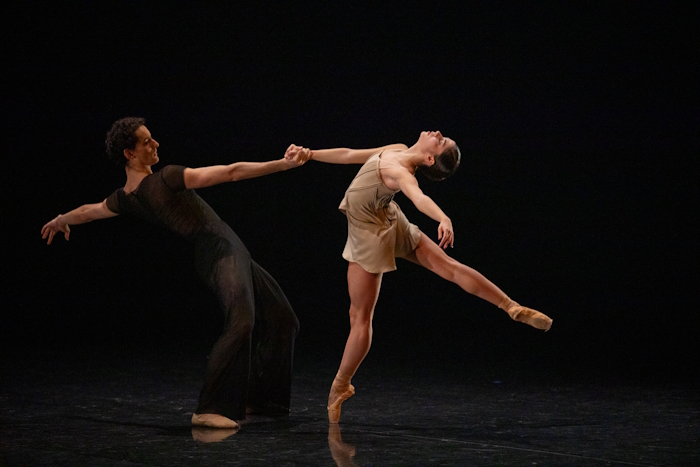
The Juniors of PNB were given good opportunities to show their talents with many small solos in the works performed. Reverentia, choreographed by Dawid Trzensimiech, a soloist with the Royal Ballet in London from 2008 to 2014, and later principal with the Polish National Ballet, made a strong opening statement. Using the fine-tuned emotions in Paderewski’s Piano Concerto it raised the formality of a showcase for the dancers’ prowess to a heightened artistic level. In a series of duets, brief solos and ensemble work the dancers showed confident partnering in some innovative lifts and throws, clean pointe work, good ballon from the men and assured presentation.
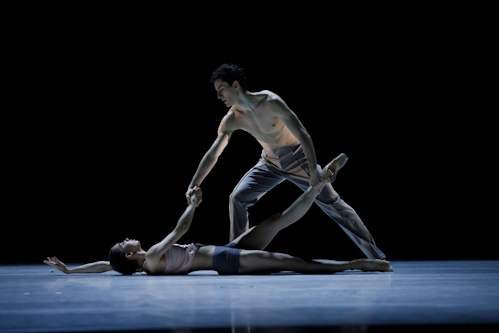
Photo Ewa Krasucka
Robert Bondara, one of Poland’s most exciting new choreographers presented Verses. Two excellent dancers, Martyna Wrzesińska and Antonio Casti, interpreted a complex concept in choreography that was both unusual and challenging.
Gnossienne No.1, to Satie’s music, also a duet, was given a sensitive interpretation by Klaudia Sarna and Kajetan Stabeusz with the intriguing addition of their two shadows. Choreographer Anna Hop, a dancer in the National Ballet, used the shadows to extend the concept of loneliness giving the dancers opportunities to explore deeper emotions in a well-choreographed work.
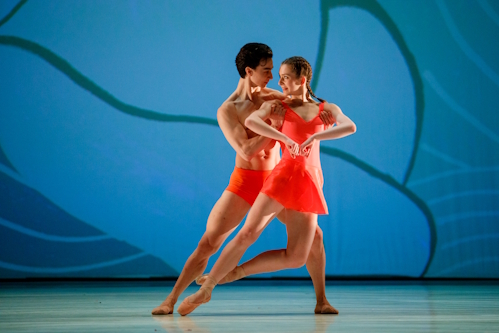
Photo Ewa Krasucka
Choreographed by company dancer Antonio Lanzo to music by Bela Bartok, Rumänische Volkstänze, performed by Kyle Lippoth, Maja Augustyniak and Klara Melerska from the Junior Company, was a delight. Dressed in bold orange, it revealed comic skills in a cheeky contest of boy/girl relations.
Katarzyna Kozielska has created a number of works for Stuttgart Ballet. Her Fluxus, a piece for eight dancers searches inwardly, delving into our thoughts that can move so freely and open our imagination. It is a serious work full of ideas and the strong team of technically confident dancers delivered a moving and emotional performance. Like the rest of the works, it was simply and stylishly dressed and effectively lit. It was a treat to welcome the Junior company of PNB to London.
in Session 1 by Ben Duke
Photo Gregory Batardon
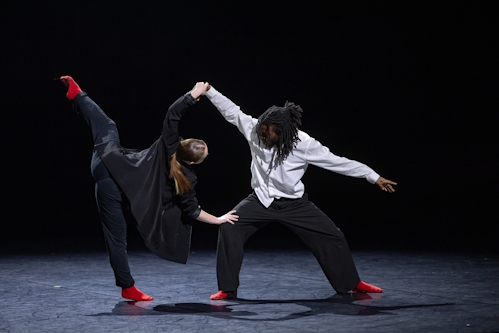
From the Rambert School, Ben Duke’s Session 1 is a witty take on a multi-persona Hamlet visiting a therapist was my favourite. The cast of six had the dramatic skill to deliver, notably Beatrica Carrozzo who opened the show with a confident and very clever verbal soliloquy. A complex structure shifted the persona of the characters from one dancer to the next and was presented in movement and text with speed and dexterity. A smart close, very much in Duke’s style, came as a final Hamlet is about to empty his soul to the therapist, when the session is timed out and the patient is dismissed.
The Last Hamlet, Duke’s latest creation for his own company, Lost Dog, is also inspired by the Shakespearean king, and gets its first UK performances at Sadler’s Wells East in November.
Blues in Three choreographed by Holly Blakey and Outside the Stadium by Alesandra Seutin both tackled big themes but didn’t quite rise to the occasion. Blakey’s work was multifaceted. There was no question of the dancers’ commitment but with so many divergent paths it was difficult to find a clear direction. The rather beautiful blue masks were intriguing but their purpose was obscure. The dance was energetic with flying hair and pulsing torsos as dancers celebrated their own acrobatic specialities with many repetitions.
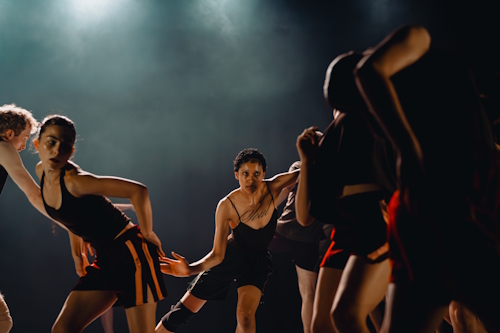
Photo Omar Toussaint
Seutin’s creation is also a large ensemble work. The focus is on running; an excellent starting point but with programme notes that promised more than the work delivers. The commitment again was unquestionable, the energy levels high but I would have loved to see more individual moments for the dancers.
Whether graduating dancers or junior companies these programmes are a showcase for dancers needing to attract a director’s eye and land a contract. On this score the Polish Juniors did better, with dancers looking prepared and confident to step into a company. However, while Session 1 clearly identified talent, the two longer Rambert works, while showing evidence of collaborative creative working, could have gone further in challenging the dancers.