
Sadler’s Wells, London
June 26, 2026
Spain’s role in the development of what we now know as ballet is frequently disregarded, but the Spanish crowns of Aragon and Castile ruled large areas of what is now Italy, from, Milan to Sicily from the late 13th to the 18th century, and Italy in turn influenced the development of ballet in France.
Spanish dances were adapted for Italian and French court pageants whilst back in Spain, its own national ballet style, the Escuela Bolera took root. By the 19th century, regional Spanish dances had been incorporated into what we now know as classical Spanish dance, what is commonly thought of as flamenco, including castanets. What goes round comes around. Actual flamenco with traditions originating in India is not at all above incorporating ballet turns and will even use castanets for flamenco versions of regional dances such as Sevillanas and Fandangos.
Ballet Flamenco de Andalucía embody all of this tradition in Tierra Bendita (Blessed Land). The women wear wigs reminiscent of the permanent waves of the 1930s a there is even a suggestion of the civil war as both men and women enter in ranks, zapateado echoing marching feet. The whole company are then introduced by way of bulerias, tangos and tanguillos. The women are dressed soberly in dark green traditional dresses in spite of the natures of the palos, the men in traditional high waisted trousers topped by boleros.
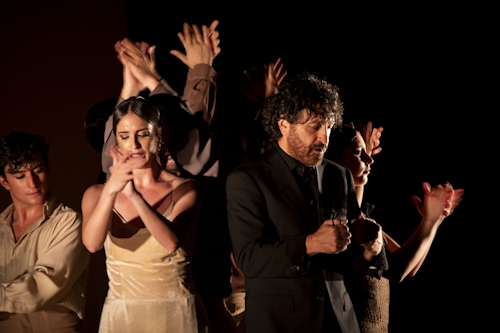
Photo Teresa Montellano
Manuel de Gines delivered a fine taranta, a sorrowful style of song often associated with miners. Then we were back to tangos with more sombre songs in a tavern setting more suitable for flamenco than the chorus/soloist format.
David Chupute the provided one of the highlights of the evening with a virtuoso performance on castanets. In flamenco, they are usually played by dancers, but when the performer is freed from the demands that impose, as here, they can be a remarkable percussion instrument in their own right. In Chupute’s hands they become a whole orchestra section in themselves. So subtle was his initial entry that I at first thought that it was finger-snapping pitos. He even seemed to get two different pitches out of his left castanet and he executed the carretilla, with its distinct roll sound, simultaneously on both. The empathy that he had for the dancers was palpable.
After a madrugá, a sort of devotional processional song, from Amparo Lagares, dancers Ángel Fariña and Adriana Gomez echoed its solemnity by performing a passionate pas de deux deux complete with lifts to a granaína, another song in darkly mysterious Phrygian mode.
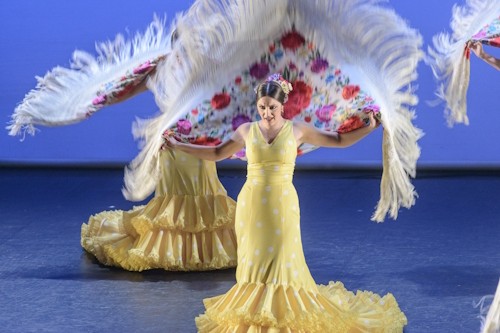
Photo Marcos Medina
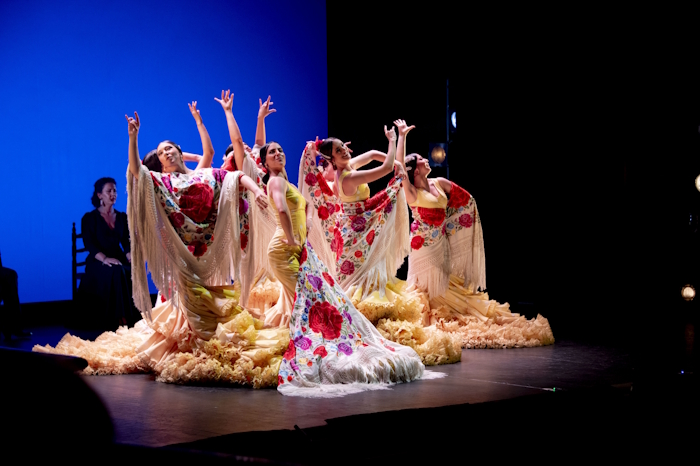
The mood was lightened when the men strutted their stuff in a rather camp tanguillos with some nifty sombrero work, and the seven women retaliating with a vibrant cantiñas in equally bright yellow dresses topped with manton (shawls). They were so focused that I failed to notice how they managed to clear the latter from the stage.
A poem by Manual Benítez Carrero celebrating the legendary guitarist Ramón Montoya (1879-1949), who was largely responsible for the prominence of the guitar in flamenco and who pioneered the playing of solos, was not just recited but partly danced. Here Montoya is credited with thawing the frosty personage of St Peter with his wonderful playing as he entered the pearly gates and by establishing café cantate in the clouds as he was joined by colleagues!
The evening drew to a close with spirited song and dance, as expected, followed by a deep and dramatic song, giving an unusual ending to a very enjoyable performance.