
Kampnagel, Hamburg
June 21, 2026
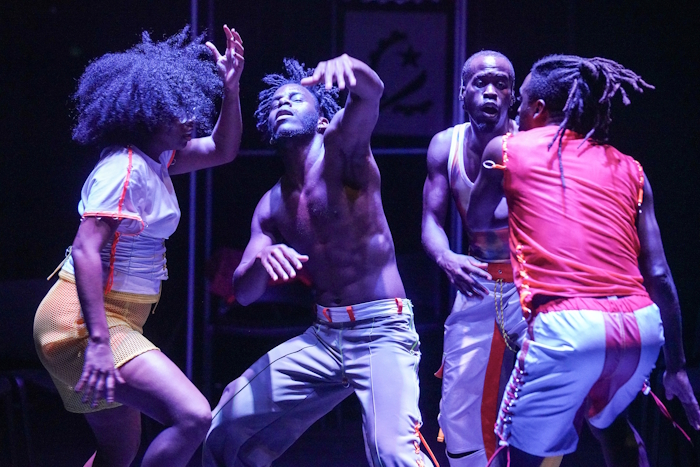
Drawing on kuduro, an upbeat, energetic music and dance style from Angola, Fábio (Krayze) Januário’s Musseque is a work that doesn’t forget the country’s troubled past: the struggle against Portuguese colonial rule that lasted from the late 1950s until the mid-1970s, and the subsequent battle between the former anti-colonial guerilla movements, UNITA and MPLA, that lasted until 2002.
But more than anything, Musseque highlights the joy and strength found in moving together. It’s a celebration of people, of home, of Angola. It’s a work of belonging, of who its four fabulous dancers are. And what a terrifically vibrant fifty minutes of music and movement it is too, full of heavy kuduro percussive beats and sometimes stomping, often very fast-moving dance.
The title refers to the suburban neighbourhoods of Luanda, areas mostly inhabited by the poorer members of society. It’s where kuduro, the energetic style of music and dance specialised in by now Lisbon-based Angolan choreographer and dancer Fábio (Krayze) Januário originated.
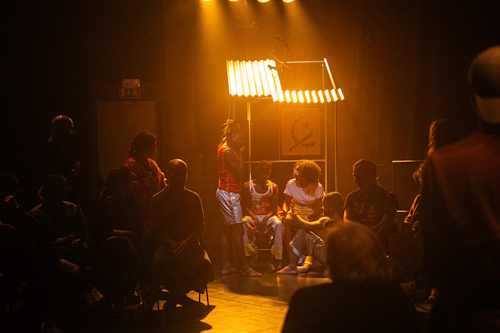
Photo Paulo Pacheco
Performed in the round, it opens with the four dancers (Januário, Selma Mylene, Xenos Palma and Elvis Carvalho (Grelha)) off to one side, talking in Portuguese in a shack, its tin roof topped by the machete, half-cogwheel and five-pointed star of the Angolan flag, symbols of labour, the resistance of farmers and peasants and solidarity.
Unfortunately, there was only one translation screen, its situation high above them making it frustratingly difficult to read if you happened to be sat or stood that side of the space. Later, speech was even harder to follow, a choice often having to be made: watch the dancers or read the text.
That speech references the country’s problems including its colonialist past and the struggle for freedom and peace. Past experiences become present-day dance as we see arms held outstretched as if bound, or painfully behind the back as if cuffed. Gunshots are heard at one point too.
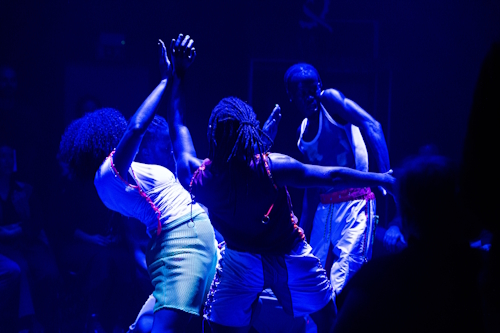
Photo Paulo Pacheco
We also hear about how people migrate to Europe to find a better life, but then that Europe, has problems too. Is it really any better? But there’s also talk of how the light will come, of democracy, of freedom, of how ‘this is our land.’
Alongside the text, the dance is electric and infectious. The rhythmic movement fills the space. Whether in solos, duets or with all four together, it often looks at least semi-improvised, an unconscious response to DJ Poco’s pulsating music. But you realise you how tightly choreographed it is when the unison moments come, always appearing out of nowhere. And when they do come, the synchronicity is remarkable given the speed. This is dance you want to watch.
Januário and the other three performers sometimes even weave in and out of the audience, interacting with people as they go. Later they even teach a few movements as the whole space takes on a party feel.
Pedro Guimarães’ light design with its white lit channels, red washes, strobes and smoke adds another layer to the overall effect.
At the end, there’s the usual bow. But we’re not finished. As the music kicks off once more, most of the audience take to the stage as the scene turns into carnival, a dance jam of the most marvellous kind. Dance that brings everyone together.
Tanztriennale: a festival with something for all
The evening brought to a close Hamburg’s first Tanztriennale. Co-directed by Monica Gillette and Gwen Hsin-yi Chang (張欣怡) and under the motto ‘Brave Moves. Courageous Joy’, it featured 83 events over eight days in settings including the city’s opera house, other regular performance venues, museums, skate parks and schools. The public response was overwhelming with performances largely sold out.
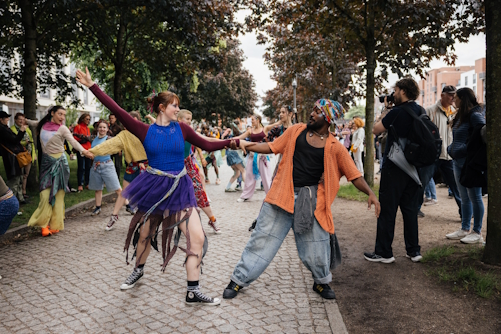
Photo Enver Hirsch
Things got going with a City Parade that involved more than 550 dancers, organised through dance schools, clubs and other institutions, and that showcased the diversity of their dance Patricia Carolin Mai and the MAI:COMPANY provided a finale on the large festival lawn in the Stadtpark.
The performances over the next week were certainly wide-ranging in style too. They included a triple bill of German premieres by Jan Martens, Twyla Tharp and Marco da Silva Ferreira, performed by the CCN Ballet de Lorraine; and Alexei Ratmansky’s Wunderland, a world premiere by the Hamburg Ballet, which also opened the annual Hamburg Ballet Days season. More new work came as part of the Counter Balance residency programme.
Amongst other shows, Tjimur Dance Theatre (蒂摩爾古薪舞集) from Taiwan performed Living Cultural Body (formerly presented as bulabulay mun?) and Ljuzem’s Walk (路之行走), there was Julien Carlier’s BETON, Agniete Lisičkinaite and Igor Shugaleev in CLAP & SLAP, and a second Chiara Bersani piece, Michel – the animals I am. The Tanztriennale also featured two pop-up performances by explore dance – Network for Dance for Young Audiences, which were staged seven times in schools across Hamburg.
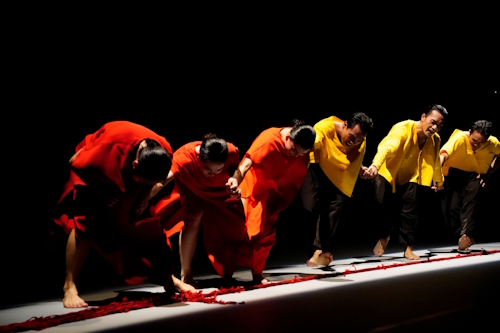
Photo Ba Sa-xi
Running parallel, the Collective Impact’forum took place over four days, in which around 400 international, national and local dance professionals, and members of the public, came together in discussion sessions and workshops to discuss the artistic and social potential of dance, as well as its current challenges.
The Tanztriennale is an initiative of the German Federal Cultural Foundation, and was co-funded by them and the city of Hamburg’s Authority for Culture and Media. The next edition will take place in 2029.
Catch up on Tanztriennale here.