The Place, London
May 30, 2026
Two works close this year’s Festival of Korean Dance with very different forms of propulsion: one travels outward, the other pulls inward. Together, they made me remember how thrilling modern dance can be when rhythm takes hold of the body and refuses to let go.
Young-doo Jung’s Voyage begins in deep blue haze. Smoke sits across the stage. The light blurs the eye so completely that, for a moment, I wonder whether my contact lens has shifted. Beneath that haze comes electronic interference, heavy beats, and a recurring movement: a dancer half-squatting, one arm extended sideways, slowly rotating as though scanning the horizon. It looks like a telescope adjusting its focus, or a radar dish turning towards a signal.
Inspired by NASA’s Voyager programme, Jung builds a dance of searching, rhythm and direction. The body carries the journey.
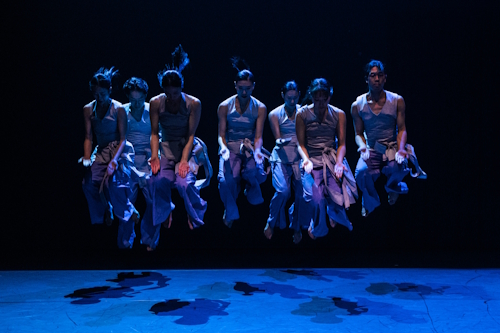
Photo Choi Keunou
What strikes one first is the Korean quality of the movement. The pliant knees, linked breath, sudden jumps, weighted landings, claps and grounded attack give the work a distinctive physical accent. Jung uses two Korean traditional rhythms as the base for the movement, and that rhythmic grounding is already visible in the body.
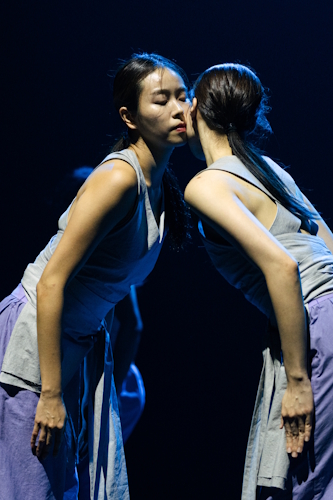
Time in Voyage has weight. Dancers gather, separate and return through shared rhythm, giving the work travel without literal narrative. In the bright Brandenburg Concertos section, that shared travel becomes suddenly, beautifully human. A female dancer enters and catches the eye of the male dancer opposite her. They smile at each other before the phrase begins. It is tiny, almost private, and completely alive. For a moment, the cosmic scale of the work narrows to something wonderfully simple: one body noticing another before they set off together.
in Voyage by Young-doo Jung
Photo Choi Keunou
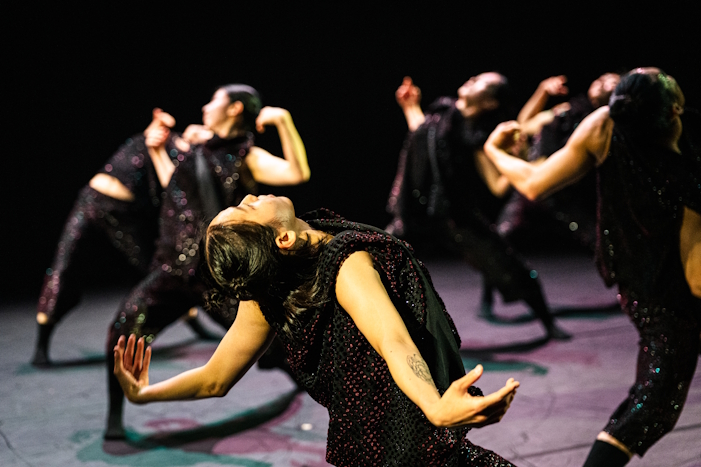
The image I keep returning to is that half-squat with the arm stretched to one side, the body slowly turning. Another hand gesture, held near the shoulder and rotating outward, adds to the same feeling of exploration. It has the quality of a question sent through the body, small but alert, as if the hand is testing the air before the whole body follows. It searches rather than simply pointing. These gestures hold the whole work’s logic: human body, machine signal, traditional rhythm, cosmic search. Around them, Jung builds a dance that feels ancient, grounded and curious, with its feet in the earth and its attention fixed somewhere beyond the visible world.
Ryu Suzuki’s Hakkō is the dangerous one. It looks simple at first. Then it gets into the nervous system.
Its starting point is kendama, the Japanese cup-and-ball toy Suzuki has practised for nearly thirty years. He has spoken of repeating a trick more than a thousand times, until the sense of self begins to melt away. Hakkō turns that almost comical obsessiveness into choreographic fuel.
The piece begins with a group standing together, pulsing in tiny bounces. The movement is almost nothing at first. At the edge of the stage, in darkness, another dancer inches towards them in small, repeated impulses until joining the group. It is patient, nerdy, slightly absurd, precise, and funnier than it has any right to be.
The sound repeats. The bodies repeat. Then the repetition starts to misbehave. Different dancers mark different rhythms. One remains steady while others alter timing, direction or emphasis. Small, sharp turns of the head cut through the pattern. The group sways, gathers, disperses, and suddenly lands back in the same rhythm and direction. The effect is ridiculously satisfying, like a musical resolution snapping into place.
Somewhere in the middle of Hakkō, I realise I am swaying with them. Then I realise I am counting.
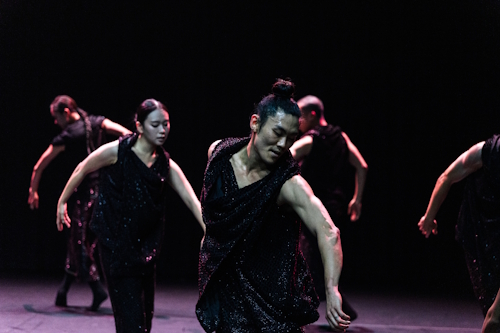
Photo Choi Keunou
Suzuki later revealed that the choreography contains 3,840 counts. Once that number enters the mind, the piece becomes even more addictive. I start watching the dancers as if I am watching a living equation: one body detaches from the main pulse, another shifts timing, another flickers at the edge, and then the whole system pulls itself back together. It is mathematical, full of appetite and strangely joyful. Bodies behave like particles inside a rhythmic field, or atoms and electrons shifting around a shared centre of energy.
The arms in Hakkō stay with me. In the light, skin catches and releases flashes of brightness as the dancers move. The arms ripple, hover, flicker and fold through changing rhythms. They are soft and strong at once, loose through the joints yet sharply articulate. Sometimes they seem to belong to the body; sometimes they appear to have their own intelligence. I realise how long it has been since I have seen arms speak so clearly on stage.
Voyage uses accent, breath and weight to send time forward. Hakkō uses pattern, repetition and micro-variation to trap the viewer inside time. Jung’s dancers move like travellers held by a shared direction. Suzuki’s dancers move like particles inside an addictive rhythmic mechanism.
That is why the evening gave such pleasure. There was no plot to follow. Movements did not translate themselves into fixed statements. Still, I heard them. I understood enough. Voyage travels outward with weighted breath, grounded rhythm and small human encounters. Hakkō pulls inward until counting becomes pleasure and repetition becomes trance. Together, they remind how modern dance can speak without explaining itself, and how a body, counting, breathing, swaying, listening, can begin to carry someone else’s world.