
Birmingham Hippodrome
September 24, 2026
The familiar strains of Tchaikovsky’s famous score evoke mystery and magic. They transport you into another world even before the curtain rises.
A major reason Sir Peter Wright’s productions of the classics are so successful is that their narratives make sense, even to non-ballet regulars. His tellings are clear and credible, or at least as credible as they can be, with the characters strongly drawn. That’s certainly the case with Swan Lake, although it helps having such impressive dancer-actors as are at Birmingham Royal Ballet. Swan Lake is long, one of the longest ballets in the repertoire, but they carry the story through all four acts.
It’s all very well having a brooding and moody Siegfried, but why is he like that? Wright shows us precisely, illustrating the musical prologue with the funeral of his father, the death of whom meant the previously carefree prince not only has the weight of state affairs on his shoulders, but also in urgent need of a bride, at least in his mother’s eyes.
Photo Bill Cooper
You can’t help feel that the Queen (Daria Stanciulescu) is actually a big part of his problem. If there was even a splash of motherly warmth, maybe things might have turned out rather differently. But she is coldly formal. Perhaps she’s still wrapped in her own grief. Is it just a coincidence that, in the Act Three ballroom, they sit about as far apart as it is possible to get and barely look at one another?
But Siegfried doesn’t exactly help himself. Agreed, it’s not easy but, and despite Benno’s best efforts to get him to snap out of it, he is truly a man lost in the morass of his own self-pity. Yasiel Hoderlín certainly delivered his feelings very realistically. But there is the occasional flicker of hope when he gets to dance.
And what dancing. In Act One, he showed prodigious height on his batterie, not only super-clean but that also somehow spoke of his emotions within. In the beautifully lyrical Act Two pas de deux, he showed all too clearly his very slowly falling for Odette. Later, in the ballroom, he gave us some soaring leaps and wonderful turns in second position as his feelings for Odile gushed forth.
In the ballroom, there seemed to be very little surprise when Rothbart and Odile gate-crashed proceedings, from both Siegfried and the Queen. No, ‘What is going on here?’ Now his head was turned almost instantly. But then he was suddenly faced by the quite delicious Yu Kurihara. Her Odile was assured, dominant, strong. She dazzled the court and all of us watching. Her fouettés had a bit of an off afternoon, notably slowing towards the end but elsewhere she was electric.
Exuding power and directed by Rothbart, she knew want she had to do, knew what she wanted, and was going to make absolutely sure she got it. Her body language and facial expression, both so important, spoke volumes. Now and again, she directed some very knowing looks at the audience. One in particular, a malicious broad smile just after she snared him, was especially delicious.
As Odette, she was the polar opposite. Utterly divine, she was as fragile as the most delicate porcelain. You did sense that she knew she was trapped in her destiny, though, that as much as she wanted Siegfried to be a glimmer of hope, she knew deep down that it could not be. Her gorgeous épaulement, smooth port de bras and, again, face, revealed the depth of her emotions.
Returning to Act One, Siegfried’s coming-of-age party is exactly much of one. It’s as downbeat as can be. Even the courtesans there to entertain him struggle in the gloomy mood. The scene does provide a stage for Benno, though, who is more prominent, especially in Act One, than in many productions.
Enrique Bejarano Vidal’s portrayal is of someone not just a friend, but a very close friend. Indeed, the number of times of actually touches Siegfried caringly is very noticeable. Vidal’s dancing was excellent. He shone in the central pas de trois along with Rosanna Ely and Sofia Liñares. An interesting sidenote, Benno is the first person seen after the prologue, and the last seen at the end of the ballet, carrying the body of the drowned Prince Siegfried as the curtain falls.
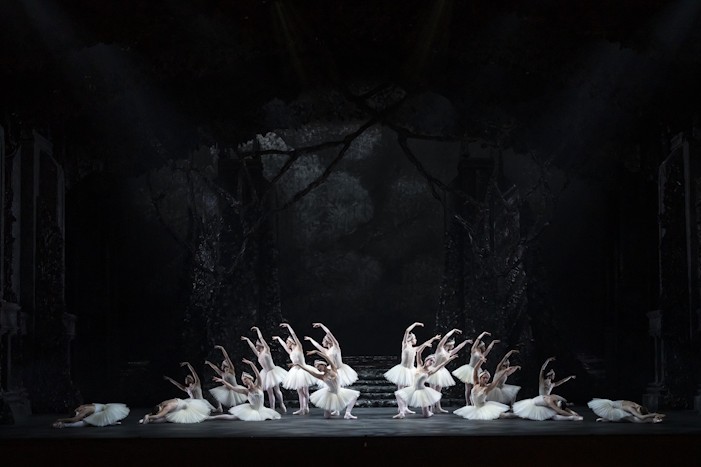
Away from the lakeside, some Swan Lakes come with a lightness about them, in Act One at least. John Cranko’s production, helped along by Jurgen Rose’s designs, is one such. Not here. Birmingham Royal Ballet’s version is dark and heavy from the off. Philip Prowse’s designs are not just Gothic, they’re Gothic-plus-plus. The costumes are magnificent and luxuriously embroidered, but some are heavy in weight too. A note in the programme tells us that the Master of Ceremonies’ cloak weighs six stones (that’s 38kg in new money) and, like most of the others, is too heavy to hang and has to be kept in a skip.
Like all the best Swan Lakes, there is no happy ending. Just a beautiful final dance for Siegfried and Odette and two suicides. Although there is time for one more salvo of fireworks from Hoderlín’s Siegfried, who quite literally appeared to spear Rothbart with his sharply arrowed jetés.