
Sadler’s Wells East, London
November 4, 2026
For someone who has spent more than four centuries asking whether to be or not to be, Hamlet is remarkably reluctant to disappear.
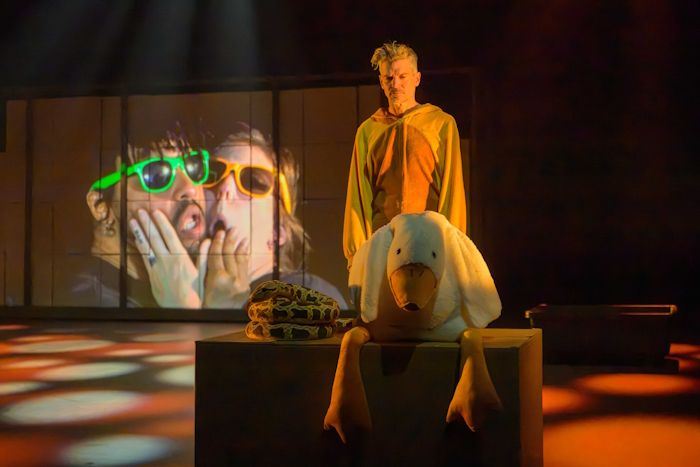
A spotlight picks out a small radio in the darkness. From it comes the recorded voice of theatre director Katie Mitchell, questioning why we continue to stage Hamlet, with its depressed, angry and misogynistic men. Slowly, Ben Duke emerges from the shadows, struggling to reach the radio and switch it off. A rope across his shoulders connects him to an entire wall of cardboard boxes. Having finally silenced Mitchell, he drags the wall towards a microphone.
“To be or not to be.”
Duke has kindly delivered the famous soliloquy everyone has been waiting for right at the beginning, so we can all relax. Hamlet, it seems, has already decided what we want.
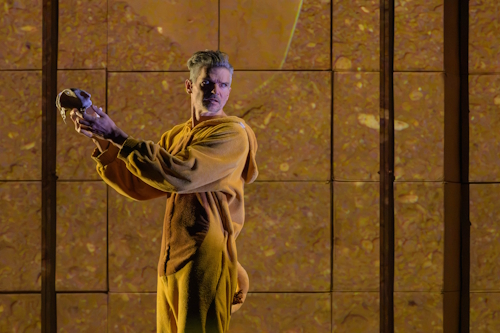
Photo Jane Hobson
The government is rather less convinced of Hamlet’s continued relevance, granting him one last production on a reduced budget. Inspired by Duke’s own house move and a collection of old toys, designer Soutra Gilmour has created a wonderfully adaptable cardboard wall and an entire royal court of stuffed animals. With occasional help from the audience, Hamlet is back in business.
There is a mischievous intelligence to Duke’s treatment of Shakespeare, particularly in the way he allows the famous language to become an embarrassment to its speaker. Hamlet seems to reach for verse whenever ordinary life defeats him. Frustrated at a car hire counter, helpless before an injured child in Sudan, even confronted with Ophelia’s abortion, he finds himself reciting Shakespeare. The last occasion earns him a furious response. All that literary prestige is of remarkably little use when your girlfriend needs an answer.
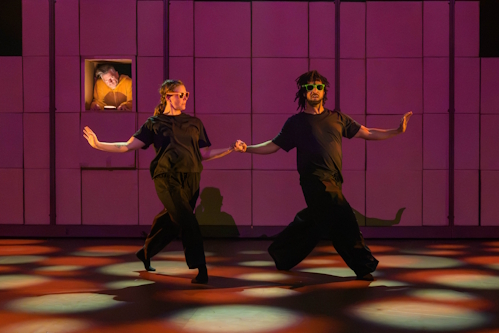
Photo Jane Hobson
Duke’s theatrical imagination is similarly irreverent. Through an opening in the cardboard wall, Hamlet spies on Gertrude and Claudius dancing to Yazoo’s ‘Only You’. Their initially furtive movements develop into a duet, before live video transforms their intimacy into an enormous, grotesque collision of faces. The shift from bodies dancing together to faces distorted against a camera is deliciously indecorous. Elsewhere, a little water, a camera and an ultrasound image are enough to bring Ophelia’s pregnancy into this improvised world. Duke makes the mechanics of theatre part of its pleasure.
His ideas are not always as successful in execution. Gertrude, voiced by an audience volunteer, is allowed a vocabulary of one word: “No”. It is an excellent choice. Depending on the question, the same answer can deny Hamlet’s accusations, frustrate his demands or assure him that his mother loves him. I enjoyed watching him extract an entire relationship from a single syllable. But the exchange continues until its possibilities begin to feel exhausted. With so little variation in Duke’s physical responses or the rhythm of his questioning, the cleverness becomes increasingly laborious. Even Hamlet’s mother must eventually tire of him.
Yet some of the production’s most affecting moments come when Duke lets the bodies do the talking.
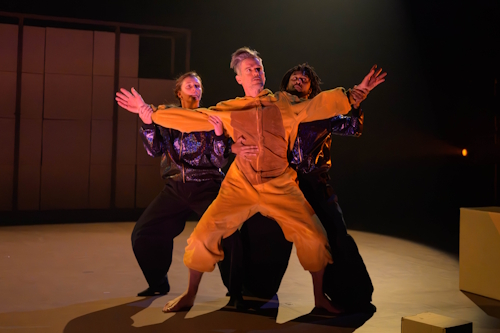
Photo Jane Hobson
In a childhood trio to the Scandinavian lullaby ‘Byssan Lull’, Duke, Hannah Shepherd and Miguel Altunaga create a beautifully fluid sequence from an almost disarmingly simple principle. The parents touch Hamlet, and his body responds. He initiates nothing, yet the movements pass continuously between the three dancers, each small contact redirecting his weight and setting off another phrase. There is no visible resistance, no struggle to manufacture an image of control. The choreography is graceful and remarkably economical, with the child’s dependence written directly into the movement. When his parents leave him at boarding school, the beauty of their earlier physical connection acquires a painful irony.
Altunaga is particularly impressive. His portrayal of Hamlet’s father, hidden beneath a lion-skull mask and an oversized military coat, is a masterclass in physical characterisation. The gestures are extravagantly cartoonish, yet his command of timing gives every movement a distinct purpose. With his face invisible, he can still suggest authority, impatience, menace and sudden absurdity. His body seems to do the work of an entire face, and then some. The same assurance carries into his dancing and his Spanish-speaking gravedigger, although the latter’s tiny projected English subtitles are frustratingly difficult to read. Near the end, he appears to reveal yet another talent: a beautiful singing voice.
Shepherd is equally enjoyable as the thoroughly disenchanted car hire employee. Her reluctant delivery and irritation are wonderfully recognisable. She has little interest in Hamlet’s status or his increasingly agitated explanations. His royal suffering is simply another inconvenience in her working day.
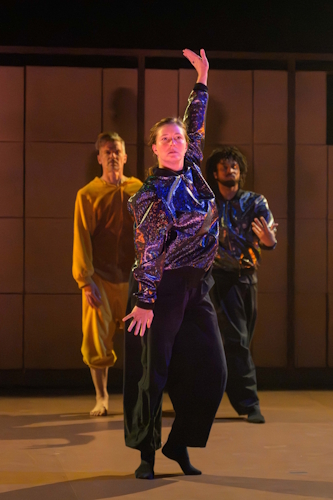
Photo Jane Hobson
Music makes its own substantial contribution, with live singing and an eclectic selection of pieces moving between solemnity, tenderness and exuberance. Sometimes the contrast is almost outrageous. The cheerful ‘I Like It (I Like It Like That)’ accompanies Hamlet’s attempts to save the man he has just shot, while Shepherd and Altunaga dance around him. I admired the audacity of the choice, although the scene left me more bewildered than amused. The music does not wait for tragedy to finish before getting on with its own business.
For all the production’s comic excesses, Duke himself remains a curious Hamlet: awkward, self-absorbed, frequently irritating, and capable of considerable cruelty. Yet his humour exposes a vulnerability that becomes increasingly difficult to ignore. Behind the adult who cannot manage his relationships is a boy desperate for his parents’ affection, and a son still trying to prove himself to a demanding father. I began to feel sorry for him, almost against my better judgement. Duke has made an already tragic character surprisingly sadder.
The trouble arrives in the later stages. From Hamlet’s confrontation with Gertrude onwards, the production begins to lose its earlier energy. There are still individual moments of invention, but the dramatic movement feels increasingly hurried towards its conclusion.
Ophelia is particularly difficult to reconcile with the Hamlet we have come to know. When she confronts him about her abortion, his retreat into Shakespeare leaves her understandably furious. Shepherd brings a sharp, assertive presence to the role, and Ophelia has every reason to be angry. Yet I found it harder to see what lay beyond her responses to him. A tender dance with the stuffed bear representing her father briefly offers a glimpse of another side to her, but by then my attention has already begun to wander. I understood her circumstances far more readily than I felt I understood her.
Finally, she condemns Hamlet to irrelevance and sends him into one of his own cardboard boxes. She rises from a shallow basin of water and performs a solo to Anna B Savage’s Corncrakes. Her movements are abrupt and halting, with repeated downward punching gestures. There is little fluidity or expansiveness to the choreography. It feels almost mechanical, more like a display of grief than a dance that gathers emotional force. Then the stage falls dark.
When I interviewed Duke earlier this year, I asked why a woman should need a man to create the space in which she is allowed to speak. Here Ophelia finally has the stage to herself. Yet after an evening spent discovering Hamlet’s foolishness, fear, tenderness and failures, I found myself knowing far less about the woman who had displaced him.
Duke has made Hamlet so difficult to live with, and so difficult to abandon, that I was still feeling sorry for him inside his box. Ophelia had finally escaped his story. I was less certain that hers had begun.