
Sadler’s Wells, London
November 3, 2026
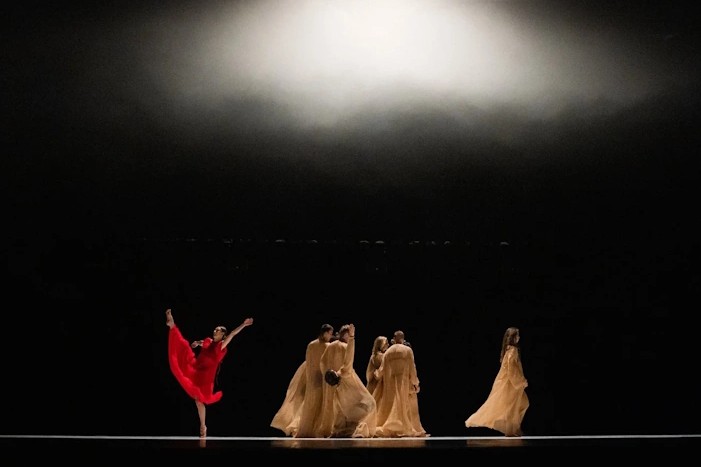
Long, translucent robes ripple over near-naked bodies while they twirl and play. It could be a description of the Three Graces from Botticelli’s Primavera. It could also be a snapshot from the start or end of FIVE DAYS IN THE SUN. They both share much of the same whirling, innocent playfulness, though Botticelli’s dancers, despite their divine descent, haven’t been gifted the same sports bras or tighty-whities to go beneath their robes.
The movements and costumes of FIVE DAYS IN THE SUN also evoke the flowing Grecian robes and whirling frolics of Isadora Duncan. However, even admitting it’s slightly unfair to tempt comparison with Renaissance masterpieces or modern dance pioneers, the result is not incredibly optimistic for FIVE DAYS IN THE SUN. Wonderful moments of gusty whirling never really fall into a structure that sustains or develops them. It’s hit-and-miss: a dance whose emotional depth also comes in intermittent gusts.
Pairing his choreography with Mahler’s Symphony No.5, Israeli choreographer Emanuel Gat sets himself a difficult task by grappling with a giant of classical music. The dance starts slow and small, with duos or trios from the total twelve dancers performing miniature gestures, shyly shifting their arms, twisting, mostly staying on the spot. They watch each other closely, as if imitating one another in a teasing game at odds with their epic soundtrack.
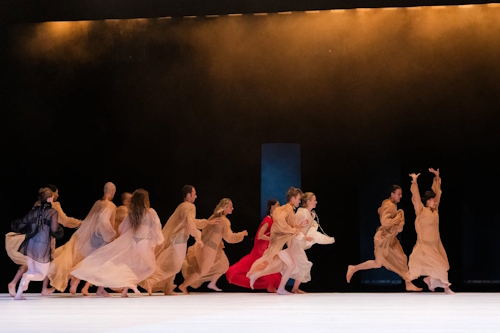
Photo Julia Gat
The de-coupling of dance and music is not an issue in itself. There’s a good passage later on where the music is almost completely inaudible. But at this early stage, the difference between dance amplitude and music amplitude feels reckless: the dance seems underwhelming, almost an annoyance, distracting from the music’s majesty.
By the time the first act closes, the stage has grown dynamic and busy, with all twelve dancers storming around in swirls of whirling, kicking, spinning threes or fours. But when the curtains come down on their spiralling mosh pit, it all feels a little lost in the flurry of motion.
Following a costume change to more modern outfits (mostly sportswear), there are some more memorable solos and duets. One dancer in a pink top and another in a white three-quarter length tracksuit dance a delicate duet. They flow together, bodies rippling into and around each other in some of the most compelling dancing so far. It feels like love, but it isn’t quite unleashed to the full.
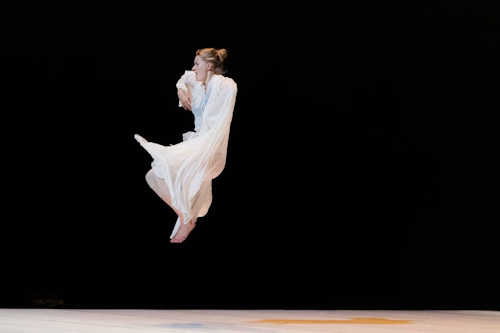
Photo Julia Gat
Shortly after, another dancer in a red dress has a strong solo where the same whirling spins from before become something almost drunken, and the graceful break-dance elements have become impressive writhing floorwork. It’s as if the earlier choreography has had its drink spiked.
There are more stand-out movements: a lingering headstand, no hands; a capoeira-like kick sequence when two dancers dodge one another’s sweeping legs; huge acrobatic tumbles like Hollywood stunts. These moments build the general impression of feisty nature nymphs, but those in the first half don’t quite build into anything more emotionally deep or nuanced than impressive miscellany.
Often the dancers patiently watch each other on stage, sometimes observing in eerie stillness. At these times, Gat begins a thought-provoking choreographic exploration of exposure. There are two audiences, us and them, and there are two kinds of watching for us: watching dancers, and watching dancers watching dancers. In these double-witnessed moments, there’s an intriguing, layered vulnerability: attention is intensified in a peculiar way, like light refracted through two prisms.
Sometimes Gat exposes the boundaries of the usual stage. At one point, a dancer comes so far forward to perform a miniature, twitching, mime-like dance at the very front edge of the stage that, when the curtain falls, it traps the individual on our side, alone. At other points, we see dancers lurking at the back (previously impenetrable darkness), watching beside the curtains. That’s where we even see them strip to their underwear, the next costume change. These moments of fourth wall-breaking gesture towards some deeper underlying tension between freedom and vulnerability. But, no matter how interesting they are as concepts, they’re only sometimes captivating.
Eventually the dance becomes more impressive. There’s a section in the second half where the sounds of laughing, shouting, playing children take over that, at first, I thought was someone’s kids who’d grown impatient and left to entertain themselves in the atrium. Those sounds grow, until Mahler’s orchestra is relegated completely. The dancers, all in their underwear by now, are mostly still. Sprawled around the stage, they watch movements spread among themselves, slowly at first, as if underwater. In this strange freeze-frame world, movement passes in twitches and ripples around the group, leaving stillness behind it. Imagine a film set where the actors only come to life when the camera sweeps over them, and after the camera passes they become inanimate again. It’s surreal and surprisingly captivating.
By the end, they’re back in flowing robes. The dancers follow in a gaggle behind the one in red, as if behind a prophet or demagogue. Then, with a clap, they’re released from their tame crowd in a striking dam-burst blossom of movement. Some wonderful ebbs and flows of collective control and release come at the end, albeit with a hint of better-late-than-never bittersweetness. For all its jumping and whirling, FIVE DAYS IN THE SUN flutters through some wonderful passages, but never quite manages to soar.