
Dundee Rep
October 30, 2026
The past is important, should be respected and certainly never forgotten. But dance companies must also drive forward. New work is their lifeblood. So, it seemed entirely right that, ahead of the following evening’s gala celebration of forty years of Scottish Dance Theatre, the company showed us what they are about today in this double bill of recent creations works by Édouard Hue and Emilie Leriche.
Scottish Dance Theatre grew out of the community dance movement, and community is very much at the heart of Hue’s 30-minute The Game of Life, inspired by the Soma cube, the playful solid dissection puzzle invented by Danish mathematician Piet Hein in 1933; and John Conway’s Game of Life, which takes place on grid of cells which, based on a few mathematical rules, can live, die or multiply, forming various patterns. And a human version of that is precisely what Hue delivers in a light piece that often has a smile on its face.
It starts with Ben McEwan alone on stage. As others join him one by one, they pick up on his movement. The way arms are extended and directed suggests the hands of a clock, perhaps not surprising given the underlying clockwork ticking in Jonathan Soucasse’s electronic score; a sound that adds a distinct rhythm to everything. Later, there’s a cuckoo clock, what sounds like birdsong, and strings towards the end.
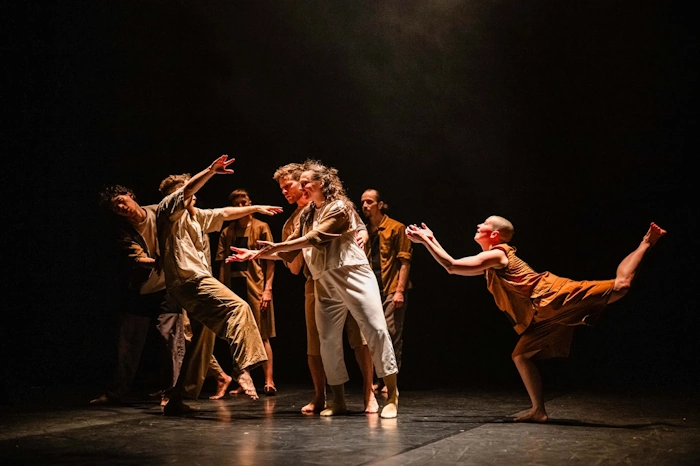
Photo Brian Hartley
But this is not some sort of contagious dance from which there is no escape. All the time there is the sense that each dancer is very much in control of their own actions. As they work out how they fit in, they choose to follow, they choose to leave the sequence. And they seem to be having fun doing it. They actually interact with each other, look at each other, smile at each other.
The choreography, structure and patterning are complex. The whole ensemble or smaller groups come together briefly before disintegrating and reforming. At times it’s very sharp and dynamic, but there are some quiet contemplative moments too. It’s fascinatingly mesmerising and rather appealing.
The arrival of Yasmina Patel and Samuel Gilovitz around halfway through brings a change in mood. The ensemble back off. They watch as if unsure about these strangers who have suddenly appeared in their midst. Unsure too about their movement, which is more fluid, slower, smoother. Gilovitz’s in particular is more expansive too.
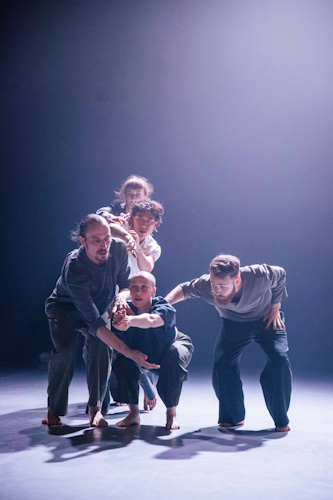
in Rotten Work by Emilie Leriche
Photo Brian Hartley
Eventually, the freedom their dance evokes trickles through to the initial group, who take the ideas up, moving in their own way. The Game of Life ends very personally with a startlingly beautiful, utterly captivating solo from Patel that seems to emphasise all that is good about being individual, being yourself.
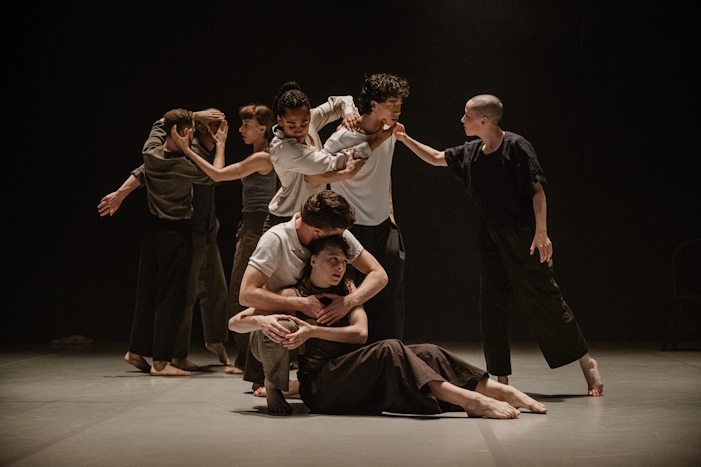
Leriche’s Rotten Work also starts with a single dancer on stage, this time Molly Danter, who is seated facing an empty washing line, her back to the audience. And, again, dancers arrive one by one, many bringing shirts on hangers that are hung on that line.
According to the programme note, the work is about an interconnected society, how we reach out to each other, support each other. Not me or you but us. That path isn’t always easy though. Sure enough, there is a lot of support, of holding each other, of catching each other as people gently fall, not unlike happens in trust exercise. Several times, hands and arms are formed as if cradling a baby. As in The Game of Life, the whole cast were terrific.
But there are also any number of aggressive moments when one dancer reacts to another by forcibly breaking a physical connection or pushing them away. Elsewhere, momentary tableaux of intertwined dancers form before breaking or quite literally falling apart. ‘Falling’ is a word quite often heard as the dancers speak.
But where does this leave Danter, who time and again seems to be the central figure around which everything revolves? At times, she appears to be watching or is she seeing them in her mind but they’re not actually there? Maybe I was subconsciously looking for it, but I couldn’t help feeling there was some sort of underlying narrative at play.
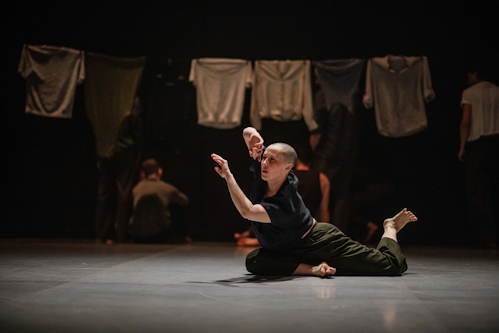
Photo Brian Hartley
That sense is helped by the spoken text. It was not always as clear as it might be but phrases like ‘Sorry’, ‘I didn’t mean to’, ‘If only we could…’ and especially, ‘I remember’, are heard time and again. Could everyone else be figures from the past, albeit figures who are now clearly trying to help and support?
The pace and Wolff Bergen’s score, which fills the auditorium with a low hum adds a dreamy quality to things
The clothes on that line add to the confusion. I can only assume they are some sort of metaphor, but the intent or meaning behind some dancers changing shirts is unclear.
And yet, the more my questions and thoughts piled up, the more I found Rotten Work increasingly fascinating. The more it drew me in. The more intently I found myself watching. And the more I would rather like to see it again. Maybe I’ll find some answers.