
The Coronet Theatre, London
October 30, 2026
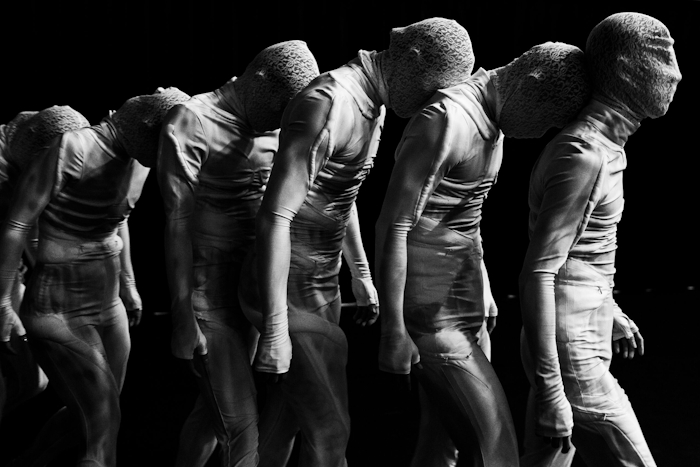
Clad from head to toe in tight white suits, they’re faceless and genderless. In the half-light, especially over the Halloween weekend, their outfits could resemble mediocre Egyptian mummy costumes or bleached Power Ranger outfits. There’s also something faintly comical about their entrance. Combined into one body, the seven dancers lumber onto the stage like a mass mime of a Transformer. But as the monstrous Megatron breaks down, spewing dancers onto the floor, Non-Ordinary Services (非普通服務) quickly becomes something to be taken far more seriously.
Created by D_Antidote Production (身體處方) artistic director Chuang Po-Hsiang (莊博翔) and getting it’s UK premiere, Non-Ordinary Services was the first of two works by the group that evening; separately programmed rather than a double-bill. The Taiwanese company and choreographer make dances labelled as sci-fi and dystopian, but their extraordinary quality is perhaps best described as mutant motion.
The motion signature of the work is a train of conjoined dancers: the first leads their unsettling goblin-like gait, the others following behind, each connecting their forehead to the hunched back in front. They become the vertebrae of a ghoulish millipede. They snake around the stage, movements spreading along the chain in fantastic ripples like the Mexican waves of some elite, alien-possessed football fans.
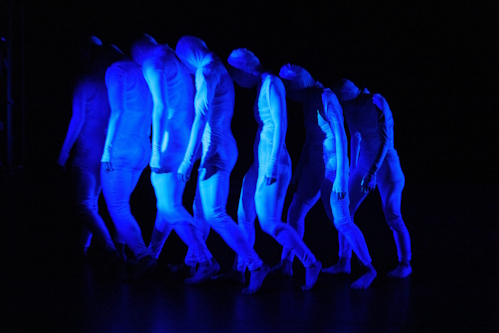
Photo Chen Po-wei
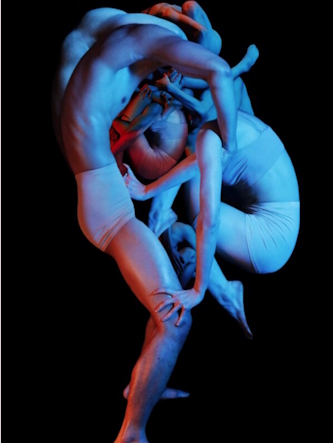
These dance-organisms come in all shapes and sizes. Some writhe and pulse like a hive mind. Some are suspended in the stillness and impressive strength of acroyoga poses and counterbalances. Some spin in daredevil acrobatics. Together they produce the same unsettling feeling of sinister wonder which a dripping alien maw produces in a sci-fi film, but through the slick co-ordination of cunning human contraptions.
However, Non-Ordinary Services is a little too much like those sci-fi films; the ones which relish the visuals of alien horror so much that they forget to give us a reason to care. The dance only really begins to build serious emotional depth in the second half; before that it feels a little confused.
There are glimpses of a narrative arc of the kind that could weave together these phenomenal snapshots of mutant muscle-flexing, but they’re fragmentary. For example, at one point a creature rises centre stage as a potential leader, and all the other dancers smash into it, challenging but not toppling it. So, they embrace it and form another combined creature. But then a key difficulty is revealed. The solos and duets hint at significance, but it’s hard to anchor that somewhere and to build deeper emotional connection when you can’t tell identically-costumed dancers apart.
There’s more direction when one dancer leaves and returns in a new costume. They appear more human, with skin-coloured underwear (as if almost naked) and a face covered by a flowing veil that reaches their waist. They dance a vulnerable duet with another dancer still wearing the old mutant costume, the outdated mutant stumbling and stuttering, as if forced to break habits and think for itself. When the others all return in this new veiled outfit, we can’t then tell who this original liberator was, but at least now we have some sense of narrative development via character evolution.
by Chuang Po-Hsiang
Photo Chen Po-wei
The fresh-costumed dancers undergo a metamorphosis (to heavenly orchestral music) from monstrous creatures to something very different. They do their millipede walk again and it appears elegant, even beautiful.
At one point, they whirl round each other in two concentric circles, veils whipping about, the lighting suddenly changing to a rear spotlight. That light, pointing through them and right at us, creates the stunning feeling of being inside one of those early film illusions: we inhabit a whirling, stomping zoetrope.
The most arresting passage comes near the very end, after frenzied synchronisation boils over and leaves a hellish pile of bodies on the floor. Bosch himself would have been proud to paint the writhing mass of this amorphous extraterrestrial cuddle puddle. If it weren’t so creepy, it would be pretty steamy stuff.
One dancer emerges, face finally revealed. It might be one of the soloists from before but who knows. There’s no sense of their individual arc, it’s just a dancer thrust forward by the organism. He throws himself around in an impressive solo, manic but fragile. At one point he smashes his back so hard against the stage floor that the audience collectively winces. It’s as if he’s re-discovering movement, freedom, and pain (the cost of his freedom?). He ends the dance crouched in a solitary foetal position, as if terrified to be apart from his hive.
Non-Ordinary Services doesn’t find the same success as Palingenesis, the second dance of the night. The ending feels a little flat, perhaps because some of the early uncertainty lingers. But the power of the dance still hits home when they all un-mask to receive our applause: it’s astonishing to see their smiling faces, and to realise that they were human all along.
Coming soon: ‘Mesmeric Mutant Motion (Part II)’, Eddy Gibb’s thoughts on ‘Palingenesis’, D_Antidote Production’s second performance of the evening.