
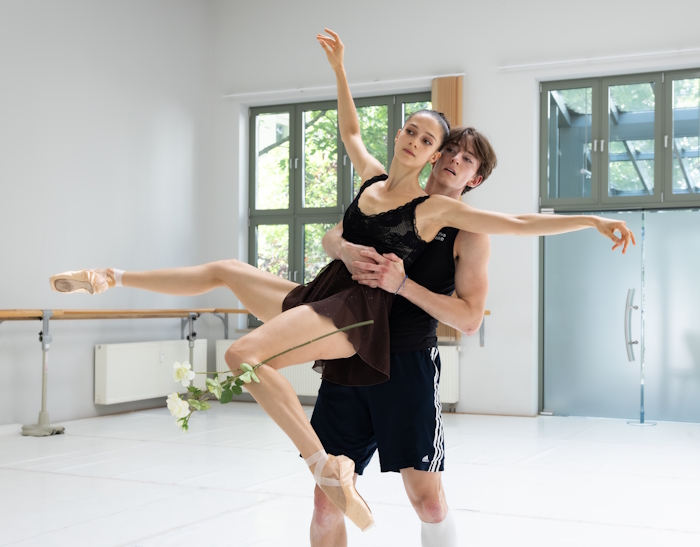
Jeannette Andersen talks to Jörg Mannes, the Austrian choreographer and director of Magdeburg Ballet in Germany, who has just created ‘Was ihr wollt’ (What You Will), a new ballet based on Shakespeare’s ‘Twelfth Night’, for the Bayerisches Junior Ballett München (BJBM); and to dancers Rose Perrot and Axel Mero about what it is like to have a ballet created on them for the first time.
The lobby at the Heinz-Bosl-Stiftung is a busy place. The building accommodates the BJBM’s administration and apartments for the foreign dancers, which this season is all of them, while another, across the backyard, houses a studio.
Undaunted by the dancers going to-and-fro, Jörg Mannes talked about his creative process with the BJBM. He recalls, “I started before the summer. I was here for four weeks, and now I have been here for five more. For many of the dancers it is the first time that they get out of the steps, to express something, to be a character, and it is always nice to work, to get that out of the dancers. But you have to know them well, to see what they can express and figure out how they should express it, because every person is different.”
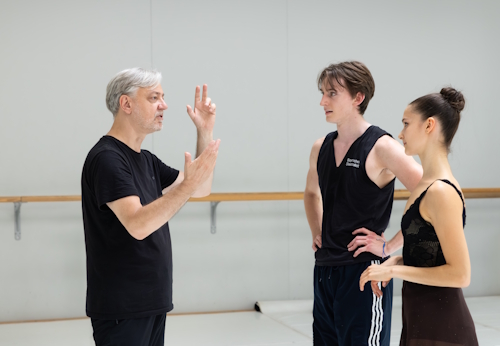
Photo Marie-Laure Briane
Before the summer, he explains that he was focused more on the steps. “Now we are really getting into the story. In schools you are more occupied with technique, to get the steps, to find perfection. But now they have to add this other level of emotion. This at first is a bit disturbing, because they have to let loose concentrating on the steps. But they are coping very well with it.”
The dancers, having their first experience of creating a work within a company, have clearly enjoyed working with Mannes.
Rose Perrot, from Paris, who is performing the role of Countess Olivia, says, “I am really enjoying the process, creating a role. It is the first time, we’ve actually done this with the Junior Company. Before, we have been learning pieces that were already created or even made somewhere else. So, it is really nice to be able to give something of our personality, or our way to see the character. Of course, Jörg is giving us the material, but I feel like there is also a collaboration, where we can offer some steps, and he can take what he likes.”
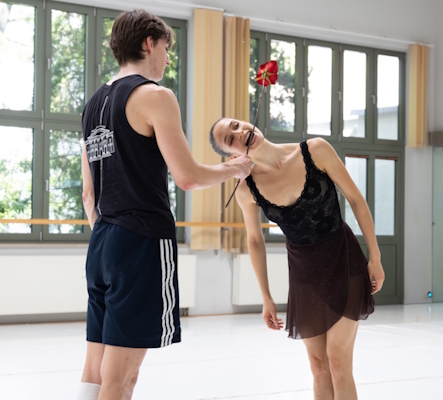
Photo Marie-Laure Briane
Axel Mero, from Wodonga in Victoria, Australia, dances Count Orsini. He explains, “I’m doing some parts that Mannes created on his company in Magdeburg. So, for me, it’s been a mix of creating and sort of reworking what was already there. And I’ve really enjoyed the experience.”
“It’s nice to not just dance and explore steps, but also to tell a story, to develop a character. If you are looking at a long-term goal, it is to do the big principal roles, and they have stories. It is really special to be able to do this now, because next year when we join main companies, we will not have these opportunities,” he continues.
Looking ahead, he adds, “Having this experience now, maybe one day in the future, we can look back and remember, how we were getting into a character. I think this experience is really valuable.”
The BJBM ballet is the third time Mannes has choreographed Was Ihr Wollt. His first production was for Hannover Ballett, where he was director from 2006-2019. He then premiered a second version in Magdeburg earlier this year.
He explains, “I’m a bit crazy. I always do pieces again, but every time they’re different. It is because I have the impression, after having done a piece, when I’m finished, that I finally have understood it, and can do it differently. In this version I have only taken one part from the one I created for Magdeburg, the rest is new. Also, what you do depends on the dancers you work with.”
Twelfth Night is complicated with gender confusions, but Mannes says, “It is easy to translate into ballet, because the emotions between the people are quite clear. And what I like about this piece so much, is that the characters are changing and you have surprises. I mean, they do not change their character, but they show different sides of it. Also, there is this not clearness between Viola/Cesario and Count Orsino.
“I always say that when dancing with expression is well done, it is often more immediate and stronger than what even actors can do. Because we don’t have a technique to project emotion. We have the emotion itself. Most of our emotional dialogues are expressed non-verbally, and you cannot lie with your body. So basically, dance is already behind the real emotion in a way and is therefore very suited to tell this kind of story.”
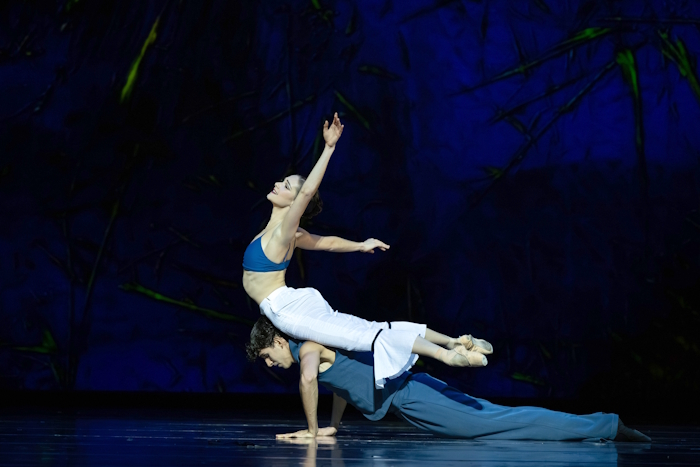
Photo Marie-Laure Briane
Also, the dancers find Shakespeare relevant. Mero says, “Shakespeare is very old, but I think it is still modern in a way. Especially with my character Count Orsina, there are homosexual connotations, which are very relevant today. He thinks he is in love with Olivia, but then he falls in love with Viola, dressed up as a man, Cesario. He is a bit confused, and he does not really know what it is. But at the end of the ballet, he gets together with Viola.”
About her role as Olivia, a rich Countess, Perrot says, “I fall in love with a woman, but I think she is a man. I gather that the ballet kind of mocks Olivia. But still, she is really persistent and independent in her choice. At the beginning of the ballet, she grieves the loss of her father and brother. Then she falls madly in love with Cesario, who is really Viola. She is very passionate and very extreme in her feelings. She is a really strong woman”
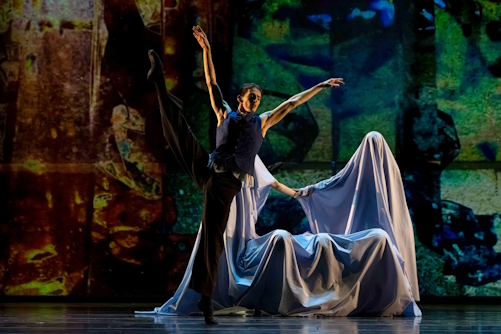
Photo Marie-Laure Briane
The first dress rehearsal of Was ihr wollt was not only attended by Mannes and his assistant, Monica Caturegli, but also by Ivan Liška, the BJBM’s director and former director of the Bayerisches Staatsballett, and Olivier Vercoutére, ballet master and former dancer with the Staatsballett. During a break, Liška walks up to one of the dancers, practicing pirouettes. He simply points to a spot just under the ribcage and says something inaudible to everybody but the dancer. After that her pirouettes work.
This kind of attention is one of the reasons Perrot and Mero chose to join to BJBM, which receives 500 to 600 applications every year. Mero says, “I think it is very personal to us, because we are a small group of sixteen dancers. So, we get a lot of attention from the director and the ballet master, and we do not get lost among a lot of other dancers like we might in a bigger company. This is tailored to us. We are still young and growing and to have that kind of attention is what keeps pushing us forward.”
Perrot adds, “I was in the corps de ballet at the Opera Ballet in Paris, I was lucky, I did get to dance in all the shows, but it was corps de ballet work, very different from what I do here in the Junior Company. But I like the repertoire here, it is very diverse.”
This season the BJBM is performing pieces by Jiři Kylian, Marco Goecke, Eric Gauther and John Neumeier, to mention just a few. Another important thing is that, “We get to perform on the big stage with the big company, the Bayerisches Staatsballett,” Perrot observes.
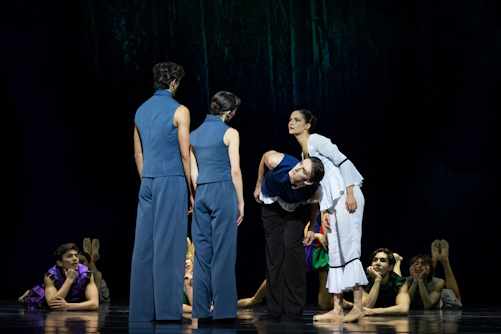
Photo Marie-Laure Briane
Mannes created his first choreography in 1994. How have dancers changed since then, I wonder. He replies, “Dancers nowadays have to be much more versatile. This has evolved over time, and it is a bit like waves in a way. You have the classical canon of steps, but we went out of that for a while. Now we are building a canon of contemporary steps, and then we will get out of that, and build a canon of whatever comes next. It evolves all the time. Nowadays for any dancer to do a monkey slide or to do stuff which is out of the contemporary world, is completely normal, but when I started this was not so. Dance has gotten so much broader, so have the number of styles a dancer has to be able to do.”
On the question of whether dancers are technically better today than before, Mannes says, “It is different, you cannot really compare it. If you look at an old video of, say, Carla Fracchi, her technique is incredible. But it is just not the way you would do it today. It is like with style. It is evolving all the time.”
The rehearsal goes well and all sixteen dancers seem to have fun. Besides Perrot and Mero, ten others have to leave the company at the end of this season because they can only stay for two years. So, in between their busy rehearsal and performance schedule they are preoccupied with photo shoots, making videos and writing applications for companies. Both Perrot’s and Mero’s dream is to join the Bayerisches Staatsballett.
A one-hour short version of Was ihr wollt will premiere at the Heinz Bosl-Matinée on November 8, which the company is sharing with the Ballett-Akademie München. After that the BJBM will take a full-evening version on tour.