
Sadler’s Wells, London
6 November 2026
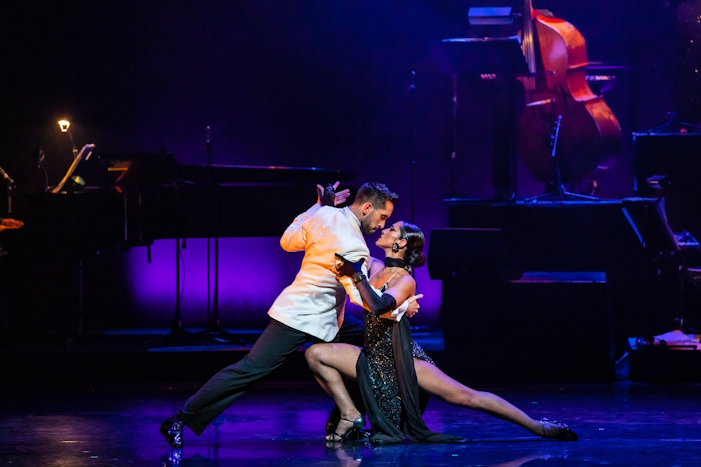
Passion, precision, temptation, seduction. Germán Cornejo’s Tango After Dark had them all in abundance in what was a exhilarating and superbly executed evening of Argentine tango, bringing together some of Argentina’s finest dancers, musicians and singers in a celebration of this most evocative of dance forms.
Created and choreographed by World Tango Champion Germán Cornejo, who also leads the company, the production is a showcase not only for the remarkable virtuosity of its performers but, perhaps even more significantly, for Cornejo’s own creative and choreographic imagination.
Tango has a relatively defined vocabulary of steps and movements, yet Cornejo demonstrates just how extraordinarily varied that vocabulary can become in the hands of a gifted choreographer. Familiar steps are continually reinvented through changes of sequence, rhythm and direction, an additional twist of the body, a turn of the head, an expressive movement of the arm or the merest flick of a foot. The result is a dizzying succession of dances that are recognisably tango, yet each appears fresh and different. It is a remarkable achievement, and one that speaks volumes for his artistic ingenuity.
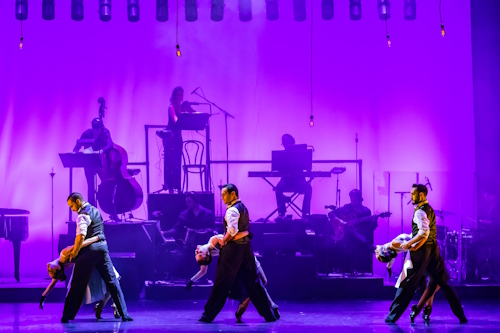
Photo Danny Kaan
The dancing itself was quite breathtaking. The needle-sharp precision, particularly of the female dancers, was awe-inspiring, while the intricate partnering and astonishing lifts frequently defied belief. Some of the duets contained sequences of four, five or even six lifted movements seemingly flowing into one another without pause, creating extraordinary combinations of position that left one wondering quite how they had been achieved. I have rarely seen anything quite like them.
Cornejo himself was exceptional, particularly when partnering the outstanding Noelia Pizzo, whose technical brilliance and elegance made her a compelling presence throughout.
It is interesting that, in the contemporary male-female tango partnership, the man frequently assumes the role of enabler, providing the strength, balance and support through which his partner can display her virtuosity. This is by no means to diminish the considerable skill required of the male dancer; indeed, Cornejo’s seemingly effortless partnering of Pizzo was itself a masterclass in control, strength and artistry.
The company also includes the newly crowned 2026 World Tango Champions Nicolás Schell and Nair Schinca Rosas, alongside Esteban Simón, María Luján Leopardi, Guido Palacios, Flor Zárate Castilla, Juan Cupini and Erica Rossi. Collectively, besides wonderful technique, they delivered all the passion, sensuality and theatrical intensity that is so central to Argentine tango.
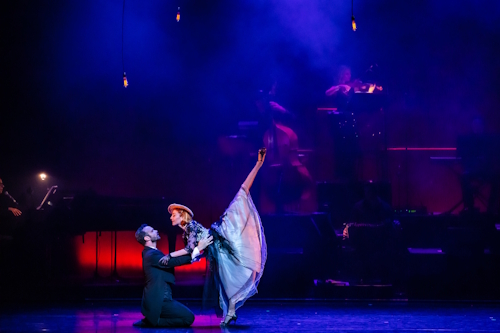
Photo Danny Kaan
Although essentially a non-narrative production, Tango After Dark nevertheless contains stories within its dances and, perhaps more particularly, within its songs. These speak, through music and emotional expression, of love won and lost, desire, longing, excitement and despair. Although the songs were performed in Spanish, it was possible to follow their emotional trajectory through the music, the singers’ vocal interpretations and the dancers’ responses. Whether there was a more specific narrative underlying the sequence of dances difficult to determine, however.
The programme was exceptionally well paced. Group dances alternated with intimate duets, while fast, explosive passages gave way to quieter, more reflective moments. There was a carefully considered balance of light and shade, intensity and restraint, which ensured that the audience’s attention never wavered. Given that the production comprises almost two hours devoted to essentially one dance form, this was no small achievement.
The music, drawn from the work of the great Argentine composer Astor Piazzolla, was performed by an excellent live ensemble under the musical direction of pianist Diego Ramos. The programme allowed several opportunities for individual instrumental virtuosity. A particularly impressive piano solo, although somewhat atonal and not entirely to my personal taste, was technically superb, while the violin and drum solos also provided welcome musical variety.
Singers Vanina Tagini and Jesús Hidalgo were equally impressive. Hidalgo in particular possesses an extraordinary voice, rich in emotional intensity and expressive power, which seemed capable of transporting the entire auditorium into another world. Their individual solos and shared duets provided a valuable reminder of the central importance of music and song to tango’s origins amidst the working-class and immigrant communities of Buenos Aires where it developed as an expression of displacement, longing and shared experience.
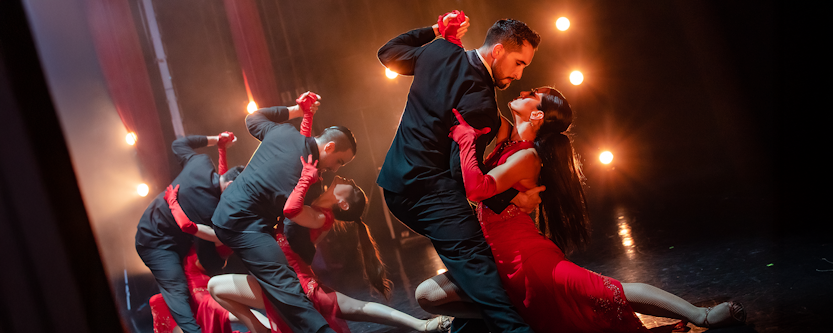
Photo Danny Kaan
While dance is necessarily the principal attraction in Tango After Dark, the musicians and singers are given sufficient prominence to remind us of the richness of the tradition from which it springs.
There was one rather puzzling interlude involving a female dancer, dressed entirely in black with her face concealed beneath a hood, performing a suggestive sequence with what appeared to be a dummy bandoneon, while a musician played the real instrument. The hooded figure had an almost wraith-like quality, and the episode was certainly intriguing, but its significance remained elusive. It certainly did not quite fit the character of the rest of the production.
The costumes, overseen by Jacqueline Aviles Díaz, were everything one could wish for in a glamorous ballroom-style tango production: elegant, glittering, sequinned and sparkling, enhancing the dancers’ movements and adding considerably to the visual spectacle. Less successful was the lighting design by Charlie Morgan Jones, however. At times unecessarily dark, it also lacked imagination and occasionally seemed a little under-rehearsed, with spotlights slow to follow changes of focus between dancing couples.
It also missed opportunities to enhance the contrasting atmospheres of the production; the intimacy and earthiness of the traditional Buenos Aires tavern versus the glittering glamour of the ballroom, for example.
Tango After Dark was an exceptionally enjoyable evening however. Cornejo has created a production that demonstrates just how much invention, variety and theatrical excitement can be achieved within the apparently limited vocabulary of a single dance form. His choreography is wonderfully imaginative, his dancers are quite outstanding, and the musicians and singers bring their own considerable artistry to the performance. From beginning to end, the performers held the audience spellbound with their precision, virtuosity, energy and passion. Whether one is an aficionado of Argentine tango or simply someone who enjoys extraordinary dancing, this is a production well worth seeing.