Sadler’s Wells, London
September 24, 2026
After a bit of a shaky start under Aaron S. Watkin’s leadership, English National Ballet are back on form with Rhythm Riot, a cracking triple bill comprising no less than two world premieres.
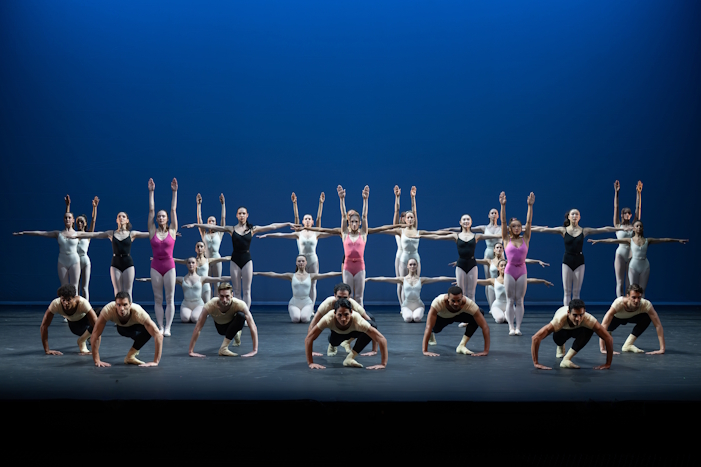
Balanchine’s collaboration with Stravinsky, Symphony in Three Movements, is rarely performed here. Stravinsky composed the work as his ‘war symphony’ in 1945 and Balanchine used it as part of his Stravinsky Festival twenty-seven years later. It wasn’t seen in the UK until Birmingham Royal Ballet first danced it in 1990, and was later also performed here by Boston and San Francisco Ballet. We have been deprived, if English National Ballet’s spirited rendition was anything to go by.
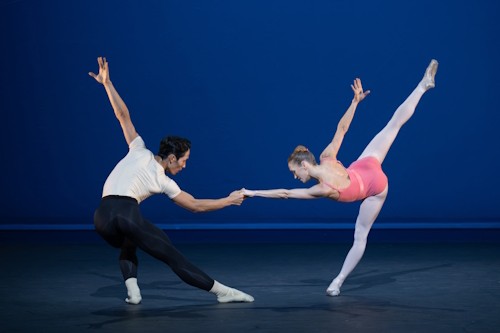
Photo ASH
English companies can sometimes give insipid renditions of Balanchine, lacking the boldness, attack and sheer speed that his works often demand. It takes more than flashy presentation to do justice to a work such as this though. English National Ballet’s dancers, coached by Cynthia Harvey, embodied the cool classicism of the St Petersburg school with more than a sprinkling of Cecchetti showing through in the batterie in particular. In fact, Balanchine teases with such gestures and even toys with pedestrian dance.
Like so many his works, it is thoroughly embedded in Manhattan, its rhythms evoking the crowded streets, log-jammed traffic and bloody-minded assertiveness of the city that never sleeps. Diagonal lines of women execute a simple canon of ports de bras producing a flickering reference to the Rockettes. Ksenia Ovsyanik and Rentaro Nakaaki danced the meltingly lyrical second movement until the pizzazz returned with the full complement of dancers in the final movement.
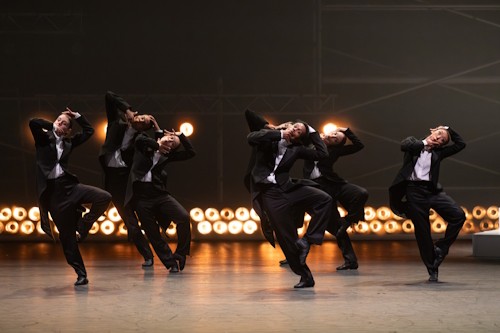
Photo ASH
One may be tempted to challenge the company to ‘follow that’. But they most certainly did with a completely different work loosely based on the iconic tap duo, the Nicholas Brothers. One of the most extraordinary things about the utterly extraordinary pair, to the fore in the 1930s and 40s, is that they they had no formal training whatsoever and were not keen on rehearsing either.
It may seem odd then that ballet dancers are chosen to remind us of their feats but Los Angeles choreographer Micaela Taylor mostly puts it off in Bow Out, not least by adding a fair bit of commentary about the social conditions under which they worked.
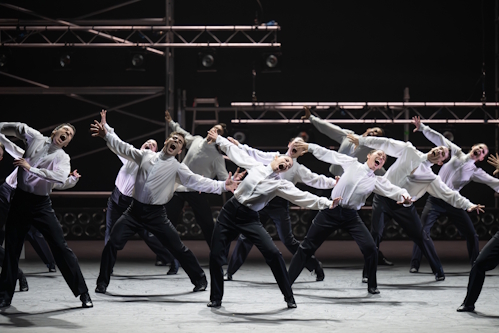
Photo ASH
There is a clever ruse of choreographing ballet to a recording of tap dancing which covers the fact that even tap specialists would be pushed to emulate the brothers. Taylor is less successful when including steps in the set that are evocative of their famous ‘flying splits’ routine in Stormy Weather. Of course, it is impossible for English National Ballet’s dancers reproduce the routine, not least because the steps are much smaller and there are no cylindrical rostra or piano on which to dance.
Candice Mac’s set recalls a dimly lit basement club, light filtering in from above. Rows of orange spots provide the only other illumination where for once, mostly black costumes and low lighting work to serve the narrative, such as it is.
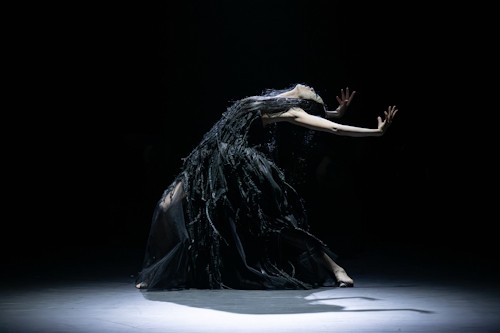
Photo ASH
Jae Man Joo’s closing Auguries of Innocence provides an incongruous mix of Korean and English culture, and for which the programme helpfully reproduces Blake’s mystical lines in their entirety. Peteris Vasks’ score, also a mix of recorded and live music, is an exciting challenge for orchestra and conductor to which both rose magnificently. It uses the beopgo, a huge drum, the playing of which is considered sacred by Buddhist monks. A notable sight is Sangeun Lee as The Weaver of Souls, wandering through the cast in a large-skirted black dress with an excessively long train, looking for all the world like a huge crow in a bata de cola. The work ends with the company in nude-toned body stockings and leotards, a stage full of Adams and Eves in all their naked innocence.