Theatre Royal, Bath
September 24, 2026
Back on tour and once again delighting audiences, London City Ballet wowed the Bath audience with a triple bill that just got better and better.
Ashley Page’s ten-minute Mephisto Waltz is a tasty hors d’ouevre that shows off the company’s classical skills. It’s bright, cheerful and non-stop, a dance of fast footwork and changing patterns with dancers swirling constantly. All rose to the challenge excellently in the ballet’s two ensemble sections and in the central series of short pas de deux by each of the five couples.
Jerome Robbins’ Quiet City maybe the same length, but that’s about all it has in common. Created in 1986, the ballet is an homage to New York City Ballet dancer Joseph Duell, who committed suicide by leaping from the fifth-floor window of his New York apartment building just one day after a performance in Balanchine’s Symphony in C for which he received much praise. It is very affecting work that speaks to a bridge between life and death, this world and the hereafter.
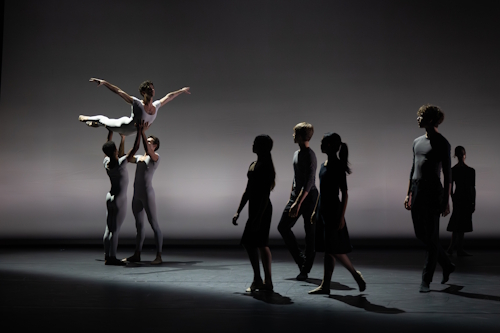
Photo ASH
The title comes from an orchestral interlude by Aaron Copeland written in 1940. Robbins’ creation immediately evokes comparisons to Robert Helpmann’s 1944 ballet, Miracle in the Gorbals in which Christ returns to the infamous Glasgow slum area and is sent to his death by the populus.
Quiet City opens with a group of figures in vaguely 1940s dress, static in what almost seems to be a misty darkness. Soon, a light appears out of the gloom, from which an ethereal Jospeh Taylor and two supporters, Samuele Barzaghi and Arthur Wille, appear. In white and off-white, they are undoubtedly angels.
Taylor could be anyone from the past of any of the onlookers, the audience included. He starts intentionally slightly tentatively, but becomes increasingly assured. There’s this strange sense of him almost clinging on to this world, not wanting to let go, despite the inescapable call of the next. The three danced wonderfully cleanly. The lifting and partnering of Taylor by the other two was exemplary before the action ends as it begins, a he is carried away allowing the shadowy figures in grey take up their lives once more.
(pictured centre: Ellie Young and Arthur Henderson)
Photo ASH
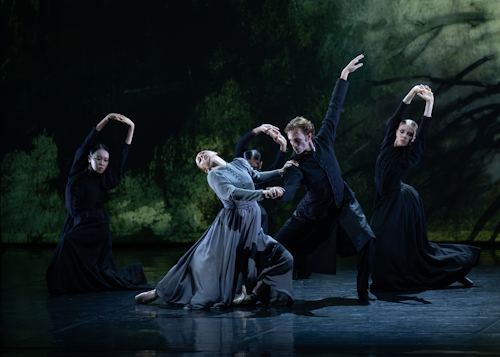
Created for the Royal Danish Ballet in 1981, Firebird, Glen Tetley’s ballet to Stravinsky’s score, is very theatrical and highly seductive. Tetley jettisons the fairytale plot of the 1910 Fokine production, which combines the Slavic folk tale with elements from other Russian folk stories, replacing it with one about a repressed young woman (the Firebird of the title), who breaks free from her controlling family, the patriarch in particular, and who finds love and liberation for all.
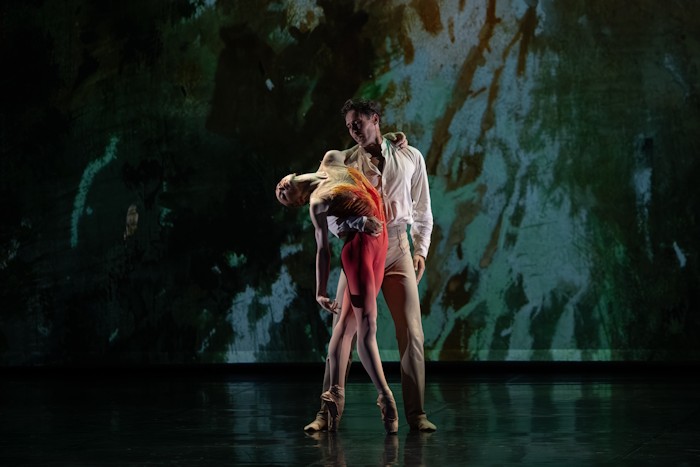
The opening imagery is of a puritanical Victorian-era household ruled over by the rather severe and threatening patriarch Kotschei, danced convincingly by Arthur Henderson. After the family encircle the put-upon and gentle Firebird, the previously grey-clad figure re-emerges, is reborn. Her new figure-hugging one-piece costume, full of the oranges, reds, yellows and whites of flames that gradually blend into one another, is stunning.
Stunning sums up Francesca Velicu too. It’s impossible to take your eyes off her. Supremely flexible, her movement flows easily with a wonderful liquid beauty.
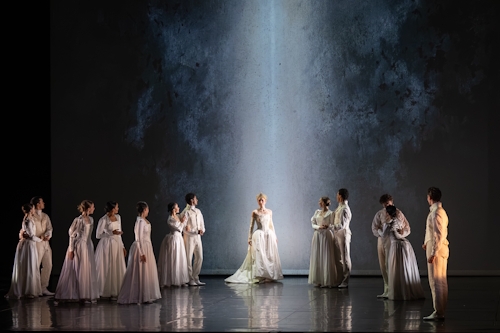
Photo ASH
Despite the continued attention of Kotschei, who reapperas in a rather unsettling skeletal bodysuit that’s all sinew and bone and that suggests death, the Firebird does find what she is looking for. Her duets with Joseph Taylor’s Ivan, the young man with whom she finally finds the love and liberations she seeks are sensual, full of mutual chemistry and, best of all, totally believable. They really draw you in. As throughout, the choreography is sleek, a fusion of classical and modern, light and grounded.
The leads are well supported by the ensemble who menace as a sort of backing chorus. As birds, in strange costumes that evoke the deep forest, they feel particularly threatening
John Macfarlane’s atmospheric backdrops are artworks in themselves. His projected images shift between inky, wintry blue-greys, and warmer autumnal reds and golds, as the story develops. Several times, they did so without me noticing, so engrossing was the story and the dancing in front of them.
A world away from the bleakness of the opening, the ballet’s concluding wedding scene, the ladies in gleaming white dresses, is as bright and happy as you could wish for. And none was as bright as Velicu’s.
I’ve never particularly got on with Fokine’s Firebird, but Tetley’s is a version that I’m already looking forward to revisiting when the company return to Sadler’s Wells in late-October, in a programme that also includes John Neumeier’s Ghost Light. If you haven’t already got tickets, do so now!
London City Ballet continues on tour, including to Sadler’s Wells, London from October 22-24, 2026.