
Royal Ballet & Opera, London
November 9, 2026
Visionary. “A person who has the ability to imagine how something will develop in the future,” says the Cambridge Dictionary. Context is all-important, of course. Visionary depends in part on time and place. Even so, whether that description applies equally to Jerome Robbins and Kenneth MacMillan, as indicated in the title of this Royal Ballet double bill, I think is open to question. But even if Robbins was, what is certain is that Dances at a Gathering is not a visionary piece of dance.
What is undeniable, is that Robbins’ ballet has a lot of very pleasant dance, to a lot of very pleasant music. Pleasant costumes too, especially the simple, airy dresses for the women. And, on this occasion, a lot of very fine dancing.
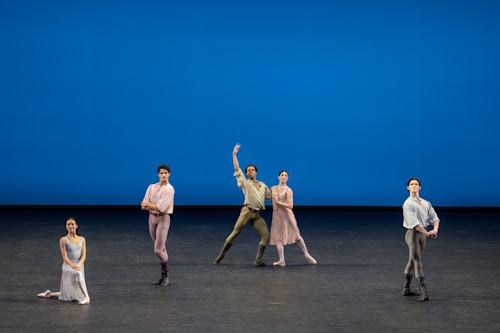
Photo Johan Persson
The cast of five men and five women come and go, both between and within the eighteen Chopin piano pieces that make up the score, played beautifully by Leonardo Pierdomenico. Even so, two of the women, Anna Rose O’Sullivan in apricot and Yasmine Naghdi in pink, appear more prominent than anyone else. O’Sullivan shone in particular. Generally softly lyrical, every time she appeared, her spirit and freedom seemed to lighten the ballet. Among the men, Recce Clarke, who anchors several duets, stood out. His partnering was impeccable.
The dance certainly matches Chopin’s music. At times it’s subtle and tender, elsewhere bright and expansive. Little moments of humour too. Eastern European folk movement is seamlessly woven in the classical choreography, especially in the first half, where most of the musical selections are mazurkas.
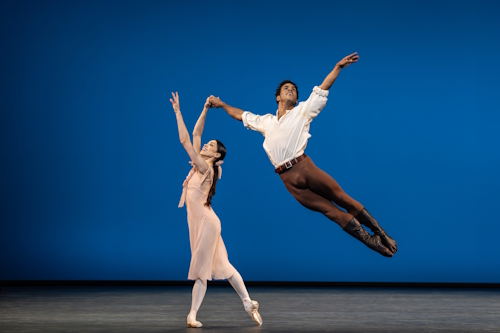
Photo Johan Persson
While Dances at a Gathering might have a different movement style, it’s impossible not to see much commonality with José Limón’s Mazurkas, in terms of music, mood and structure. But while Limón made no secret of that fact that Mazurkas, made eleven years before Dances and recently revived in full by the Limón Dance Company for the first time in decades, is a reflection on time and place, 1950s Poland, and full of mini narratives, Robbins was adamant that there are no stories in his work.
That maybe how he saw it but I’m not quite sure how that squares with Balanchine’s observation that, if you put a man and a woman on stage, there is already a story; a man and two women, a plot. That happens all the time in Dances, and there are times when there does seem to be something behind the dance. Not least in a pas de deux for Naghdi and Marcelino Sambé that gets increasingly intense. There are other moments too, even if it’s only a look, a glance. I have certainly found more in other performances by other companies, however.
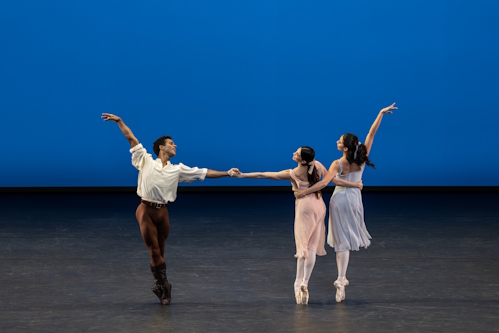
Photo Johan Persson
The ballet is a bit like looking at a world that no longer exists. Perhaps, probably, never did. A place where everything is sweet, everyone gets along, no-one gets mad. Each dance is beautiful, most rather sublime. But it does go on rather. Apparently, Robbins was intending it to be shorter, the ballet only growing to what it became thanks to Balanchine’s encouragement. But more is not always better. And, unfortunately, Dances at a Gathering starts to drag well before its overdue conclusion.
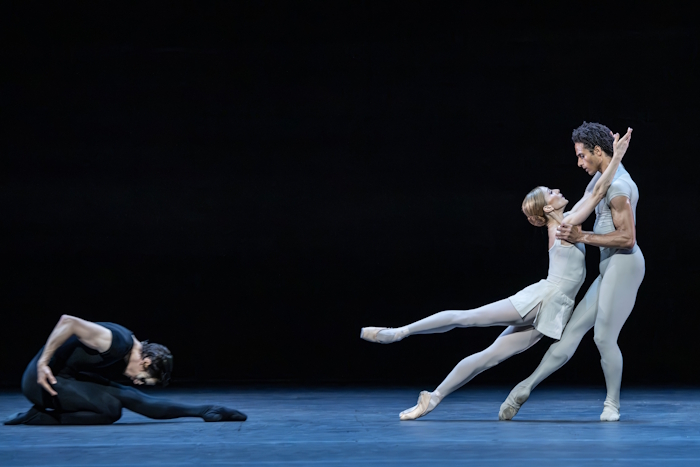
Kenneth MacMillan’s Song of the Earth, also made in the 1960s, doesn’t so much come from a different planet as a different universe.
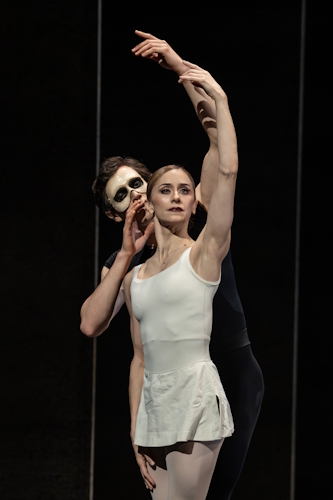
in Kenneth MacMillan’s Song of the Earth
Photo Johan Persson
When proposed, it was so forward looking that it was beyond the comprehension of the Royal Opera House, which refused to countenance his idea of a ballet to Mahler’s song-symphony, Das Lied von der Erde. Soiling such grand music with dance was simply not acceptable, they reckoned. To be fair, it probably didn’t exactly sound like one to pull in audiences. So, he went off and made it for his great friend John Cranko’s burgeoning company in Stuttgart. Such was its success that, six months later, Covent Garden did an about turn and invited him to stage it for The Royal Ballet. It’s been in the repertory ever since.
Mahler’s composition is one of those works that’s open to different interpretations within its themes of beauty, transience and mortality, all of which MacMillan picks up on his is startlingly powerful choreography.
Set on a bare stage, the outstanding cast gave an intense performance as the dancers and singers Beth Taylor and John Findon brought to life MacMillan’s take on the eighth-century T’ang Dynasty Chinese poems on which the songs are loosely based.
MacMillan’s modernist choreography is spare but of grace and passion, love and sorrow, all stalked by the ever-present menacing presence the masked William Bracewell as the Messenger of Death. The title makes it sound more sinister than it really is, even if death is inescapable, however. That the event is a natural part of humanity’s existence, or humanity’s renewal just as much as is birth, is emphasised in the role’s original German title, where it is known as Der Ewige, The Eternal One.
As The Man, Patricio Reve danced with authority, portraying nicely all the joys, especially in the opening song, and the later anguish of the character.
The star however was Marianela Nuñez as The Woman, who appeared to understand the choreography and the work’s meaning as if she had devised it herself. Very much a figure apart when we first see her in the second song, she finally finds a man in the final song, which makes up almost half the entire ballet, only for death to claim him. Her solo expressing her loss, and then the way she wandered among her younger companions was terribly moving. That solo ends with a fast pas corus, fast, tiny running steps on pointe as if she’s driven by something we can’t see.
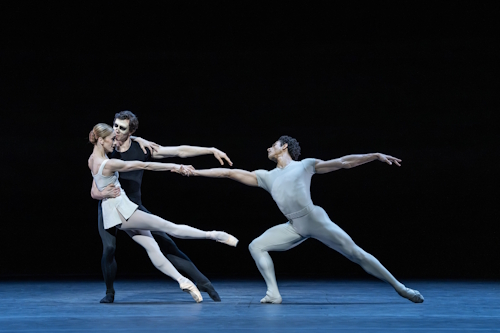
in Kenneth MacMillan’s Song of the Earth
Photo Johan Persson
Elsewhere, Sae Maeda was delightful in the third song, ‘Of Youth’ the lightest of the ballet, and in which we see young people enjoying life. But why not? Even if one is all to aware of what is down the road, living for the moment has a lot to recommend it.
The ballet ends beautifully. The leading three characters walking towards us, the dance, music and song all perfectly situated between life and death. And we are back to renewal. “Everywhere the dear earth / blossoms in the spring and grows green again. / Everywhere and forever the distance looks bright and blue! / Forever… forever…”