
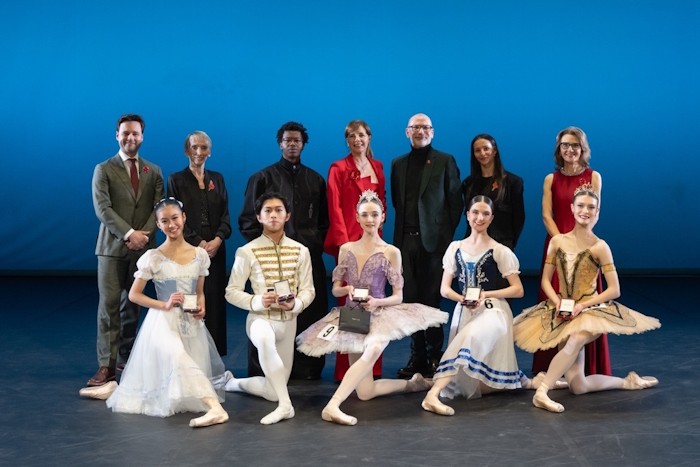
Final, London Coliseum
November 8, 2026
The final of the 2026 Margot Fonteyn International Ballet Competition brought twelve talented young dancers from across the world to the London Coliseum, each hoping to demonstrate the qualities needed for a successful professional career. The technical standard was consistently high, as one would expect at this level. Yet the evening also raised an interesting question: is contemporary ballet training placing sufficient emphasis on the development of artistry alongside technical accomplishment?
Organised by the Royal Academy of Dance (RAD), the competition, formerly known as the Adeline Genée, attracted 71 candidates from 19 countries. Following an intensive week of coaching and semi-final performances, twelve finalists were selected to compete before a distinguished judging panel comprising Dame Darcey Bussell, Francesca Hayward, Kevin O’Hare and Lynn Wallis.
This year also marked a collaboration with the Frederick Ashton Foundation and the introduction of Ashton in Competition, a digital resource designed to support the performance of Ashton’s choreography by young dancers. Each finalist performed three short pieces: an Ashton variation, a newly choreographed solo of between sixty and ninety seconds, and a variation from the classical repertoire.
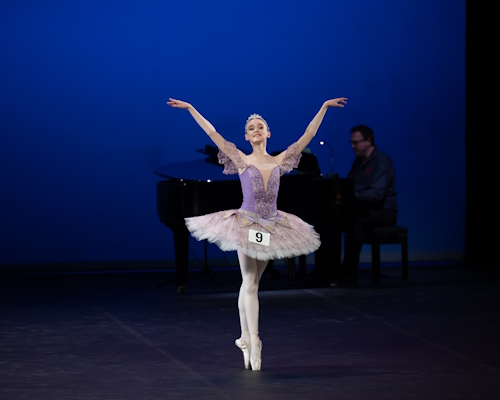
Gold medallist at the Fonteyn International Ballet Competition 2026
Photo ASH
The evening opened with a quite exquisite performance by Royal Ballet soloist Marianna Tsembenhoi, dancing the Shadow Variation from Ashton’s Ondine. Her movement possessed an almost liquid quality, flowing effortlessly from one step into the next, her body seemingly melting into the choreography. Every movement appeared completely integrated with the music, creating a performance of extraordinary fluidity, sensitivity and emotional depth. It was one of the most beautifully realised short pieces of dancing I have seen for some considerable time.
More significantly, Tsembenhoi demonstrated that elusive quality which was to prove largely absent from the competition itself: the ability to move beyond the execution of steps and become completely invested in the character, music and emotional world of the dance. She was not simply performing a dance; she was inhabiting it.
In the competition itself, the Genée gold medal was awarded to Erin Alarie, age 17, from Canada, currently training at the Oakville School of Classical Ballet near Toronto. Alarie also won the Dancer’s Own Choreographic Award.
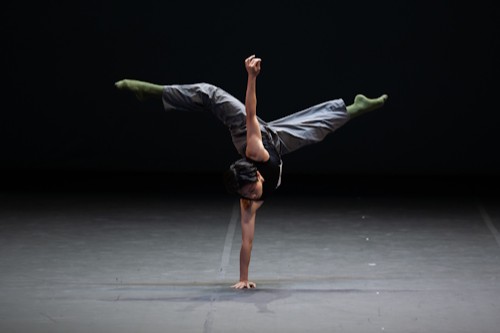
Photo ASH
The silver medal went to Tsz Ho Ting, age 18, from China, training at the Berlin State Ballet School. Two bronze medals were awarded: to Chi Kok Ip, also 18 and from China, currently training at Tring Park School for the Performing Arts; and Siena Murphy, 17, from the United Kingdom, currently at English National Ballet School.
The Margot Fonteyn Audience Choice Award went to Chelsea Humm, 19, from New Zealand; while Gonzalo Toledo picked up the Musicality Award and Erin.
The twelve finalists were all technically accomplished, although there was relatively little to distinguish one from another in terms of exceptional brilliance or artistic individuality. None quite produced that moment of astonishment when a young dancer’s talent appears to transcend their training and announce itself as something truly special.
This is not to diminish their achievements. These are young people still developing their skills, and it would be unreasonable to expect the maturity of established professionals. Nevertheless, one might hope to see at least the beginnings of an individual artistic voice, an understanding that ballet is about considerably more than beautifully executed steps.
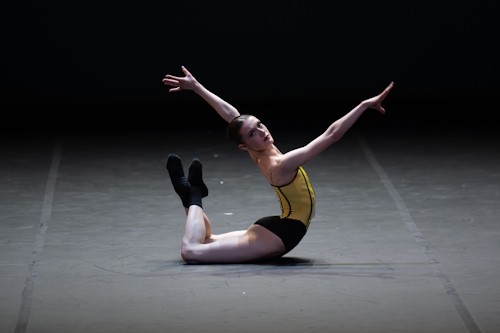
Photo ASH
Two finalists, Rafferty Ebury and Sarah Wheatley both choreographed pieces that were innovative, creative and bold in the way they used classical dance. Although neither won the choreographic medal, they are worth watching to see where their singular choreographic voices will take them as they move into their professional careers.
Generally, the dancers felt more self-assured and invested in their dance in the individual choreographic pieces. Perhaps the freedom of contemporary choreography, together with the chosen music, enabled greater personal expression than they are yet able to bring to established repertoire.
It was disappointing that the Choreographic and Musicality Awards, which the programme indicated would be presented at the final, were not included in the ceremony. As the finalists were identified on stage only by their competition numbers, it was also difficult to connect individual performances with their names or discover who had created the choreography until after the performance.
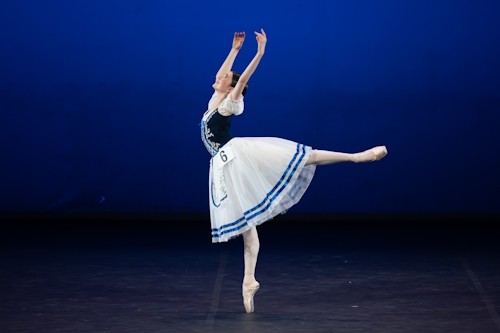
Photo ASH
The question of artistic expression has arisen for me repeatedly during recent ballet performances, including The Royal Ballet’s centenary celebration and Madam, the tribute to Dame Ninette de Valois. De Valois believed passionately that ballet should be far more than a succession of steps; it was a theatrical art form in which music, movement, character and dramatic expression were inseparable. There appears, from some recent performances, to be an emphasis on technical accomplishment at the expense of this wider artistic development.
The physical demands placed upon today’s dancers are extraordinary. Strength, flexibility, elevation and athleticism have become essential, and technical standards are frequently astonishing. Technical virtuosity is the means through which dancers communicate, not the ultimate purpose of the performance. Without emotional engagement, dramatic understanding and musical sensitivity, even brilliantly executed steps risk becoming little more than impressive demonstrations of physical ability.
What was interesting in the Fonteyn final was that the seeming lack of artistic individuality was common across dancers trained in different schools and countries. The RAD’s internationally recognised examination system clearly provides a strong and consistent technical foundation, but perhaps a little more focus on developing dramatic and expressive skills alongside technique, would enable young dancers to understand how to live their dancing, rather than only performing it. Certainly, these qualities can develop through experience and observation but, surely, they should also be actively nurtured through teaching. Tsembenhoi’s opening performance demonstrated just how extraordinary the results can be when technique and artistry become inseparable.
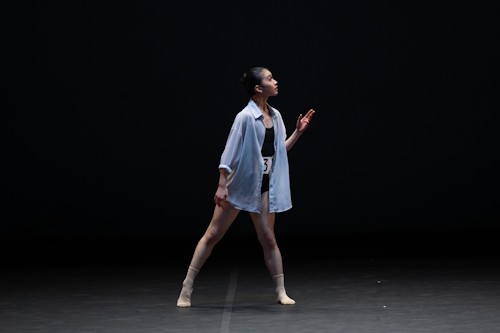
Photo ASH
The evening concluded with a beautifully performed pas de deux from Ashton’s Sylvia, danced by Royal Ballet Principals Fumi Kaneko and Vadim Muntagirov. Kaneko was elegant, assured and technically impeccable, while Muntagirov provided exemplary partnering, his strength and effortless support allowing her dancing to take centre stage. It was a fitting conclusion.
In terms of presentation, the competition was extremely well managed. RAD Artistic Director Alexander Campbell, together with Chief Executive Elizabeth Honer, ensured that proceedings were conducted with professionalism and appropriate formality. Introductions were brief and unobtrusive, allowing the dancing to remain the focus. The pianists, Rebecca Leshures accompanying the Ashton variations and Richard Norriss the classical repertoire, provided sensitive support, while the restrained lighting by Chris Wilkinson and appropriately chosen costumes ensured that nothing distracted from the competitors’ performances.
The awards ceremony was equally well handled, with the welcome inclusion of all the semi-finalists on stage, acknowledging the considerable effort and commitment of those who had travelled from around the world. Proceedings were warm and appreciative without becoming unnecessarily prolonged.
There is much to celebrate in the remarkable technical abilities demonstrated by these young performers, and the opportunities provided by the Fonteyn competition are undoubtedly invaluable. Many will surely progress to successful professional careers, building upon the considerable skills they already possess.
But I come back to the fact that technical excellence alone does not create an exceptional dancer. The real distinction lies in the ability to transform movement into artistic expression, communicating emotion, character and meaning through dance. Perhaps that is the challenge facing ballet education today: not simply to produce ever more technically accomplished dancers, but to ensure that the dramatic and expressive traditions so central to the art form are given equal importance.
The Fonteyn 2026 demonstrated that the future of ballet is in technically capable hands. The hope is that these young dancers will, as Dame Ninette de Valois so elegantly put it “…utilise their classical foundation to expand the possibilities of the art of dancing in harmony with the other arts of the theatre.” Her emphasis on dramatic engagement and narrative clarity was the cornerstone of British ballet. Artistic imagination and emotional depth are needed alongside technical excellence to make that future truly exciting.