
Royal Ballet & Opera, London
June 11, 2026
Sol León and Paul Lightfoot have a catalogue of over fifty works, most made during their time as house choreographers for Nederlands Dans Theater. Their creations are danced by ballet companies across Europe and beyond. But never by those in the UK. Until now, and The Royal Ballet’s So Are We double-bill.
Both Shoot the Moon, made in 2006 for NDT and danced by them in London in 2018, and the newly extended and reimagined Salle de Danse, originally made as a film during the Covid pandemic, are full of the duo’s unique movement language that blends softness, weightless transitions and fluidity with angular movement that features lots of twitches, shivers and huge extensions, along with the occasional silent scream and mouthing of unheard words.
The Royal Ballet dancers looked terrific in both, Salle de Danse in particular a super vehicle for their wonderful physicality. You would have thought they had been dancing the choreographers’ works for years.
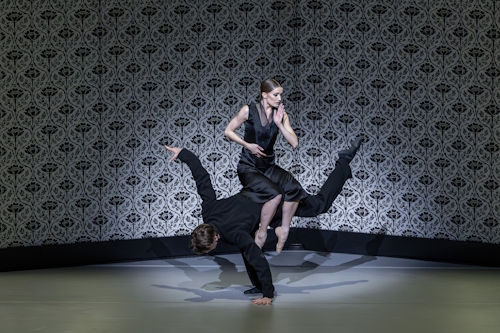
Photo Johan Persson
Set to the second movement of Philip Glass’ Piano Concerto No.1 (usually called the Tirol Concerto), the gripping Shoot the Moon explores relationships and solitude. It’s intense, elegant and deeply compelling; a work of emotional drama, theatricality, and one or two moments of dark humour.
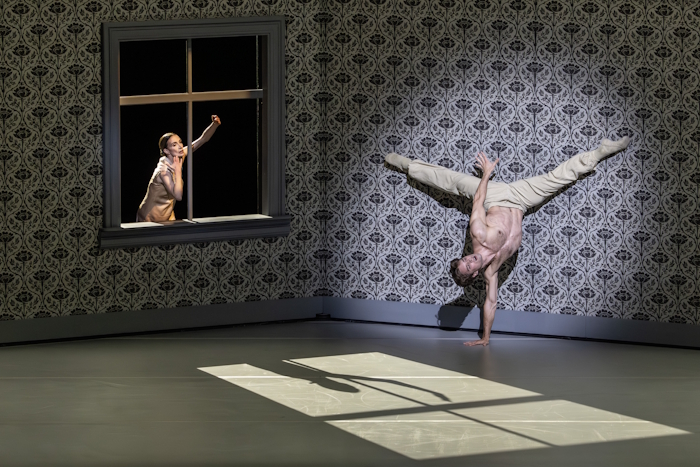
The audience is effectively fly on the wall to three love stories, in three separate rooms, each visited in turn via the clever use of a revolving stage. Apart from its occupants, each room is empty in the sense there is no furniture, just a black door, and sometimes a window. They are full to the brim of simmering emotions and tension, however. Wallpapered identically, the near-monochrome locations feel stuck in a time warp. The identical décor also reflects similarities in the relationships.
Shoot the Moon is a ballet of light and shadow, of things open and things hidden. In one room, we find Anna Rose O’Sullivan and Vadim Muntagirov. She’s edgy, anxious. You sense that a distance has grown between them but that they still cannot bear to part. Then, Lauren Cuthbertson and Matthew Ball, who seem more openly in conflict. Finally, having to deal with his inner conflicts all alone, the bare-chested Lukas B. Brændsrød.
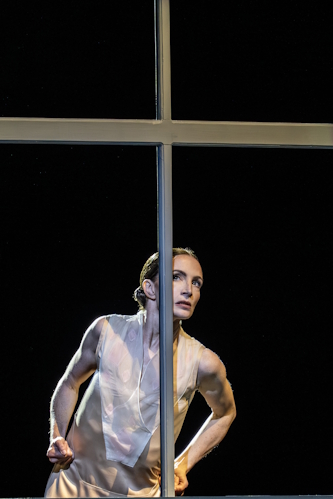
Photo Johan Persson
The rooms feel like prisons, their occupants hemmed in by the walls. They are places where emotions are initially bottled up, before spewing forth. The people we see are lonely and frustrated. Attempts at closeness invariably appear to fail, the expression from all five slowly becoming more and more incautious. Towards the end there are one or two shouted sounds and grunts. Sometimes the dancers literally climb and hang off the walls.
Emphasis on facial expression is given a helping hand by projected live images that recall actors in silent movie melodramas. The camera is also cleverly used to give the viewer a glimpse of what is hidden, or part-hidden. At times, it feels like it could have been directed by Alfred Hitchcock.
Tom Bevoort’s lighting is equally moody. Particularly impressive is the way is shines through a window, casting its image in light and shadow on the floor. It’s very reminiscent of an Edward Hopper painting, although his characters invariably keep their thoughts hidden. Here, all is very visible indeed.
Glass’ sorrowful and full of longing music is as beautiful, as pensive and melancholic as the choreography. Its long, simple phrases constantly repeatt, weave and mutate to create harmonies as arresting as Léon-Lightfoot’s visuals.
We may have been watching in the vast auditorium that is the Royal Opera House, but the work feels incredibly intimate. The cast all performed with remarkable clarity, precision and with powerful expression. Shoot the Moon is intense, elegant and deeply compelling.
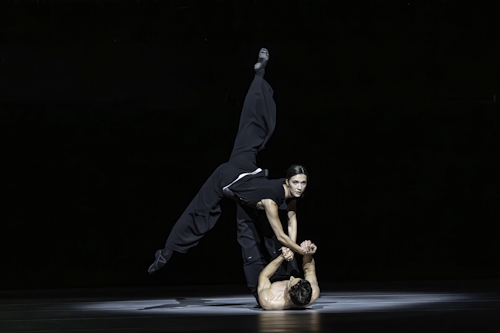
Photo Johan Persson
Inspired by dancers’ daily class, Salle de Danse could hardly be more different. Originally choreographed as a film by Lightfoot during the Covid-19 pandemic, it has been extended and reimagined for the stage. A world premiere for The Royal Ballet, and performed to a new and very listenable-to score by Ilya Demutsky, it’s a multi-section, large cast work that gives plenty of opportunity for dancers to have their moment in the spotlight.
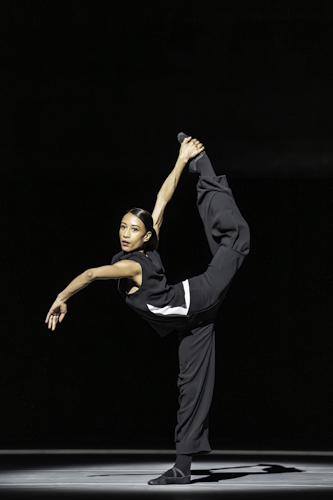
Photo Johan Persson
But the work is not a ballet about class in the sense that Harald Lander’s Études or Asif Messerer’s Class Concert is. Rather, each part of class is interpreted in Léon and Lightfoot’s unique way. It’s not so much a celebration of classical technique, although that surely underpins everything, as a celebration of creativity and invention, and where that technique can lead.
The ballet comes in twenty numbered sections. Most are named after a classroom exercise or dance, but some are simply called ‘Prelude’, ‘Interlude’, Postlude’, ‘Coda’ and so on. Some of the choreography more closely resembles dance steps than others. ‘III. Ronds de jambe’, for example, opens with just that, Joseph Sissens performing some of the most controlled you’ll ever see, turning as he performs them.
That’s followed by ‘IV. Étirements’, a gorgeously complex and fluid duet for Melissa Hamilton, Martin Diaz. ‘V. Adage’ is a duet of a different sort for Calvin Richardson, Marco Masciari.
Salle de Danse is one of those ballets where everyone will have personal favourite moment. Mine would be Annette Buvoli and Mica Bradbury in ‘XII. Relevés’, which is especially quirky and energy filled. But each new section brings something new, something inventive. The one thing you could never accuse Salle de Danse of being is predictable.
At sixty minutes it does start to feel quite long, however. I suspect it would benefit from a few sections being cut, from the second half in particular. But I also think it’s a ballet that will be in demand by other companies.
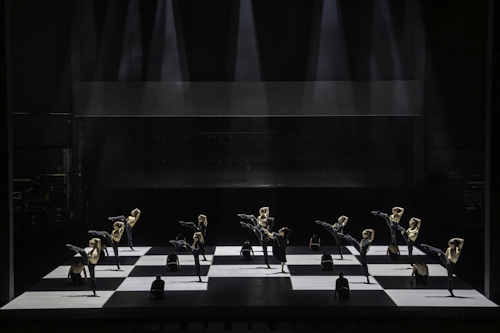
Photo Johan Persson