
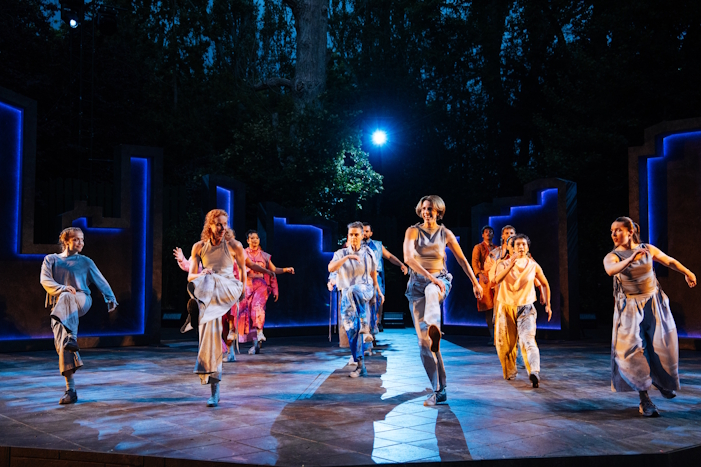
Regent’s Park Open Air Theatre, London
June 12, 2026
A warm June evening in Regent’s Park turned unexpectedly chilly by the end of A Life in Four Seasons. The timing suited it. As darkness settles over the open-air theatre, the production arrives at winter, its three protagonists having travelled from youth to old age accompanied by a reimagining of Vivaldi’s score by DJ Walde.
The premise is straightforward. Head, Heart and Gut represent different aspects of a single self, moving through life’s seasons together. In spring they appear as excitable teenagers, dressed in colour-coded uniforms. By winter they are embodied by older performers, and time can be read directly in the body.
The ageing process is the clearest thing in the production. You can see it happen.
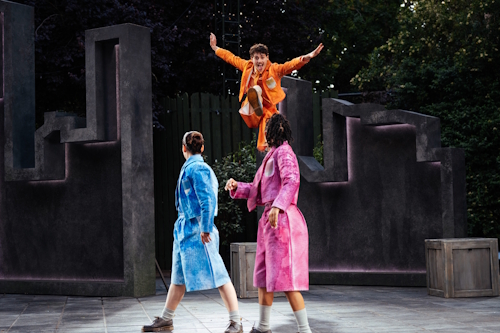
at Regent’s Park Open Air Theatre
Photo Helen Murray
Less convincing is the choreographic necessity of Head, Heart and Gut beyond costume colour and programme-note description. The work suggests thought, feeling and instinct, but their individual identities rarely emerge with enough physical force to make the distinctions matter.
Much of the movement shares the same buoyant, open quality, with street-dance-inflected steps, quick directional changes and playful shifts of weight as bodies gather and scatter across the stage. There are conflicts and reconciliations, but the physical language often smooths them into the same general current rather than letting each force pull the life in a different direction.
There are enjoyable moments. Alexzandra Sarmiento’s choreography keeps the stage active and accessible, while the cast throw themselves into the material with conviction. The audience responded warmly throughout.
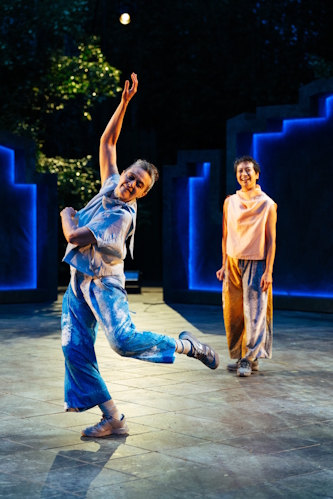
in A Life in Four Seasons
Photo Helen Murray
The strongest section comes late in the evening. Winter introduces older performers, and suddenly the theme of time gains substance. A slight wobble, a delayed reaction, a body negotiating balance rather than commanding it: these details carry more emotional weight than many of the production’s larger symbolic gestures.
Susan Kempster, as the Winter Head, is especially compelling. Her weariness is not simply acted; it sits in the timing, in the small losses of control, in the way certainty begins to drain from the body. Mami Tomotani, as the Winter Gut, brings the sharpest physical clarity among the older trio. Her solo has speed, a clean attack, and clearly drawn lines, giving the final section an energy that does not simply belong to decline.
Yet for all its sincerity, A Life in Four Seasons remains oddly elusive. I understood what it was doing almost immediately. A life unfolds. Different impulses compete for influence. Seasons pass. What I did not always feel was why these divisions needed to exist so urgently on stage. For that, Head, Heart and Gut would need sharper choreographic stakes, not only clearer labels.
At one point a pigeon wandered across the stage, apparently unconcerned with questions of identity, ageing or human consciousness. It was a brief interruption, but also a reminder of what Regent’s Park Open Air Theatre does best: the world beyond the performance never entirely stays outside it.