
The Place, London
August 1, 2026
The summer show by the students of the Centre for Advanced Training at The Place brought together eight short works and a final celebratory extract in a programme that placed considerable demands on its dancers, all of whom are under 16. Moving between contrasting choreographers, styles and emotional worlds, everyone performed with flair, confidence and impressive technical ability.
The standard of the presentation spoke clearly of the energy, discipline and rehearsal time invested in it. Not every choreographic challenge was fully mastered, particularly when large ensembles and complex counter-rhythms came into play, but the dancers’ willingness to test themselves was one of the evening’s most encouraging qualities, showcasing the potential for these young dancers to pursue professional careers, should they wish to.
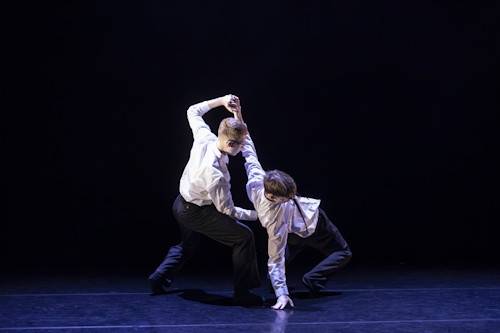
Photo Jemima Yong
The programme opened with arguably the standout piece of the show, Jess Yeo’s 21/26. Set to Jerk Driver, a Marcus Lancaster remix featuring music by Gabriel Prokofiev and Peter Gregson, it responds to a 1966 BBC archive film in which children imagined what life might be like in 2026. Performed by an all-male group, the piece was crisp, clean and technically assured.
The choreography was exceptionally well judged for the dancers’ abilities without appearing simplified for them. They did not look as though they were cautiously negotiating unfamiliar material; they inhabited it fully. With its clarity, commitment and precision, 21/26 worked on every level.
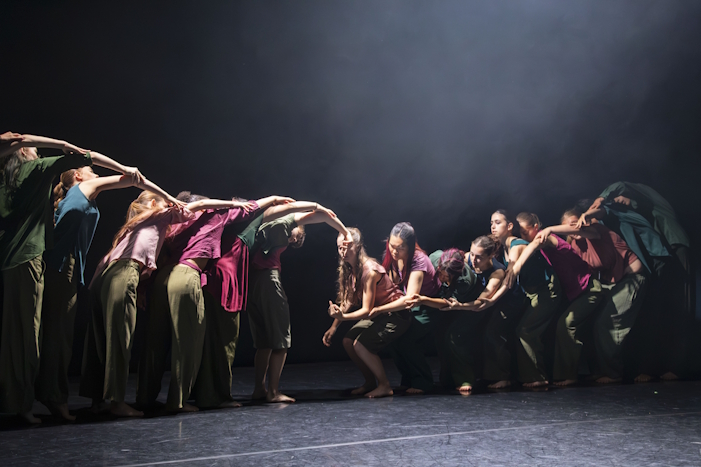
Created and performed by an all-female group, The freedom we forgot considered three stages in the journey from childhood to young adulthood: early innocence, the restrictions imposed by education, and the eventual recovery of individual freedom and agency as young adults.
The middle section, addressing the rules and conformity of school, was the most effective. Performed by a smaller group, it had a clear structure and responsive ensemble quality. The final section was more ambitious and consequently less controlled. With more dancers occupying the stage and moving through opposing rhythms, some of the precision was lost. At such moments, choreography that needed sharp definition became slightly smudged. Yet this was a self-created work by young dancers prepared to expose their ideas, trust their instincts, and push beyond what they could already accomplish comfortably. A huge milestone in and of itself.
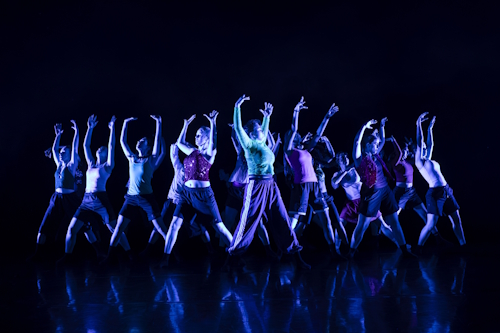
Photo Jemima Yong
Max Revell’s intriguingly titled Like Little Lost People in Their Grown-Up Clothes and Poses, set to Peter Svensson’s Dongog, remained entirely floor-bound. Its vocabulary was confined largely to movements of the head, arms and upper body as dancers entered, settled into place and departed. The restriction produced some very clean ensemble work. The dancers maintained a strong shared rhythm, and the choreography held together formally. Conceptually, however, the piece was harder to penetrate. With no programme note to provide a clue, its emotional or creative impulse remained elusive. Its abstract strangeness was not without interest, but it left the audience with little indication of what lay behind its carefully controlled surface.
A much darker atmosphere followed in Mark Bruce’s Fury Parade, an extract from his company work, Liberation Day. Choreographed and composed by Bruce, it presents young people protesting in an environment shaped by intimidation and violence.
The dancers communicated its danger effectively through angular, stark and sometimes violently interrupted movement. The mood of protest and threat registered strongly, although some of the ensemble passages were technically demanding. When large numbers filled the stage, the dancers became somewhat untidy, limiting the full disturbing force of the choreography. Even so, they approached this difficult material with seriousness and commitment. Greater experience will bring the control needed to make its darkness still more unsettling.
Jordan James Bridge’s Bloom, set to music by Rival Consoles, was another highlight. Its central image is of growth beginning beneath the surface: something working through unseen challenge, connection and transformation before finally emerging into flower. Bridge describes the work as describing the patience, resilience and strength, found in individuals and a developing community.
Choreography, music and dancers came together almost perfectly. The work played to the group’s technical strengths while allowing them to communicate more than technique alone. It was focused, exciting and immediately engaging, revealing just how accomplished these young performers can be when the material fits them so completely. At its best, Bloom made these young dancers’ age easy to forget.
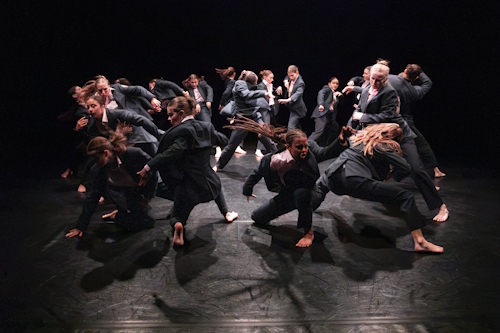
Photo Jemima Yong
Anita Zwierzynska’s Kintsugi drew upon the Japanese art of repairing broken pottery with gold, to preserve its cracks as part of the object’s history. The choreography translated that practice into a process of putting oneself back together after fracture. It was an apt concept for dance, and the performers engaged thoughtfully with its patterns of breaking, returning and rebuilding.
The work was, however, a little overlong. Its recurring material became too literal in its repetition, rather than developing gradually as the idea of repair progressed. Some judicious editing, together with greater variation within the repeated phrases, would have given the piece a stronger dramatic journey. Nevertheless, it suited the dancers well, and they remained fully invested in it.
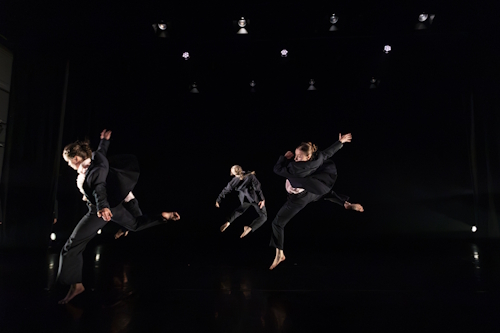
Photo Jemima Yong
Emily Powell’s Blushing offered a welcome change of tone. Set to music including Dean Martin’s Sway, Emile Mosseri’s Infinite Love and Robbie Poitevin’s Bubba Dub Bossa, it explored playfulness, nonchalance and shifting relationships.
Originally created in 2024 in collaboration with students at Central School of Ballet, the choreography felt well attuned to young performers working at a high level. Its changes of music brought corresponding changes of mood, which the dancers recognised and articulated with confidence. Their quality of movement and interaction shifted with the tone of each section, making this inventive and choreographically lively work particularly enjoyable.
The final piece was Ripple, from the BalletBoyz repertoire. Originally choreographed for and with the company by Xie Xin (謝欣) in 2019, it was restaged with the CAT dancers in collaboration with Dan Baines.
The choreographer describes the work as natural and transparent, moving like the memory of an ocean. Some of its choreographic demands sat just beyond the dancers’ present experience, but they met those demands with confidence and produced a creditable, absorbing performance. Their involvement in the restaging appeared to give them a valuable sense of ownership. Even where the movement challenged them, they approached it decisively rather than tentatively.
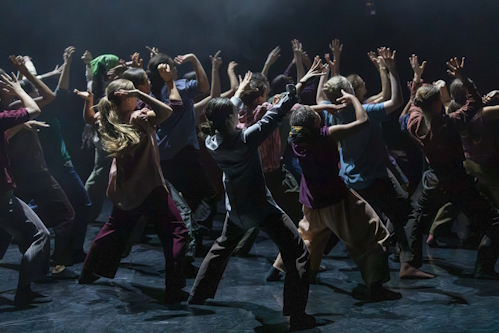
Photo Jemima Yong
The evening concluded with an extract from Hofesh Shechter’s Grand Finale, adapted for the CAT dancers by Holly Brennan. The original 2017 work, created for ten dancers and six musicians, presents a vision of a world in free-fall. Here, however, the dominant impression was not apocalyptic but joyous. The extract became a lively celebration of dancing and shared musical energy, sending the programme towards its conclusion with warmth and exuberance.
The costumes, designed by Emma Lith, Alice Ortono Coles and Ruby Pierce, supported the varied choreography without restricting the dancers. Equally significant was the largely uncredited lighting. With no scenery, light had to shape the performance space as well as illuminate it, and it did so creatively. Apart from one brief passage that felt slightly too dark, each work was given an individual visual atmosphere that complemented both its choreography and its performers.
Across the evening, the CAT dancers proved themselves an accomplished, confident and technically capable group. Most impressive was not simply what they could already do, but their evident appetite for material that stretched them. Some of the programme revealed the limits of their present ensemble experience, but it also showed how rapidly those limits are likely to move. This was an ambitious and highly creditable Summer Show, and an encouraging glimpse of where continued training may take them.