
Sadler’s Wells, London
October 28, 2026
When the curtain rises on the final act of Birmingham Royal Ballet’s Swan Lake, a thick blanket of mist already covers the stage. The swans slowly rise through the haze, drawing an audible wave of astonishment from the audience. It is a wonderfully atmospheric, dreamlike image.
Swan Lake has become almost synonymous with classical ballet for good reason. The iconic formations of the swan corps, the colourful character dances and Tchaikovsky’s magnificent score have captivated audiences for generations. Peter Wright and Galina Samsova’s production embraces this familiar splendour, with Philip Prowse’s extravagantly theatrical designs adding another layer of visual richness. The costumes, with their elaborate decorations and dramatic silhouettes, look almost as though they have stepped out of an illustrated fairy tale. Some are so voluminous that one wonders how the dancers manage to move in them.
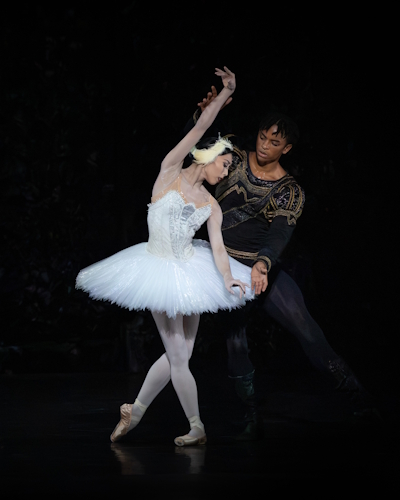
Photo Clive Booth
The dancing offers moments of considerable pleasure, although the evening is punctuated by small lapses in precision. An assisted pirouette among the ensemble loses balance in the first act, while a dancer at the back almost misses collecting a glass. Later, one of the two Swan Maidens moves ahead of her partner, briefly breaking their synchronisation. None is particularly serious, but such little incidents accumulate.
There is fine dancing, too. Yasiel Hodelín brings a youthful, almost boyish air to Prince Siegfried. He and Riku Ito, as Benno, impress with their jumps, particularly their sharp, clearly articulated batterie.
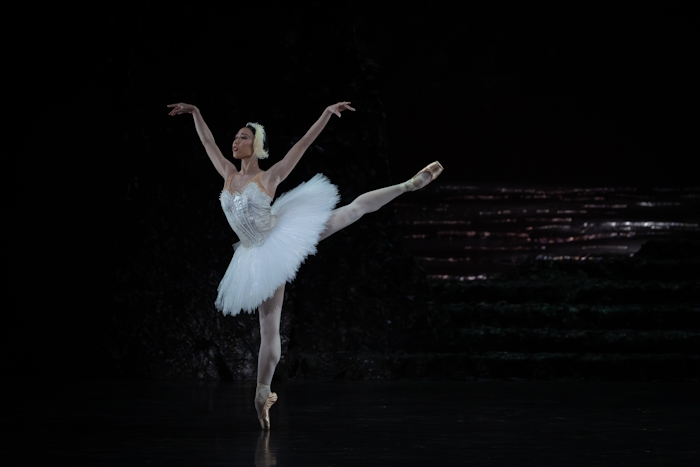
Yu Kurihara’s Odette has beautiful épaulement, the subtle opposition between her upper and lower body creating elegant, expressive lines. At the end of the second act, she turns her back to the audience, her outstretched arms gradually taking on the shape of a swan’s wings as she transforms and flies away. It is a particularly beautiful moment, the transformation expressed through the simplest of movements.
The second act also offers an unexpectedly amusing moment. During Odette’s lengthy mime explanation of her predicament, Siegfried repeatedly appears ready to respond, only for her to raise a hand and continue. The repeated interruptions lend a faintly comic rhythm to an otherwise serious exchange. There is certainly a great deal to explain about the terms of her enchantment.
He seems eager to rescue a distressed young woman, while she is understandably pleased to have found someone who might break the spell. Yet I saw little in their physical interaction to suggest a growing attraction. They seemed more like two newly acquainted colleagues faced with a problem to solve than young lovers discovering an overwhelming passion. I was never quite convinced that Odette and Siegfried had fallen in love.
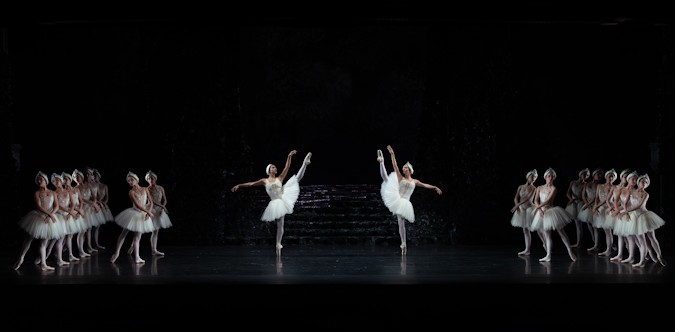
Photo Clive Booth
The third act brings a welcome burst of energy. The character dances, with their lively rhythms and contrasting styles, are among the evening’s greatest pleasures. Katherine Ochoa is particularly delightful as the Italian Princess. Her dancing feels light, spontaneous and wonderfully at ease, bringing an infectious playfulness to the ballroom.
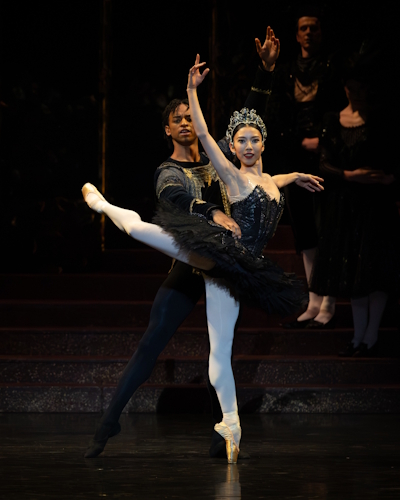
Kurihara returns as Odile with a broad, mischievous grin, apparently having the time of her life. There is little of the calculated seductress about her. She seems to relish the game itself, as though she were playing a harmless prank rather than destroying Odette’s hope of freedom. A brief loss of balance interrupts an attitude turn, and while she completes all 32 fouettés, the final rotations lose some speed. Hodelín, meanwhile, delivers exhilarating airborne turns, fast, clean and sharply finished. The speed and clarity are impressive.
in Birmingham Royal Ballet’s Swan Lake
Photo Clive Booth
Throughout the evening, the Royal Ballet Sinfonia under Paul Murphy makes Tchaikovsky’s music an enormous pleasure. The familiar melodies and irresistible rhythms of the ballroom dances are enough to make one want to get up and join in.
For all its theatrical splendour, this Swan Lake never quite drew me into the lovers’ tragedy. The music is magnificent, the costumes dazzling, and individual dancers offer moments of genuine pleasure. Yet when Odette and Siegfried finally face their fate, I found myself admiring the beauty surrounding them more than feeling the sorrow of their parting.
The enchanted lake is entirely convincing. The enchantment between its two lovers is much harder to find.