
The Place, London
October 29, 2026
Who is the mother trying to reach?
In the second half of Hang Time, a series of recorded telephone messages introduces a woman increasingly anxious to hear from her son. His grandmother is worried. His brother has heard nothing from him. She asks him to call back and not to disappear on them again. Yet I cannot tell whether her son is represented by any of the seven men on stage, or how the messages relate to what I have been watching.
Malik Nashad Sharpe, working under the name Marikiscrycrycry, brings together seven excellent dancers for this hour-long work. Their movement vocabulary is wonderfully varied, incorporating ballet, contemporary dance and street-dance styles. Fluent floorwork, vigorous ensemble passages and intricate partnering demonstrate an impressive technical range. The dancers lift, catch and counterbalance one another, handling demanding shifts of weight and direction with considerable assurance. Whatever the style, there is pleasure in watching them dance. Occasionally, however, the execution looks less secure than their evident abilities would suggest, giving certain passages a slightly under-rehearsed quality.
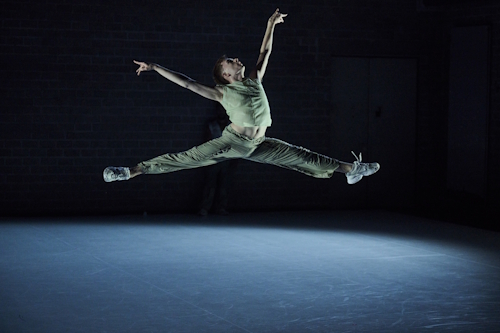
Photo Studio Pramudiya
The soundtrack is equally eclectic, ranging from dancehall and hip-hop to post-hardcore and experimental electronic music. Its musical richness matches the diversity of the choreography, although these contrasts do little to clarify how the work’s disparate episodes belong together.
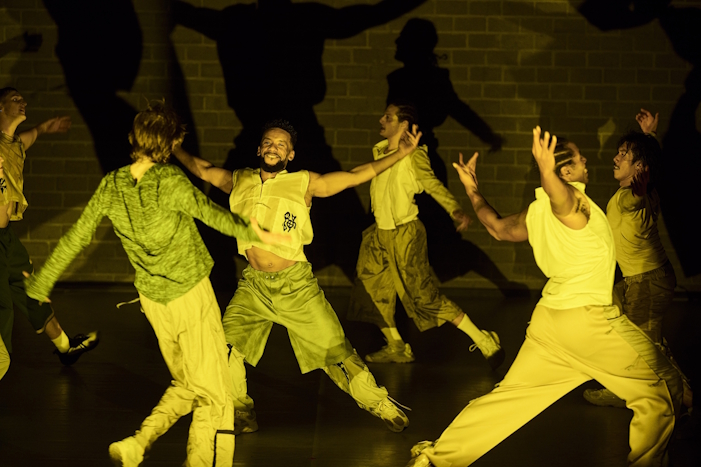
The evening begins with one man sitting on a chair while another braids his hair. Behind them, shadows multiply across the back wall, growing from one figure into several before diminishing again. The men dance together. Then one picks up the chair, its legs pointing towards the other. Pressed against opposite sides of it, they push until one is driven into a corner at the edge of the stage and falls. The other sits on the chair, illuminated by a red spotlight.
Red light returns in different arrangements. In one passage, a dancer performs within a red spotlight while another, positioned behind him in darkness, repeats his movements. The remaining performers follow different movement patterns. Elsewhere, bodies tremble beneath red lighting. In another section, four men move together through waves of the hips and torso as the whole stage takes on a reddish glow. These changing compositions offer plenty to look at, although the significance of the recurring colour remains difficult to trace.
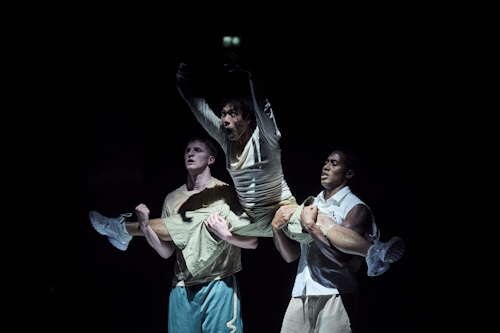
Photo Studio Pramudiya
Contact between the dancers can be volatile. They rush into embraces with enough force to send both bodies falling backwards. They lift, catch, push and strike one another, their partnering often exciting in its speed and precision.
One performer, whose movement has a distinctly balletic quality, repeatedly approaches others for an embrace. At one point, the contact is briefly returned before he is pushed away. Later, he crouches beside another man, who is folded sharply forwards at the waist, his legs straight, hands close to his feet and head turned towards the audience. The crouching dancer wraps his arms around the man’s legs and rests his head against his body. Darkness falls. When the light returns, the folded figure has gone. The other remains in the same position, still embracing the empty space, and begins to cry.
Here, one action leads directly to another. The disappearance changes the image, leaving the remaining dancer holding a position that has lost its physical support.
Such continuity is less apparent elsewhere. Speaking to One Dance UK, Sharpe described how grief changes the relationships between the performers and what we see in each individual. Yet on stage, a dancer may tremble, collapse or cry, then catch his breath and rejoin the dancing in an entirely different emotional register. The transition is immediate, with little discernible trace of what has just occurred. As these shifts recur, I struggle to follow how the performers’ experiences alter their subsequent interactions.
The performers’ footwear also attracts attention. All seven wear trainers, their soles squeaking sharply against the floor. The friction occasionally appears to interfere with the smoothness of turns and changes of direction. Whether this resistance is deliberate remains uncertain, but both the sound and its physical effect are noticeable.
The mother’s telephone messages bring the central difficulty into sharper focus. Her words develop from an ordinary attempt to make contact into mounting anxiety. There is a recognisable progression in what we hear, but I cannot find a corresponding development in the stage action. The identity of the absent son remains uncertain, as does the connection between his mother’s calls and the encounters unfolding before us.
The work has plenty of movement, but little sense of consequence. Its dancers are accomplished, its physical vocabulary extensive, and its visual compositions sometimes striking. Yet the succession of encounters, musical contrasts and changing emotional states gradually obscures any sense of progression. I leave with vivid recollections of individual moments, but little sense of how they have affected one another.
For all its physical energy and technical accomplishment, Hang Time struggles to make its accumulation of incidents feel like a developing experience.