
Opera House, Zürich
October 25, 2026
Cathy Marston, choreographer and director of Zürich Ballet, is one of her generation’s big story tellers. She has turned famous literature into ballets from Charlotte Brontë’s Jane Eyre, to John Steinbeck’s of Mice and Men to Ian McEwan’s Atonement, to mention just a few.
In many of her ballets she also tries to create a new perspective on the characters. In Clara, she let four dancers depict Clara Schumann, maybe to visualize the four roles she had in her life: concert pianist, composer, wife and mother. In The Cellist, about the famous musician Jaqueline du Pré, she lets a dancer take the role of the cello and thus draws the deep love relationship du Prés had with her instrument.
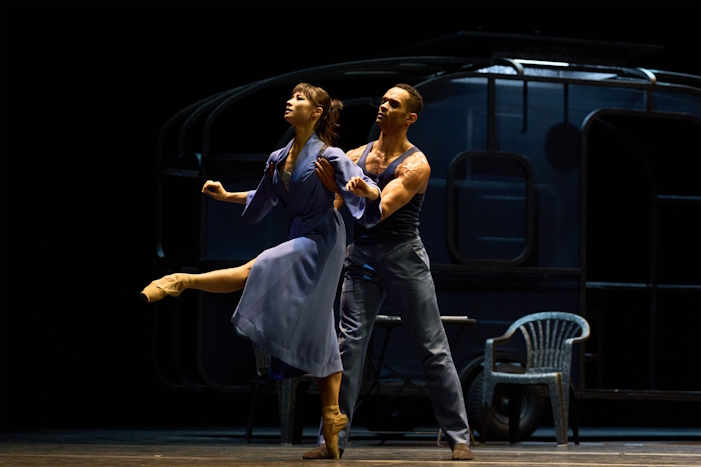
After Hamlet in 2017 and Romeo and Juliet last year, Marston has now again returned to Shakespeare and A Midsummer Night’s Dream, which had its premiere on October 11. She has turned it into a contemporary story taking place in a dilapidated fairground, closed up with barbed wire. The sets by Richard Hudson, who also designed the costumes, are very evocative.
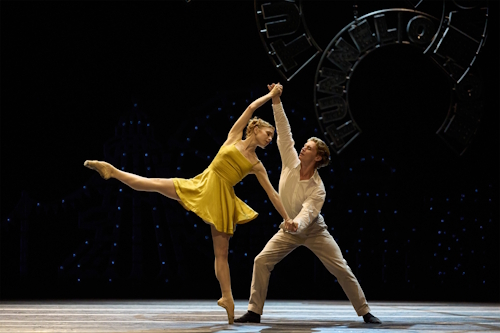
in A Midsummer Night’s Dream by Cathy Marston
Photo Carlos Quezada
Marston’s outlook on the story is contemporary, fun and hits the heart, because it successfully fuses an old tale full of recognisable emotions with elements of today. The movement is partly from the street and partly from classical ballet but not aspiring to the usual perfection. It is all wrapped in music that also mixes old and new, evoking Romantic feelings and the drumming beat of a night in a club.
The characters are reduced to Oberon and Titania the fairground owners. Lysander, Demetrius, Hermia and Helena, young students entering the fairground at night. Puck and his fairground spirits, invisible to the others, and a demolition crew led by a very strict and uptight safety inspector. The latter replaces the workers in Shakespeare’s play preparing a play within the play for the wedding festivities.
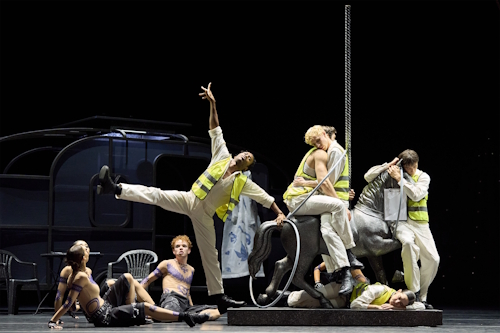
Photo Carlos Quezada
The people of the real world use the classical ballet vocabulary with the women in pointe shoes. But the execution by the young people looks sloppy. A knee is slightly bent in an arabesque and the posture at times is not quite straight. But, I gather, it is intentional, because it makes them look like the kids next door.
Puck, Lucas van Rensburg, moves in a hip-hop-like fashion. He is absolutely amazing rolling, jumping and turning.
The spirits wear boots, knee-length shorts and t-shirts which make it look as if their upper bodies are tattooed. They too move in a contemporary style except once the lovers have been united and Mendelssohn’s wedding march announces the happy ever after. Now, the women wear black tutus and pointe shoes, but their body language has nothing to do with that of the classical ballerina. The are tough and their message is: ‘Do not mess with me’.
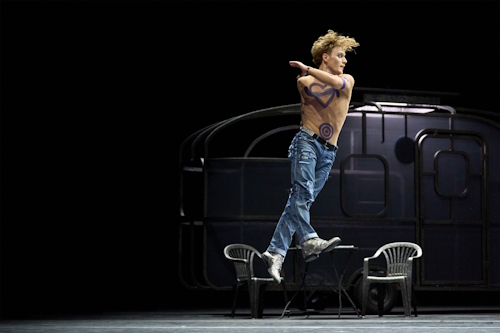
Photo Carlos Quezada
Marston follows Shakespeare’s story. Hermia, an adorable Mia Heathcote, is with Demetrius, Chandler Dadlton, less merry and light-hearted than Lysander, Charles-Louis Yoshiyama, whom she fancies. Troubled Helena, Max Richter, is in love with Demetrius, who finds her annoying and keeps pushing her away. But after Puck has cast his spell on them with an iron rod and the spirits have taken the lovers through the fairground’s love tunnel in rusty dodgem cars, he undoes it, and the correct lovers are reunited.
Oberon, Brandon Lawrence, wants to stay in the dilapidated fairground, but his wife Titania, Daniela Gómez Pérez, announces her plan to leave by arriving on stage with her suitcase packed. To help Oberon, Puck casts his spell on her. Unfortunately, she wakes up and falls in love with Zettel, the safety inspector, danced by Yun-Su Park, and to whom Puck has given a horse’s head. The two women engage in a very erotic duet. Eventually Puck undoes the spell, and Titania is united with Oberon, who then decides to leave with her.
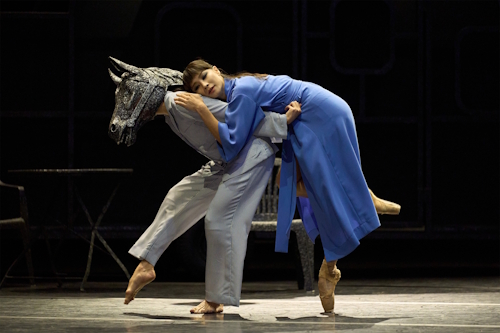
in Cathy Marston’s A Midsummer Night’s Dream
Photo Carlos Quezada
As everybody has gone, only the demolition crew and Zettel are left. After the workers also depart, leaving Zettel alone, she has an epiphany and discovers the magic in life, which makes her able to see Puck. Whether they have a future together is left in the air.
Marston’s A Midsummer Night’s Dream ends with the sound of a turntable stylus stuck in the last groove of a vinyl disc. Marston commissioned the music from Gabriel Prokofiev, who mixes his own compositions, new and old, with pieces by Felix Mendelssohn Bartholdy. While the Mendelssohn is played by the Orchestra der Oper Zürich, for his own he uses a turntable as an instrument, played and DJ’d by Mr. Switch, who stands in a spotlight in front of the stage during the performance. The mix is incredible; it evokes then and now and every emotion lived out on stage.