Linbury Theatre, Royal Ballet & Opera, London
September 29, 2026
Northern Ballet’s Three Short Ballets turned out to be rather more than three. The opening night was a gala dedicated to Mrs Aud Jebsen, whose long-standing support has benefited both Northern Ballet and The Royal Ballet. Dancers from the two companies came together for an extended programme, adding three pas de deux to the advertised triple bill.
After the first work, Northern Ballet Artistic Director Federico Bonelli and Royal Ballet Director Kevin O’Hare appeared on stage to explain the arrangement. Bonelli reassured the audience that the two artistic directors were not about to dance a pas de deux themselves. A pity. I suspect there would have been no complaints.
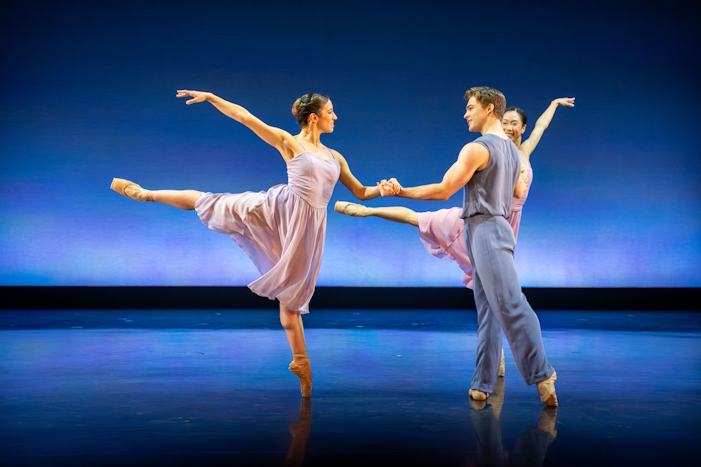
Tiler Peck’s Grandes Études, set to Liszt’s Grandes Études de Paganini and played live by Rose McLachlan, is at its most engaging when responding directly to the music. Turns catch rapid passages, poses shift with accents, and a quick fluttering movement of the women’s hands returns like a small visual motif. Peck has a light, slightly sweet sense of humour, and her musical ear is clear throughout.
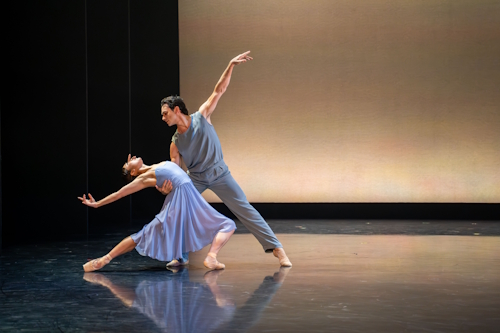
Photo Colleen Mair
‘La Campanella’ stood out. McLachlan played it with an unexpectedly gentle, fluid quality, and Peck responded in kind, letting the dancing flow as though the music were running water.
The work left a lighter overall impression than some of its individual moments suggested. Its strongest ideas remain closely tied to the musical phrase in front of us, while the larger shape feels less developed. Peck has just been appointed New York City Ballet’s first Choreographic Associate, with further commissions planned over the next three seasons. Her musical intelligence and choreographic personality are already evident, and there is plenty of room to see where that develops.
Hans van Manen’s 5 Tangos was the most enjoyable work of the evening. The opening ensemble takes a little time to gather heat. Then ‘Vayamos al Diablo’ arrives, and with it a male solo that suddenly sets the piece alight. The dancer spins with remarkable speed and precision, his sharply angled tango poses snapping into place.
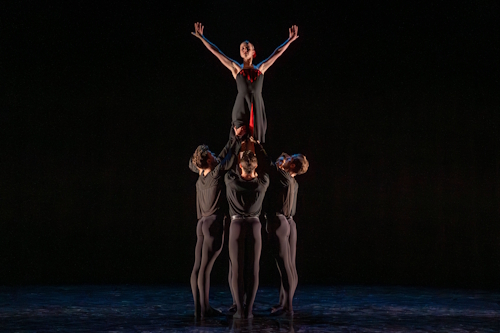
Photo Colleen Mair
My favourite section came in a duet between George Liang and Jackson Dwyer. They watch one another closely, moving together and apart with an ease that makes the exchange feel almost conversational. When their partners enter, the focus shifts, but not completely. Even in the ensemble that follows, Liang and Dwyer continue to catch each other’s eye across the stage.
Van Manen often gives the audience just enough to start inventing the relationship for themselves. A glance, a pause or a slight change of focus can suggest intimacy, rivalry or attraction without settling the matter. That ambiguity is part of the pleasure of 5 Tangos, whose tango character comes from timing, tension and the way the dancers remain alert to one another.
The principal couple, Dominique Larose and Jonathan Hanks, bring another dynamic. Larose has a wonderfully self-possessed, almost sassy presence, while Hanks responds to her without overwhelming the exchange. Up close, those exchanges become unusually vivid. A look can register as strongly as a turn.
Mthuthuzeli November’s Fools works on a much larger dramatic scale. Based on R. L. Peteni’s Hill of Fools, it tells a familiar story of lovers caught between hostile communities, with clear echoes of Romeo and Juliet. November gives that conventional framework life through a physical vocabulary of his own.
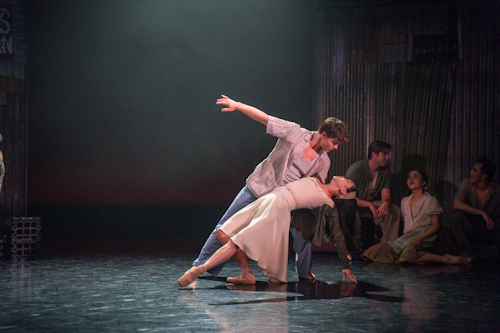
Photo Colleen Mair
During the clashes between the two communities, dancers repeatedly jump and drive into the floor as the energy builds. African-derived movement sits naturally within the choreography, while relentless jumping, accumulating rhythm, communal energy and sheer physical expenditure have become recognisable features of November’s choreographic language. In Fools, that energy is split between two opposing communities, the stage repeatedly divided and invaded as each group pushes into the other’s space.
Sound helps build that world too. Spoken English narration introduces the story, followed later by prayer-like vocal passages and more forceful singing around the scenes of conflict. A final song shifts the atmosphere towards grief.
Harris Beattie and Sarah Chun make the central relationship convincing. Their duet has warmth, playfulness and familiarity, with the ease of two people who genuinely know one another. Repeated attention to Chun’s abdomen gradually suggests pregnancy, adding another layer to the future being threatened around them. Antoni Cañellas Artigues also makes a strong dramatic impression as the Hlubi male lead, bringing real force to the conflict.
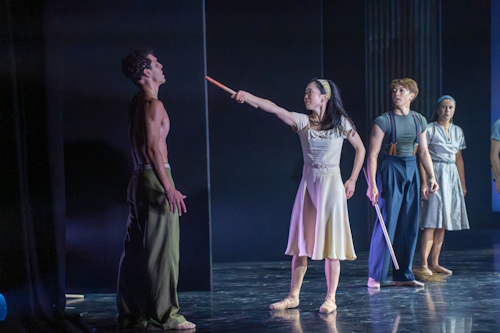
Photo Colleen Mair
The ensemble is far from anonymous. Individual dancers repeatedly catch the eye through anger, protectiveness and sharply defined reactions, giving the two communities personalities of their own. November is particularly good at keeping narrative inside movement. The story remains easy to follow without the dancing having to stop and explain itself. That directness makes Fools immediately enjoyable: it has rhythm, drama and a great deal of dancing.
The gala additions were best enjoyed as a playful meeting of the two companies, with dancers sharing repertoire and adapting to unfamiliar partners. The Royal Ballet principals brought obvious polish, while Reece Clarke was especially hard to ignore in Ashton’s Cinderella, tall, elegant and thoroughly princely. A little shameless admiration seems allowable at a gala. After the three pas de deux, Mrs Aud Jebsen was invited to stand and receive the audience’s applause, a neat reminder that evenings like this are made possible by people willing to fund them.
What stayed with me most was the range Northern Ballet’s dancers were asked to inhabit over the evening. They moved from Peck’s musical intricacy to van Manen’s cool precision and November’s high-energy theatricality without losing their own presence. Even within the ensemble, individual personalities kept surfacing. 5 Tangos may have been my favourite work, but the evening belonged just as much to a company capable of making three very different choreographic worlds feel fully lived.