
The Place, London
November 14, 2026
In 1980, Mitsuyo Uesugi performed alongside Japanese butoh pioneer Kazuo Ohno at The Place. Forty-six years later, she returns with four fellow artists for Mother Forest, bringing together three generations of butoh practitioners in a tribute to Ohno.
Butoh emerged in Japan in the late 1950s, pioneered by Tatsumi Hijikata and Ohno. Often associated with white-painted bodies, distorted postures and extremely slow movements, it challenges conventional notions of dance and physical beauty. Rather than following an established movement vocabulary, butoh explores the body through imagination, sensation and transformation. This can make it rather difficult to understand. This evening at The Place, several audience members left not long after the performance started. I don’t blame them.
Mother Forest begins with the house and stage lights still on. Uesugi, wrapped in a black hooded coat, slowly enters and kneels at centre stage while the audience continues chatting. Two similarly dressed performers appear at the front, silently staring at the audience. A light, almost folk-like tune begins to play, and conversations gradually subside. Then comes a prolonged blackout. As my eyes adjust, I can just make out the two turning towards Uesugi. The lights return, two more performers enter, and all five wander slowly around the stage in silence. They form a circle, holding hands and drawing closer until one suddenly drops to his knees and falls forwards with a startling slap against the floor. Only then does a harsh, noisy soundtrack begin.
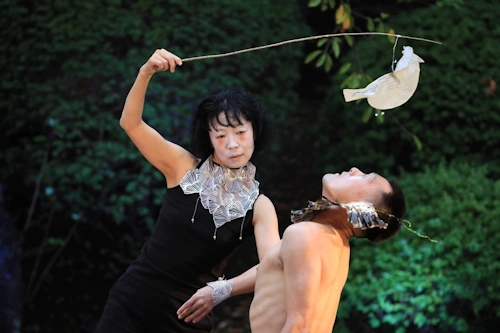
Photo Sho Sugano
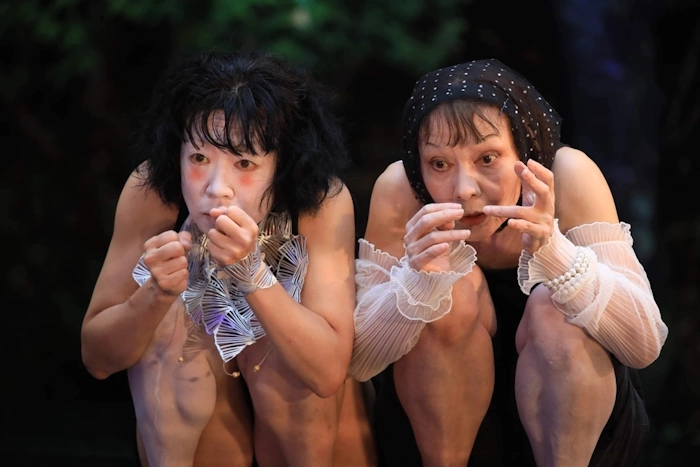
As the black coats come off, five extraordinary figures emerge, looking as though they have wandered straight out of a Japanese ghost story. Makiko Takamatsu, dressed in flesh-coloured underwear, spends much of the performance crawling along the floor. Neiro has a bright red Mohican resembling a cockerel’s comb, a white-painted body and a flesh-coloured dance thong, with a tuft of white hair covering his pubic area. At one point, he stands with his back to the audience, legs apart and knees bent, folding forwards until his head and hands extend beyond his legs, leaving his backside prominently on display.
Seiji Tanaka, slender and long-haired, wears black briefs. His white-painted face, with its faint, enigmatic smile, reminds me of the Deigan (泥眼) mask from traditional Japanese Noh theatre, associated with female spirits and supernatural beings. With his arms and legs frequently bent into odd shapes, he looks particularly ghostly. The most active of the five, he roams the stage, stares at spectators and rides a unicycle around the performance space.
Uesugi folds the discarded black coats and places them beside the back wall, where she spends considerable time watching the others. Later, she places a large branch on Tanaka’s head. He takes one end into his mouth, slowly lies down and remains there for an extraordinarily long time, the branch protruding from his mouth. I think I even hear him retching. Eventually, he hands it to a spectator.
Mutsumi ties the sleeves of the discarded coats together, and she and Uesugi pull the chain of clothing taut between them. Tanaka retrieves a flesh-coloured slip dress from a metal bucket, puts it on and lets down his hair. Neiro reappears in a dark grey jacket. The two dance facing each other, chase one another, then begin grabbing, pulling and shaking each other before ending up tightly embracing and panting. It looks rather like rough lovemaking, although I find the whole thing more comical than erotic.
Mutsumi herself is particularly captivating. Initially resembling a shop-window mannequin in her doll-like white dress, she later appears bare-chested, moving across the floor in strange, animal-like shapes. Her movement has a distinctly balletic quality. Even in these distorted positions, she moves with extraordinary grace. She is a beautiful, peculiar creature I cannot stop watching.
For all its bizarre and entertaining moments, however, the evening feels loosely assembled. The activities follow one another with little apparent connection or development. The performers interact frequently, sometimes quite vigorously, but their encounters rarely convey much emotional force to me. Certain images linger in the mind, yet I struggle to see how they come together as a whole.
The performance ends with all five gathering on the floor, pressing and piling their bodies together before the lights go out.
I spend much of the hour wondering what on earth they are doing, but I am also thoroughly entertained. Everything seems so absurd and at times so wonderfully ridiculous that I keep finding myself laughing, or trying not to. I hear little laughter from the rest of the audience, which makes me wonder whether I am missing something. The performers seem to take it all with absolute seriousness. Perhaps that is part of the fun.
I had hoped the post-show talk might offer some insight into the artists’ thinking, but the 60 available places had already been taken when I tried to enter. A disappointing conclusion to an evening that had raised so many questions.
Mother Forest is certainly a lot of things, if not everything. What exactly those things are, I am still not entirely sure.