
PARC and Teatro del Maggio Musicale, Florence
September 23-27, 2026
Since its founding in 1984, Fabbrica Europa has become a festival noted for presenting new artistic languages in dance. This year’s month-long event, shaped as always by artistic director, Maurizia Settembri and her team, runs from mid-September to mid-October. It’s programme certainly lives up to its aims. During a few days in the city, I had the pleasure of seeing several excellent performances.
On September 23, PARC (Performing Arts Research Centre) was the venue for Hito (Japanese for ‘person’), choreographed and performed by two young women, Flavia Dule and Beatrice Guastalla. The piece considers the human dynamics of closeness and distance, attachment and disconnection, affection and repulsion, power and surrender, attraction and playfulness through an organic physical dialogue.
The two performers explore support and falling, moving between forceful and delicate interaction. Heavy yet precisely executed lifts, suspended twists, and pushes and pulls create a momentum that holds the audience’s attention from beginning to end. The choreographic phrases enter into a smooth and progressive dramaturgical dialogue, enveloped by a carefully selected soundtrack that integrates the different elements of the work.
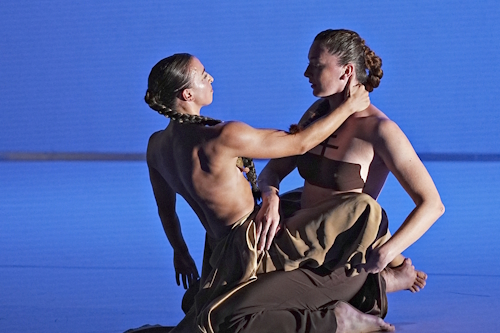
Photo Monia Pavoni
At the beginning, Guastalla neatly folds small origami penguins onstage. These could be seen as symbols of adaptability, community, and emotional strength. Penguins often remind us of resilience and the importance of nurturing relationships: they thrive in harsh conditions while maintaining strong social bonds.
Considering the current socio-political, ecological, and geopolitical climate, I could not help thinking about the catastrophic disconnection between individuals’ personal actions and choices, and their damaging consequences for the flora and fauna of our planet. Looking at the origami penguins against the bright, pristine white stage, I was reminded of the struggle faced by this endangered species as it copes with melting glaciers, an ecological crisis inevitably affected by the way we, as human beings, act and relate to the world around us.
The following day, also at PARC, I was positively surprised by Figliasanta, a beautiful dance-theatre work by Sergio Beercock and Ludovica M. Poerio. It was inspired by the figure of the ‘figlio santo’ (saintly son), and the informal practice that was widespread in Southern Italy in the nineteenth and twentieth centuries in which a child was entrusted to and raised by another family.
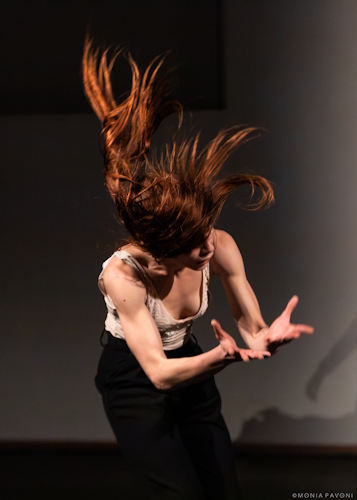
Photo Monia Pavoni
From this image, the performance develops a broader and deeply embodied reflection. Its emotional and psychological landscape is shaped by the need to establish boundaries, express desires, dare to act, belong to a place or a relationship, and still remain free to explore without being held back.
The powerful work unfolds through poignant movements, explicit expressions, and moving voices and sounds. An internal, fiery dialogue takes place within Poerio’s body, the daughter’s body. Anger, restlessness, and the desire to break away are deeply intertwined with a symbiotic love and an all-encompassing connection to the mother.
The vivid images she creates are both clear and pervasive. Beercock’s enchanting voice is equally bewitching. Figliasanta superbly explores the layered memories and nuanced emotions within the mother–daughter relationship, while undergoing a catharsis of its own.
Still at PARC, on September 25, Carusæ | sine Sole sileo, by Pierandrea Rosato, co-created with and performed by the astonishing twenty-two-year-old dancer Gabriele Scarcia, proved another remarkable work. The solo engages with the dance of tarantism in its status moriendi, its state of dying.
Rosato, with whom I had the pleasure of speaking after the performance, told me that the piece was inspired by Ernesto De Martino’s The Land of Remorse and their investigation into the dissolution and disappearance of this complex ritual.
Beginning with an ancestral knowledge rooted in the Salento origins of both Rosato and Scarcia, the artists explore the death of the tarantismo rite in dialogue with Byung-Chul Han’s The Disappearance of Rituals.
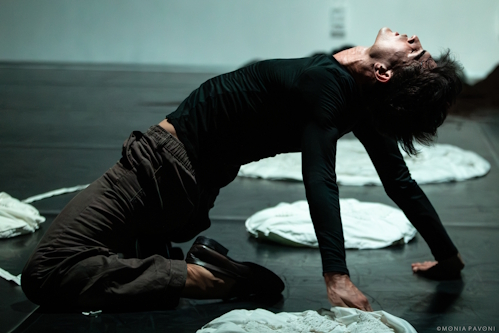
Photo Monia Pavoni
The performance is magnificently interpreted and powerfully danced by Scarcia. With mesmerising stage presence and impressive technical precision, he masterfully embodied resistance, conflict, trance, suspension, surrender, intuition, momentum, rapture, resilience, and melancholy.
In Carusæ | sine Sole sileo, the young male body becomes a symbol of porosity: an intuitive being not yet framed or tamed, capable of resonating with the historical, cultural, political, and emotional memories that surrounds it and persists in their haunting essence. Masculinity here displaces a phenomenon traditionally associated with the female body, reversing the tradition while honouring it at the same time.
Scarcia’s cries, wails and laments are piercingly poignant, resonating within the viewer like ripples on water stirred by the wind. The only music heard offstage is ‘Poveri fiori’ by Francesco Cilea, sung by Montserrat Caballé. Her intense voice conveys a profound sense of loss that intertwines powerfully with the ritual’s dying nature.
Rosato’s training at the Folkwang University, and the influence of Pina Bausch’s lineage, are beautifully visible in the choreographic and aesthetic qualities of this young yet mature work.
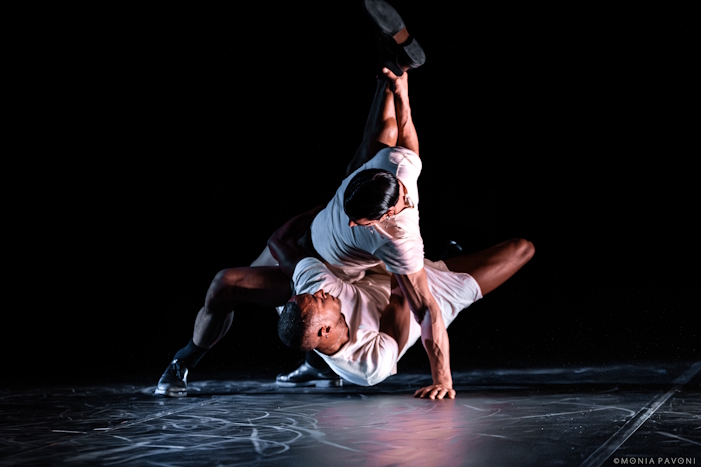
Finally to Saturday, September 26 at Teatro del Maggio Musicale and Strike Two, the latest choreographic work by Philippe Kratz, performed by the magnificent and impeccable Donnie Duncan and Alberto Terribile.
The synopsis suggests that the piece emerged from an engagement with Dmitri Shostakovich’s Piano Trio No.2, composed in 1944 after the death of his closest friend, the musicologist Ivan Sollertinsky. Rooted in the tradition of the Trio élégiaque, the work unfolds between personal grief and collective memory, between memory and remembrance.
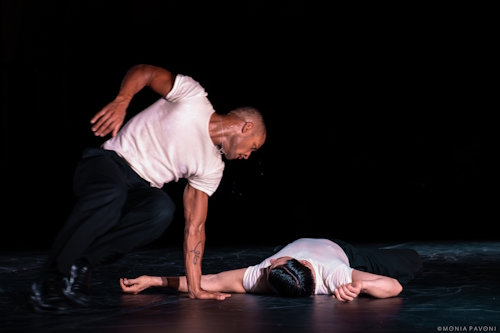
Photo Monia Pavoni
What I saw was a work that inhabits tension through a physical dialogue between dependence and support on one hand, and contrast and discord on the other. The two bodies onstage create a magnificent duet charged with masculinity, dominance, and force, but also with camaraderie, tenderness, and playfulness.
The sense of rivalry is counterbalanced by an unmistakable need for closeness and interdependence. Highly energetic, intersecting phrases are characterised by the splendid virtuosity of Duncan and Terribile, whose dancing seems to express a latent struggle, as though it were present but suppressed.
There is something sensual and mysterious in the way the two dancers look at and play with one another: perhaps an unexpressed love, perhaps a forbidden one. The work’s complex physicality is built from an eclectic range of intricate interactions and fresh contemporary pas de deux, revealing the dancers’ remarkable bravura.
Moments of surrender shift from one body to the other, while masculine force repeatedly resurfaces, fuelling a concealed conflict that seems to have no resolution. The two figures could be comrades, friends, lovers, or rivals; or perhaps all of these at once. They might also be understood as two personalities within a single being, with internal friction giving rise to opposing forces struggling to find harmony and peace.
Driven by Shostakovich’s music, performed by violinist Ruben Have, pianist Viviana Di Rita, and cellist Rebecca Rotondi, Strike Two creates a state of suspension, questioning, and uncertainty; an atmosphere that aptly reflects the zeitgeist in which we live.