
Barbican Theatre, London
November 13, 2026
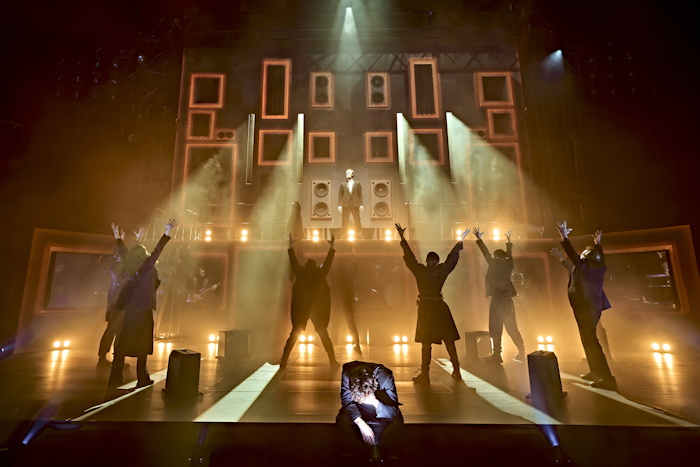
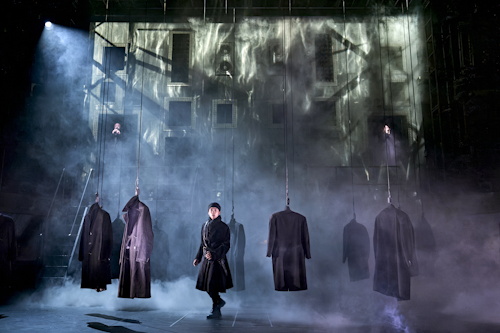
Empty black garments dangle from long cables, suspended in thick haze. Behind them looms an industrial structure of steel walkways, railings and doorways, overlooking a row of glass-fronted rooms where musicians sit among guitars, bass, drums, keyboards and mixing equipment. Elsinore has become part factory, part recording studio. Cold beams slice through the smoke, catching the hanging clothes in an eerie half-light. It is an unsettling sight, and the rock concert has barely begun.
Shakespeare’s Hamlet collides with Radiohead’s Hail to the Thief in this production adapted and directed by Christine Jones and Steven Hoggett. Thom Yorke has pulled apart the band’s 2003 album and reassembled it for the stage, giving the tragedy a restless, sometimes ferocious pulse. Jess Williams’s choreography threads through the action, finding a physical language for the conflicts beneath Shakespeare’s words. The play has been pared down to approximately 100 minutes, yet its theatrical world feels anything but diminished.
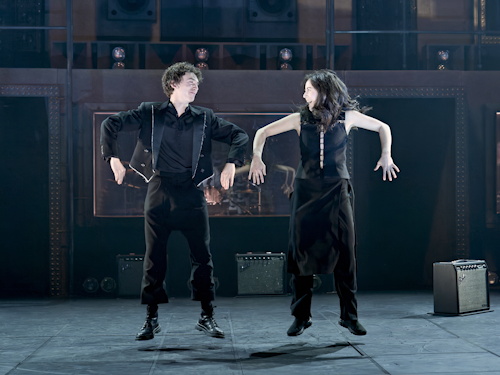
Photo Manuel Harlan
Music surges out of the glass rooms, then retreats into fragments, uneasy rhythms and passages of almost cinematic suspense. The live band shifts effortlessly between pounding bass and electric surges that make the theatre throb, and quieter passages that leave room for the spoken text. The actors’ musical talents are put to equally good use. Samuel Blenkin sings as Hamlet, lending his troubled thoughts a different urgency. Ami Tredrea’s Ophelia pours her grief into ‘Sail to the Moon’ as death approaches, while Merryl Ansah’s gravedigger lends ‘Scatterbrain’ a tenderness that lingers uneasily amid the business of burial.
Above the musicians, figures emerge through elevated doorways, solemn as saints in church niches. Hamlet appears against blazing shafts of backlight, their edges caught in the haze. Jessica Hung Han Yun’s lighting swings from the pulse of a rock concert to the stillness of religious imagery, while Will Duke’s projections summon the ghost of Hamlet’s father onto the rear wall. Later, as Hamlet rages at Gertrude (Claudia Harrison), shadows of windows and railings revolve across the background until the architecture itself seems to reel around him.
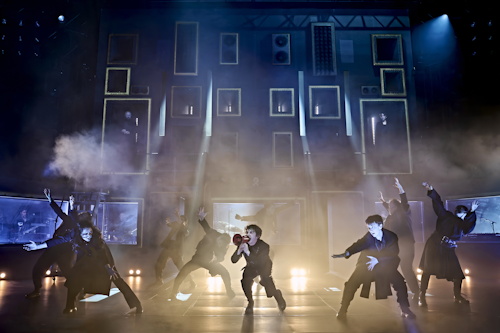
and Alby Baldwin (Horatio) in Hamlet Hail to the Thief
Photo Manuel Harlan
Blenkin’s Hamlet is mercurial, capable of switching from frantic agitation to an almost disconcerting calm. He scratches his back, touches his neck and shifts restlessly, with the distracted compulsiveness of someone unable to settle in his own skin. Yet watch him with Polonius (Nicolas Tennant). Asked what he is reading, he lets “Words, words, words” fall out with weary indifference. His shoulders droop, his gaze wanders, a smile hovers without quite arriving. Then something catches. His eyes focus, his speech gathers speed and the words tumble out with startling precision. Just as suddenly, he drifts away again. The intelligence is unmistakable; so is the exhaustion. It is hard not to feel for him.
Williams’s choreography gives the actors another means of speaking. Hamlet and Ophelia’s early duet has the loose rhythm of club dancing, their flirtation growing increasingly intimate until they lie entwined on the floor. Yet there is something oddly forlorn about their closeness, as though two lonely young people were seeking refuge in each other’s bodies.
Tredrea finds less variety in Ophelia’s subsequent distress, returning to a furrowed expression, rigid posture and the same upward gestures of her bent arms. The emotional shifts that emerge so vividly in her singing are harder to distinguish in her movement.
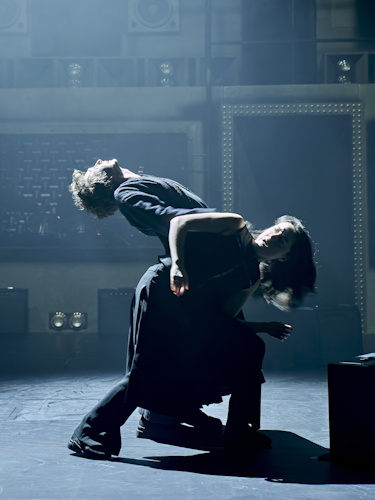
in Hamlet Hail to the Thief
Photo Manuel Harlan
As Hamlet confronts Rosencrantz and Guildenstern, the three repeatedly lose their balance towards one another, leaning into near-collisions that never quite become contact. Their fragile friendship seems ready to topple.
Claudius (Paul Hilton) suffers a more elaborate physical unravelling during his confession. Stripped of his jacket, he parades in a white gown like a Hollywood diva, then struggles in a black robe as dancers prevent his escape from a square of light. Reduced to shivering vulnerability, he grasps at clothes kept tantalisingly beyond reach, repeatedly examining the right hand that Shakespeare imagines thick with his brother’s blood. He wants forgiveness, yet cannot surrender “my crown, mine own ambition, and my queen”. Above him, Hamlet watches in eerie stillness. When he finally speaks, radiant shafts of light surround him with an almost sacred glow, while he contemplates how best to damn another’s soul.
The ensemble occasionally acts as a shifting backdrop, adding atmosphere or glimpses of events beyond the central action. With several levels of activity competing for attention, however, some of these peripheral movements lose their impact.
In the final duel, all that tension erupts into violence. Hamlet and Laertes (Brandon Grace) grapple, shove and lift one another, their bodies locked in a furious contest shaped by fight director Kev McCurdy. Suddenly, the struggle slips into slow motion. A shaft of light catches Claudius preparing the poisoned drink. Below him, the fighters remain suspended in their violence, unaware of the treachery unfolding above. Then the pace explodes. Gertrude takes the cup, poison is spat into Laertes’ face, bodies collide and stumble, and the deaths tumble over one another in a rush of music and movement. Every desperate attempt to seize control only hastens the catastrophe.
at London’s Barbican Theatre
Photo Manuel Harlan
Hamlet has spoken of a special providence in the fall of a sparrow. “The readiness is all.” Yet there is little comfort in watching him reach that readiness. Blenkin has allowed us to glimpse the young man beneath the anger, his wit and intelligence repeatedly breaking through the confusion, only to be swallowed by it again. Now, with all his struggles exhausted, even those fleeting moments of clarity are gone.
Horatio (Alby Baldwin) remains among the dead, speaking of the bodies placed upon a stage for all to see and calling for music to accompany Hamlet’s passing. Behind them, a cascade of gold gives way to dark, upward-streaming forms. The black garments that hung above the stage at the beginning descend once more. They hover briefly before suddenly being released.
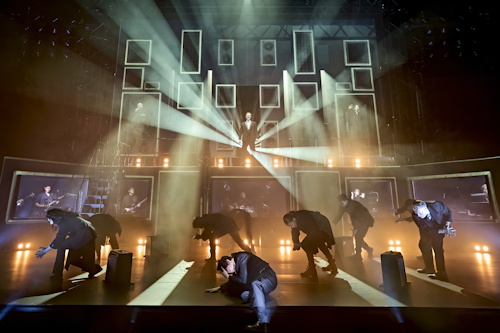
Photo Manuel Harlan
The clothes fall. Nothing remains of their former occupants. After an evening in which bodies have loved, fought and struggled desperately for control, the emptiness they leave behind is almost unbearable. I had not expected to feel such sorrow for Hamlet, yet by the end I was close to tears.
Hamlet Hail to the Thief is at the Barbican Theatre, London to January 27, 2027.