The Coronet Theatre, London
November 6, 2026
In 2020, Miřenka Čechová published Ballerinas (Baletky), the diary of a young student dancer at a top conservatory chasing her ballet dream. Part memoir, part coming to terms with her own experiences at the Dance Conservatory of the City of Prague in the 1990s, it’s a raw, sometimes brutal portrayal of life in a top school. The Covid pandemic then saw a second incarnation, metaBALLERINAS (metaBALETKY), a performative, interactive livestream, film, video chat hybrid.
Produced by Spitfire Company, which Čechová co-founded, this multidisciplinary third version of Ballerinas blends text, dance, physical theatre and video in what is an absorbing, affecting piece of theatre. It’s an hour that is more thoughtful and reflective than angry, and ends with a treatise on how the art and ballet training should go forward. How to put the human first and the dancer second, without sacrificing the art.
While Ballerinas is about ballet and ballet training, Čechová places her story in the wider context of a time when Prague was still discovering its freedom from communist control. There was clearly a bit of a rebel in her, even in her teenage years. We hear and see how she found refuge and some freedom in the dance club scene, how she frequented those bars not averse to serving underage girls.
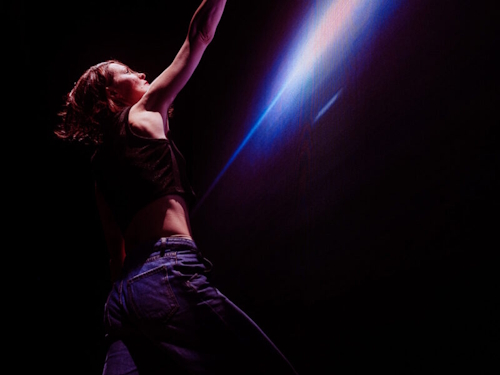
Photo Jan Hromádko
Čechová has a lot to say, and does so very eloquently. Ballerinas is not fully polished, not slick, but it is compelling. And that it is a little rough around the edges here and there just adds to the appeal.
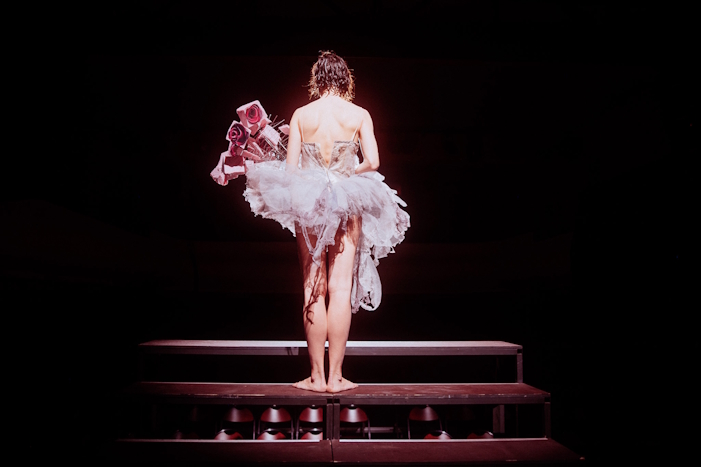
She starts with the child’s ideal of a ballerina: pretty dresses, pretty shoes, a rose after the performance. It is the romantic vision of many young girls. Standing on a stage, being Odette, in love with and dancing with a handsome prince. As she sheds her yellow dress, life is very different, she tells us.
Čechová’s school largely followed the Russian approach to teaching. Her depiction of the training is full of critical comments from teachers, which she delivers via a megaphone, emphasising just how loud and powerful their words were. “You’re a body. Nothing but a body,” is a phrase she recalls.
Most challenging were the very strict rules on appearance including physical proportions and weight, it seems. We hear how students were regularly weighed, how they made themselves sick to lose weight by sticking a finger down the throat. “You wash your hands afterwards, but you don’t wash away regrets.” Appearance is all. “Better night-time cramps than morning remorse.” All to be ‘someone’.
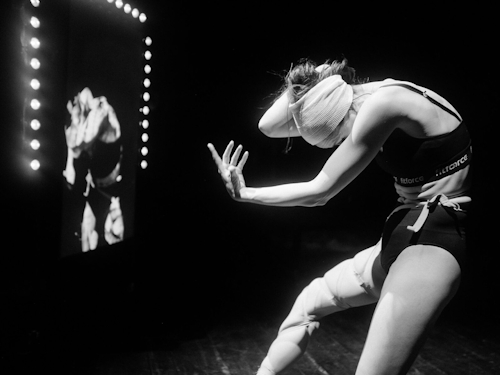
Photo Jan Hromádko
Despite all that, there’s still a determination to make it. To succeed. To be seen. To emphasise young dancers’ desire for attention, she unexpectedly appears completely naked. The odds are heavily stacked against making it but, as Čechová says, you always believe it will end well. All so that people can bear to look at you one day. But for most, it doesn’t.
Used well, humour can be wickedly powerful and, at times, Ballerinas is darkly comic, not least when Čechová demonstrates her own variations of what are usually heartbreaking choreographic deaths as she makes the point that the heroine is so often a victim. Giselle, Odette, and funniest of all, Juliet, all get the treatment. “And Coppelia? She was never even alive!”
There is plenty of bold imagery, almost all of which hits home. Overlong pointe shoe ribbons that tie all the way up her legs make the point very effectively how the art form traps people. We also later see her in a box of transparent plastic that she finally fights her way out of. Most dramatically, Čechová takes a saw in hand, and carves and hacks away at fake body parts.
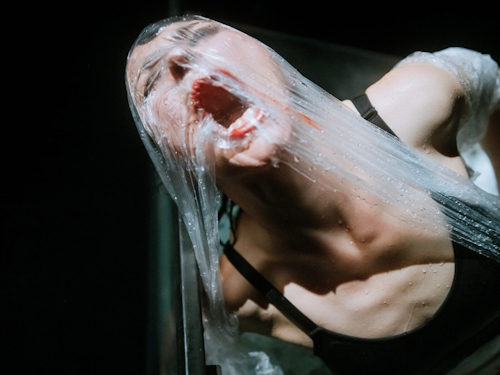
Photo Jan Hromádko
The contrast between moments of out and out classicism, Čechová can certainly still dance, and grotesque physical theatre is striking.
And yet, there’s another side that almost all dancers will recognise. “Of course it’s hard work. But I couldn’t live without it.”
Čechová is also honest about ballet being a very specific discipline that, at the very top level, like most sports, requires a certain physical and mental disposition. It does require a particular mindset and a lot of individual discipline. The problems are all rooted in how that is encouraged.
While the world has assuredly moved on, and attitudes and approaches to teaching have changed, the ‘old ways’ can still be found. It’s not that long ago that I saw a huge wall chart in a pre-vocational dance school overseas showing the individual weight of each dancer in a class. On show. For all to see. I can also recall witnessing a class of ten-year-olds from a different school being yelled at as they were drilled like army recruits. It works. If you want automatons. If you want young people scared to put even a finger out of place. But I dread to think what it does to their minds.
Photo Jan Hromádko
As Ballerinas ends, it’s impossible not to be struck by just how daring it is; just how effectively Čechová translates personal experience into inventive, powerful theatre that is also remarkably intimate. But for all its darkness, Ballerinas doesn’t come across as is not an enraged story of “my ballet hell.” I couldn’t help thinking there was more than an ounce of sorrow. Because it doesn’t have to be like that.
When she graduated from the conservatory, the disillusioned Čechová decided not to dance any more. But slowly, while studying at university, she found dance once more. The freedoms she found in physical theatre enabled her to find and develop her own creative voice. And despite all that happened, her love for the art form shines through.
But, while the ballet schools of today are assuredly a better place, the issues have not gone away fully. It is important to continue to air them in public, and I suspect theatre, this sort of theatre, might be a rather more powerful way of raising consciousness and prompting change than any number of academic and professional conferences.