The Place, London
November 10, 2026
Jo Bannon’s The Dirty Work is undoubtedly different, and her ability to hold the stage with such minimal physical activity is, in itself, noteworthy. But while there are occasions when a performance leaves one challenged, intrigued, perhaps even unsettled, there are others when, despite every effort to engage with what is unfolding, one is left wondering quite what one has been watching, and why. Sadly, The Dirty Work falls firmly into the latter category.
Bannon is a visually impaired artist whose work explores perception, identity and the experience of navigating a predominantly sighted world. The Dirty Work forms part of Blind Magic, a triptych that also includes the film Passing and an installation, Sleight of Hand.
The programme describes the piece as blending magic with the lived experience of visual impairment, using delicate choreography and a magician’s patter to reveal the invisible labour through which we negotiate the world. It is an intriguing premise, but one that, for me, remained largely unrealised.
For around seventy minutes, Bannon occupies the stage, talking, gesturing and inviting us to imagine objects and situations that are not physically present. There is no doubting her stage presence. She commands attention and delivers her text with assurance, but presence alone cannot sustain a performance indefinitely, particularly when so little develops beyond it.
The movement consists principally of repeated hand gestures, ostensibly conjuring objects into existence through the audience’s imagination. A skilled mime artist can establish the size, weight, shape and even texture of an invisible object so convincingly that we almost believe we can see it. Yet here, e gestures seemed neither sufficiently defined nor consistent to create that illusion; little of the precision or physical articulation that gives mime its extraordinary power.
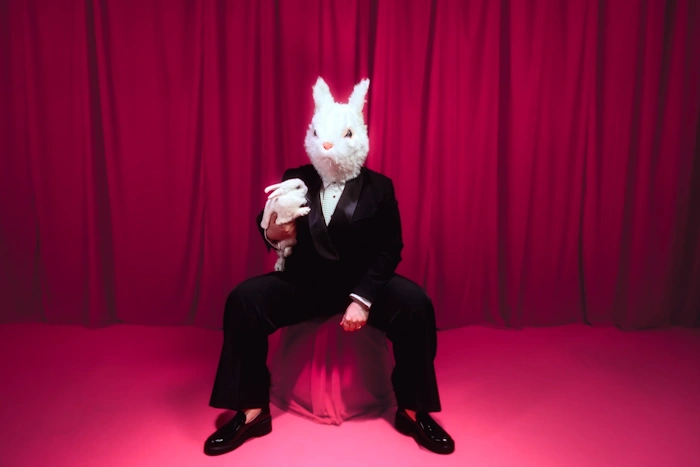
At one point Bannon appears to hold an imaginary rabbit, yet its dimensions seem to change from moment to moment, removing any convincing sense of its weight, physical presence or relationship to her hands. Rather than seeing the invisible, I found myself simply being told what I was supposed to see.
The magic is equally unconvincing. A knot shaken from a scarf and the familiar trick of linking and unlinking metal rings offers little sense of wonder. Perhaps their very simplicity is intentional, but whatever deeper significance they are intended to carry remained elusive.
A brief excursion into an imagined grand ballroom introduces a fleeting suggestion of dance. But given the emphasis on choreography in the synopsis, the almost complete absence of meaningful movement is particularly disappointing.
An additional layer is provided by a disembodied female voice, repeating or anticipating much of Bannon’s spoken text and actions. Integrated audio description formed part of the production’s design, but the relationship between this voice and the performer became increasingly puzzling. The repetition often seemed to impede the work’s progress.
Katherina Radeva’s set offers a predominantly pink environment, with a curtain, steps and a water tank into which Bannon plunges her hands at the beginning. Chris Copland’s lighting provides occasional shifts in atmosphere, notably during the ballroom sequence, but neither design element particularly helps establish a clearer theatrical narrative. Even a lengthy pause, during which Bannon disappears behind the curtain, removes her shoes and apparently enjoys a drink, seems to interrupt, rather than enrich, the proceedings.
Of course, experimental performance need not offer conventional narrative, recognisable dance or even easily decipherable meaning. Nor must every illusion succeed in a literal sense. But there must surely be something that draws an audience into the artist’s imaginative world, something that allows an idea to transcend its explanation and become an experience. I struggled to find that connection.
Bannon clearly has something important to communicate about visibility, perception and the often-unacknowledged experience of visual impairment. These are subjects rich in theatrical possibility. Perhaps there is a deliberate irony in asking a sighted audience to imagine what it could not see. Perhaps the uncertainty itself is part of the point. But somewhere, somehow, the performance needs to offer something to transform that uncertainty into understanding.
The Dirty Work raises many questions, but offered remarkably few reasons to care about their answers. I left feeling not so much challenged as excluded from whatever imaginative journey Bannon had intended us to share.