
The Place, London
October 23, 2026
This proved a long and unsettling evening. Storm Austen had disrupted train services, while fierce winds had people struggling through the streets, looking thoroughly windswept and bedraggled. The two works presented by Scottish Dance Theatre did little to make things more comfortable.
Founded in Dundee in 1986 as a grassroots community company, Scottish Dance Theatre has grown into Scotland’s flagship contemporary dance company. Its 40th anniversary season brings together works by two international choreographers, Édouard Hue and Emilie Leriche.
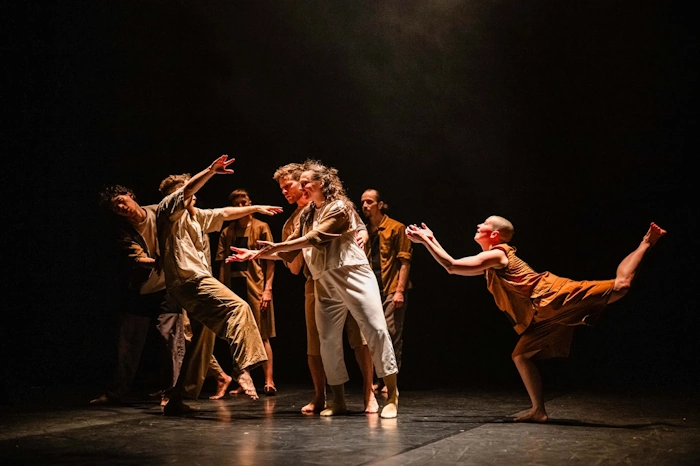
Hue’s The Game of Life begins with a dancer alone at centre stage. A woman enters, flicks her arms in time with the ticking soundtrack, and leaves when he does not respond. Gradually, movement catches on: one dancer copies another, then more join in. The six dancers form pairs and trios, break away and regroup, their movements marked by mechanical rhythms and repeated patterns.
Then, the music changes, introducing singing and birdsong. Two new dancers enter, bringing a more fluid movement quality that contrasts with the mechanical precision of the opening. The original six watch from slightly behind and to the side of the newcomers, before some begin to join in. Gradually, however, the newcomers adopt the familiar rhythmic patterns. Eventually, even a phrase repeatedly performed earlier in the work returns, this time with all eight dancers joining in. Whether this return is intended as a resolution or simply another turn in the game, it offers little sense that the newcomers’ presence has changed anything.
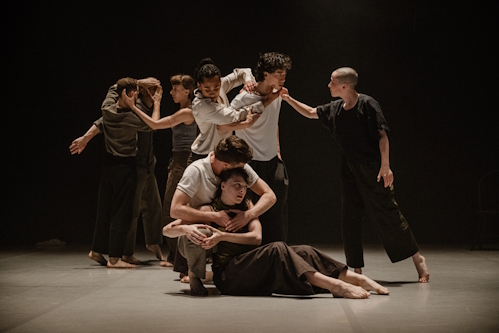
Photo Brian Hartley
Emilie Leriche’s Rotten Work builds its world around clothes, physical contact and fragments of speech. Dancers enter one by one, carrying garments on hangers which they place at the back of the stage. As the work progresses, some change clothes, while others eventually begin folding them.
Their contact work is accomplished. One dancer pushes another into motion. Another slips into the space beneath a partner’s bent elbow. Someone bends forward to catch the weight of a falling body. The dancers respond to one another with impressive speed and precision, adjusting their balance, direction and weight with apparent ease. Their confidence in handling these constantly shifting physical arrangements is evident. Yet for all the physical support, I find little sense of care in the relationships between them.
The spoken fragments offer further possibilities. “That’s not what I said” suggests disagreement, while “Let me fall” raises an intriguing question in a work full of catching and supporting bodies. Yet the words come and go without noticeably changing the encounters around them.
Towards the end, a dancer begins to speak. The words are repeated, the dancers gather, and the speaking begins again. I repeatedly think the work is about to end, only for another sequence to begin. Even “Turn off the lights” fails to bring an immediate conclusion.
When the lights finally go out on that last phrase, I feel relieved. Those few seconds of darkness and quiet are just the comfort I need on a windy Friday night.