
Jardins del Príncep, Tortosa, Spain
October 17, 2026
Led by artistic director Roberto Oliván, Arteria Tortosa is a four-day international multidisciplinary performing arts festival in the small Catalonian city of Tortosa. The programme offered workshops in the morning at different locations across the city, and performances each evening in the beautiful Jardins del Príncep (Garden of the Prince). Wandering among bulky succulents, ancient trees, with bougainvillea climbing over iron arches and romantic statues of couples in tender embraces, it felt a perfect location for a dance festival.
Arteria Tortosa emphasises community participation and involvement. This year, I not only had the pleasure of being present at two performances, but also taking part in one of them, White Noise by Paul White, former dancer with DV8 and more latterly Tanztheater Wuppertal Pina Bausch. White now works mostly as a permaculture designer and gardener, though he still dances occasionally. Here, we had the privilege of seeing him perform in a powerful piece.
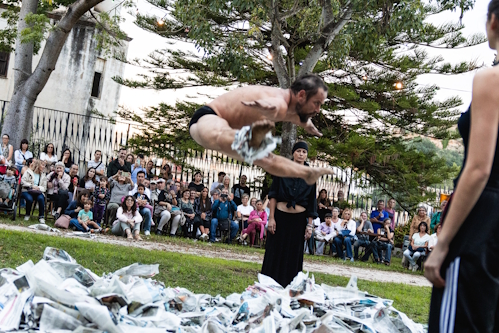
Photo Sarah Pérez
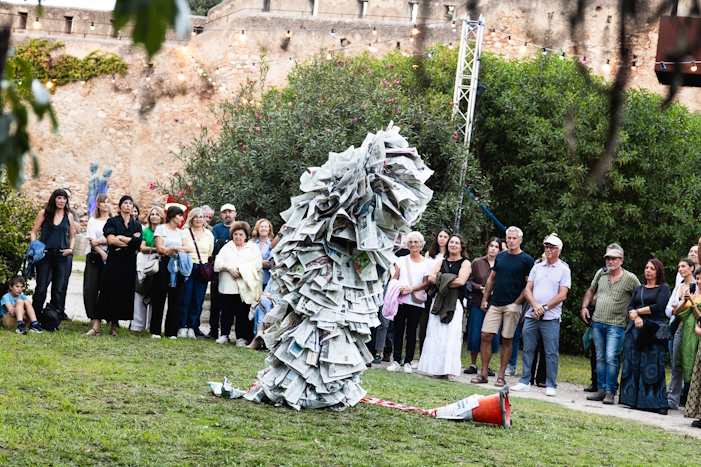
Covered in newspapers, a technician brings White to the lawn that is the stage in wheelbarrow, leaving him as if he were trash. A traffic cone and barrier tape adds to the scene. When that tape is pulled by White shortly afterwards, the cone falls, a cue for the music to begin.
Appearing as an odd, giant, layered creature, White makes sounds of his own as the many layers of newspaper rustle around him. He moves, rolls, jumps softly, and spirals across the lawn. He seems unable to see, his whole body covered by hundreds, perhaps thousands, of pages of newsprint. His appears huge, yet equally fragile. He seems lost in his difference and solitude. He tries to communicate physically with the spectators, but looks strange and uncanny.
Various unexpected moments keep everyone alert and enthralled before three figures in black approach him, of which I am one. We tear apart his layered protection with urgency and some aggression. He tries to fight back, but we manage to destroy his armour, force him to his knees, and restrain his arms. The scene turns even crueller to watch and perform as I start shaving his head, first holding his face by the chin, then grabbing what’s left of his hairs as he cries and sobs.
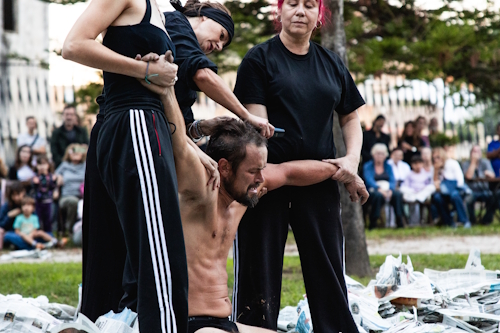
Photo Sarah Pérez
We are meant to represent an entity that applies force to a citizen who acts outside the norms or is not allowed to be or act as they want. Once White has been stripped down to his underwear, and laid on the lawn, he stands up, stops crying, and begins to perform the drills of a military parade. The exercises recall a boot camp. Now he looks emotionless. He displays an unnatural strength that rejects vulnerability and, therefore, humanity.
Sweaty, pale, and exhausted, the ground invites White to rest before he is reborn in another being. He starts behaving like a feline: licking his shoulders and paws, moving slowly, closely watching his surroundings. Basking in the sun like a lion, he seems reflective and observant. This metamorphosis continues, another transformation leading him to move like an ape. He jumps around and approaches people with gentle mischief, fully inhabiting the movements and mannerisms of a monkey. Then, suddenly, he disappears into a vast oleander bush, leaving everyone moved and dazed by the piercing vulnerability, and the coldness, that he performs so bravely and powerfully.
The evening continued with Vierge by Victor Callens, a former dancer with the Amsterdam-based Emio Greco company, now a freelancer working with it and other choreographers around Europe.
Vierge (Virgo in French) is performed on a very special stage: the long corner of the castle wall. Surrounded by trees and bushes, it could have been designed specially so perfectly did it frame Callens’ tall, slender yet muscular silhouette.
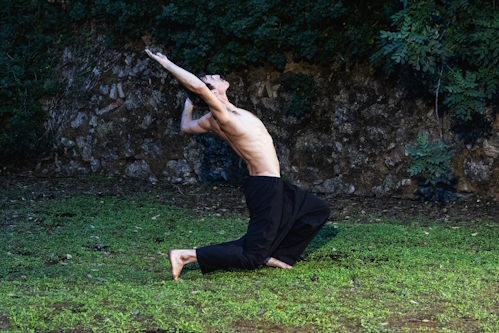
Photo Sarah Pérez
Callens is a Virgo, and his performance seems to speak about his nature, his inner voice, and his inner world. There force in the struggle, pain, and distress that he embodies just as strength shines through in his grace, tenderness, softness, and poetic vulnerability. The piece holds a dualism between feminine and masculine, between surrender and control, between human and animal.
In Freudian terms, I saw the opposing forces of the two life instincts: Eros and Thanatos. On one side is the life instinct, with its generative and creative powers; on the other, death with its destructive, ravaging force. I sensed the erotic energy of creation and the deathly energy of destruction in Callens’ stormy, embodied inner dialogue.
The show seems to be divided into three phases, each with contrasting music. There is a strident cello, loud techno, and the death scene from Swan Lake. Each draws the viewer into a different emotional and mental landscape. Callens’ magnificent performance spoke eloquently about the truth of human dualism, the contradictions that mark us, the different minds and personalities we have been endowed with, and the individual emotions, sensations, and experiences that make each of us who we are, singular and impossible to reproduce in our complex unicity.