
Sadler’s Wells, London
October 22, 2026
That London City Ballet continues to go from strength to strength under the artistic directorship of Christopher Marney was amply demonstrated by its latest programme at Sadler’s Wells: a double bill of John Neumeier’s Ghost Light and Glen Tetley’s Firebird. Two contrasting works, and an evening that confirmed the exceptional quality of this increasingly impressive company.
There is something rather special about London City Ballet’s dancers, something beyond their technical skills. They have a quality of movement that sets them apart. Classical ballet technique has advanced enormously over recent decades. The technical abilities of even newly graduated dancers are now quite extraordinary, reaching levels scarcely imaginable a generation ago.
Yet, something more is needed to make a dancer truly exceptional. That something is the ability to inhabit the dance completely, to live within the music and, where appropriate, the character, rather than merely execute the choreography. Equally important is the ability to temper technical brilliance with grace, fluidity and an apparently effortless softness of movement. It is here that London City Ballet’s dancers excel. There is a remarkable quietness about their dancing, movement flows with an extraordinary lightness, without losing any of its technical precision or expressive strength.
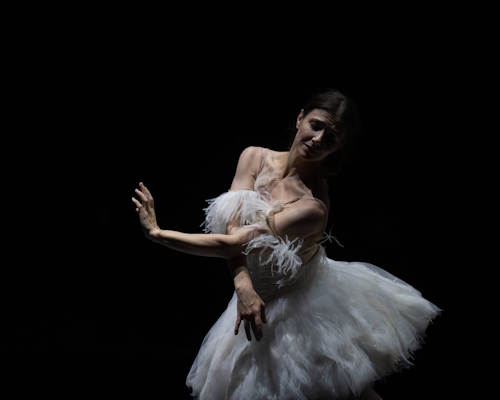
Photo ASH
This quality extends across the whole company. London City Ballet does not employ the conventional ballet hierarchy. Instead, its dancers perform as an ensemble in which all are expected to take on significant responsibilities. The company also invites distinguished guest artists to join its productions and has recently established an intensive, year-long trainee programme for emerging professional dancers. There is a sense of shared artistic purpose here, and it shows in performance.
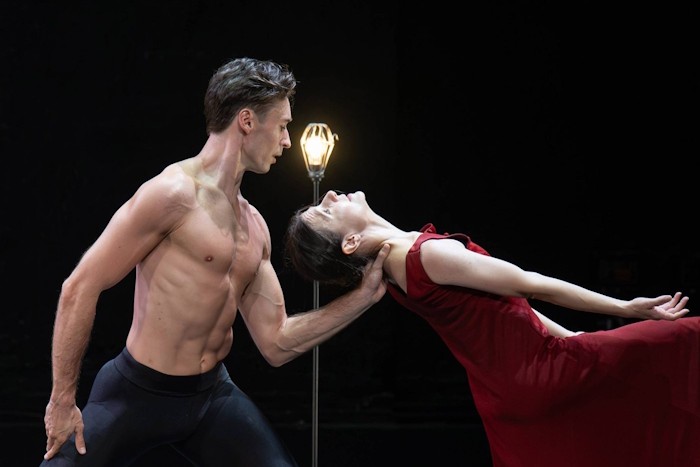
For Neumeier’s Ghost Light, the company was joined by guest artist Alina Cojocaru, a ballerina of quite exceptional gifts. To watch her dance is always a joy. Comparisons with the great ballerinas of earlier generations are inevitably complicated by the advances in technique since, but technique alone is not what makes Cojocaru so special. In Ghost Light, she made every movement seem wholly natural, deeply felt. She was always utterly absorbed in the moment. Even amongst dancers of the calibre of London City Ballet, she stood out. She was simply mesmerising.
Ghost Light, set to music by Franz Schubert, is an intriguing work, not least because of the circumstances of its creation. Conceived in 2020 during the restrictions of the Covid pandemic, it was developed in separate sections, with the choreographer limited in the number of dancers with whom he could work at any one time. Neumeier was unable to see the work assembled in its entirety until restrictions were lifted and when he finally brought the individual episodes together, he retained their original structure.
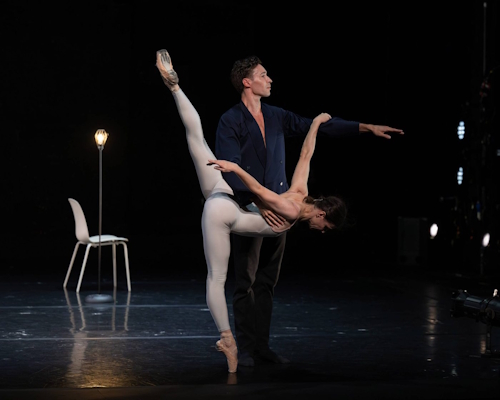
Photo ASH
The result is a succession of vignettes, often involving just two dancers, with recurring figures and changing relationships suggesting an emotional journey rather than telling a literal story. Neumeier speaks of a developing sense of unity, and there are certainly moments when the connections between the dancers achieve a touching resonance.
Yet, for all its considerable beauty, Ghost Light outstays its welcome. Movement phrases and choreographic patterns recur without always bringing sufficient development or fresh insight. Schubert’s music, beautiful though it can be, contributes to this impression of repetition through its recurring themes and relatively limited contrasts of mood and colour. The visual design is predominantly in pale, muted greys, relieved most noticeably by Cojocaru’s deeper orange-red. Combined with the subdued lighting, this restricted palette creates an atmosphere that is initially evocative but gradually loses impact.
Without exception, the dancers perform the ballet beautifully, investing each episode with sensitivity and conviction. Their expressive qualities do much to sustain interest. But, in shorter form, that atmosphere, beauty and emotional suggestions of the work may have even more effective impact.
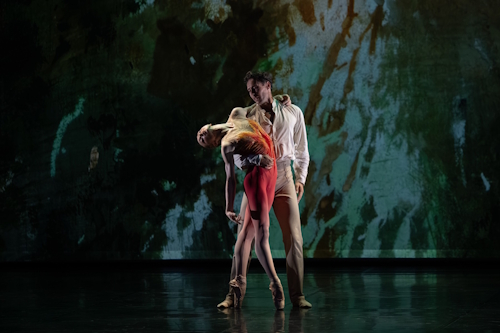
Photo ASH
Glen Tetley’s Firebird, set to Stravinsky’s celebrated score, is a striking contrast in almost every respect. Tetley’s gothic reimagining of the familiar story presents the Firebird as a young woman struggling to escape the constraints of a controlling family, ultimately finding freedom and the possibility of a different future. It is a powerful reinterpretation, in which the supernatural and the human exist side by side. The Firebird is at once a creature longing to fly free and a young woman seeking independence.
In the demanding title role, Ellie Young brought considerable commitment and expressive intelligence to the stage. She was particularly impressive in her interactions with the other dancers, whether confronting the oppressive figures of her family, led by Arthur Henderson as Kostchei, or responding to Ivan, danced by the equally impressive Joseph Taylor.
In these encounters, Young’s performance acquired a compelling intensity. She seemed to draw energy from those around her, reacting instinctively to their characters and the music. Her Firebird became a living, feeling presence, both vulnerable and defiant.
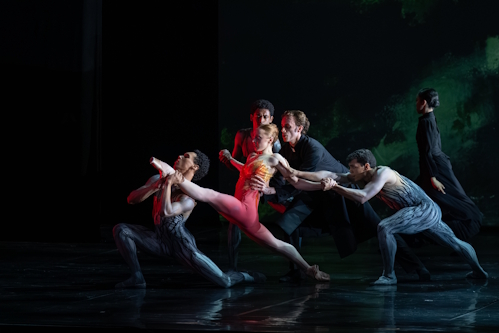
in Firebird by Glen Tetley
Photo ASH
Curiously, this strength was less apparent in her solo passages when her aura seemed to diminish. The commanding personality that emerged so vividly in her exchanges with others became less assured, and she did not quite possess the stage with the same authority. It was a noticeable contrast.
Elsewhere, the ensemble brought both dramatic commitment and beautifully controlled movement to their roles, responding to the score with a sense of immediacy that made the action feel alive. Taylor was particularly affecting as Ivan, bringing emotional depth and tenderness to the role of the Firebird’s lover, whose apparent fate ultimately proves less tragic than it first seems.
Where Ghost Light has time to spare, Firebird faces almost the opposite challenge. In a comparatively brief span, it must establish its characters, develop their relationships and carry a complex narrative to its conclusion. That it succeeds so convincingly is a tribute both to Tetley’s choreography and to the clarity and commitment of the performers.
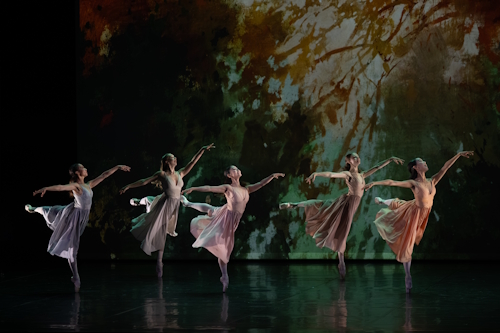
Photo ASH
Whether one prefers this more contemporary psychological interpretation or the traditional telling of the Firebird story is almost beside the point. The essential themes of confinement, longing, transformation and liberation remain powerfully present. Under Christopher Marney’s direction, the revival emerged as an excellent piece of ballet theatre, rich in atmosphere and dramatic purpose.
Taken together, the two ballets made for a thoroughly enjoyable evening, despite the reservations surrounding Ghost Light. More importantly, they offered another opportunity to appreciate what are becoming those distinguishing qualities of London City Ballet mentioned earlier. There is a quiet assurance about this company that is immensely appealing. London City Ballet is developing not merely a repertoire worth seeing, but a recognisable artistic identity. Its continued growth is a genuine pleasure to witness.