The Coronet Theatre, London
October 24, 2026
Wearing a black cap, a tight black top covered in white patterns, black Adidas tracksuit bottoms and bright green socks, Boram Kim strolls onto the stage, glances at the audience and begins dancing without music. When Vangelis’ ‘One More Kiss, Dear’ starts playing, he continues with his street dance movements, looking like someone amusing himself at home.
With half his head shaved, a small moustache, deeply tanned skin, a lean, muscular physique and kinesiology tape on his calf, Kim has a distinctive appearance. His movements can look rough, and his pointed feet are not especially elegant, but his technical ability is impressive. Smooth floorwork, flipping up from the ground, Italian fouettés and even a headstand without using his hands. There is plenty this body can do.
Gwantong 18, first performed in Seoul in 2018, presents eighteen sections drawn from Kim’s life, experiences and thoughts. The title plays on the Korean pronunciation of eighteen, which sounds similar to ‘ssibal’, a particularly strong swear word. Numbers appear throughout the performance, but the sections are not always easy to identify. Like several other spectators, I occasionally find myself checking the programme to see where we are.
In ‘Pattern’, Kim compresses an ordinary working day into a repeated routine: sleeping on a red sofa, using a suitcase as a toilet, complete with a farting sound, commuting, typing at work, then returning home and literally rolling across the floor to watch television before going to bed. The sequence accelerates, though his timing does not always keep up with the sound effects. Even when the sounds stop, he carries on until an abrupt halt.
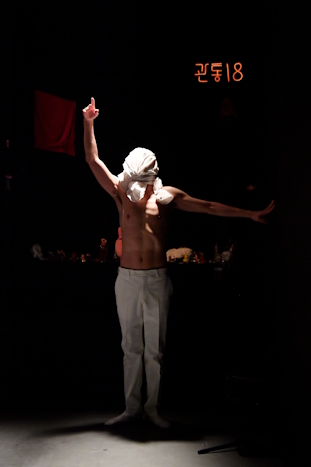
In ‘Birth’, he looks astonished by his own body. His hands circle and clasp, his shoulders rise as his heels drop, and his feet turn out seemingly without permission. By ‘Choice’, he has begun experimenting with these movements, assembling them into a dance combination. A little demonstration of his talents, perhaps. Then Carl Orff’s ‘O Fortuna’ strikes up, and he starts attacking his clothes. His white T-shirt is pulled over his head, twisted into a one-shouldered top, briefly exposing his abs, which he makes sure the audience gets a good look at. More twisting, and his trousers become a tight dress. One sock goes into the chest, the other into the crotch. He strikes a model’s pose. The audience bursts into laughter. I am increasingly impressed by the quality of his clothing.
Eventually reduced to boxer shorts, Kim crouches on a table, playing with toys and making a tiny figure under a camera. Then he disappears, leaving The Coronet glowing with club lights and music. Not a bad party venue, I think. He later returns through an auditorium door in a white suit, shows off some Michael Jackson moves, including a passage from ‘Dangerous’, and dances through the whole of Queen’s ‘Bohemian Rhapsody’, acting out its lyrics in an entertaining game of charades.
There are other stories: years spent practising in dance studios, questions about what dance is, anxieties, regrets and a recorded speech associated with the impeachment of former South Korean president Park Geun-hye. Some of his stories make me laugh, others leave me impressed. Occasionally, I find myself losing interest, wondering where he is going with all this. Then he produces another surprise.
Near the end, darkness conceals Kim running around the stage. We hear footsteps, collisions and heavy breathing. When the lights come on, he is suddenly sitting on a table in a cool pose, or quietly meditating at centre stage. Darkness returns, followed by more frantic movement and another composed image. Finally, he walks offstage in full light. For a moment, it is not entirely clear whether the performance has ended.
After seventy minutes, I cannot say I know Boram Kim. But he is a fascinating dancer, an amusing storyteller and, with all his eccentricities, pretty good company.
Hello, Boram.