
David H. Koch Theater, New York City
October 13, 2026
Buried among all the tutus, fashion-led works and pieces by contemporary choreographers that make up New York City Ballet’s Fall season is something very different. George Balanchine’s Pithoprakta was made in 1968 on Suzanne Farrell and Arthur Mitchell but disappeared from the repertory the following year following the departure of the two dancers, Mitchell to form the Dance Theatre of Harlem, Farrell to dance with Maurice Béjart’s company in Brussels. After 58 years, it’s back, pieced together from incomplete film recordings and Farrell’s memory. It may be only ten minutes in length, but it gives a lot to talk about.
The music is by Greek composer Iannis Xenakis, also an architect, who is known for works that use mathematical and scientific concepts such as architecture, game theory, set theory, and stochastic processes. The latter involve random probability distributions that may be analysed but never predicted precisely. In simple terms, in Pithoprakta, this meant the movement of particles within a fluid, each of the required two trombones, woodblock and forty-six strings conceived as an independent molecule moving within a gas. Xenakis drew a graph of the associated calculations which forms the backdrop to the ballet.
Indeed, the whole score feels a little like being in an immersive soundscape, especially at the beginning, when one hears what sounds like a wooden mixing spoon tapping on a wooden table.
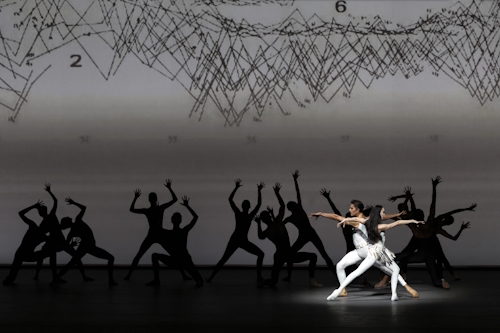
Photo Erin Baiano
A lot of the choreography is loose-limbed, especially for the corps of twelve, dressed in all black. They really do give the sense of electrons bouncing around. They jump repeatedly and freely on the spot, feet parallel, arms hanging by their side. The roll. They form circles. Sometimes shadowy, the figures form tableaux. At one point they set up in two lines, the intricate gestural choreography making them look like some sort of machine. A loom in an old factory, maybe. It all feels very experimental, although equally very of its time.
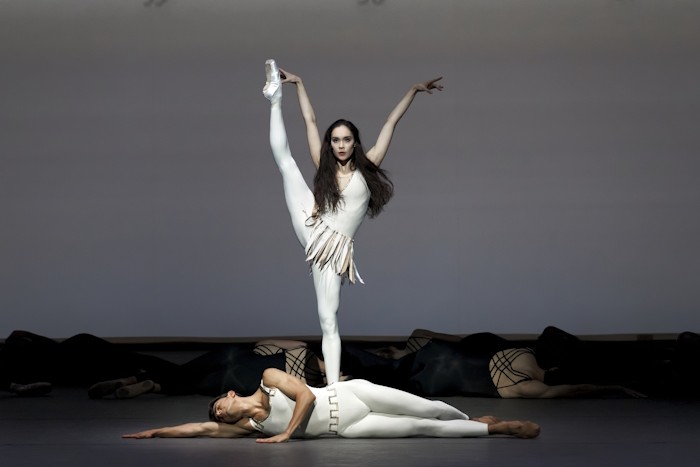
But while Pithoprakta is a strange ballet in many ways, it’s far from inelegant, especially when it comes to Mira Nadon. Dressed in white, she dances with a man, Davide Riccardo, who seems largely peripheral to the action. While the pair interact in that they frequently occupy the same space, they very rarely touch. She’s like a siren calling, but who he never actually gets to meet. When she steps over him, you wonder if she’s deliberately ignoring him.
That lack of contact may be an accident of history. While Pithoprakta was filmed before its premiere, Mitchell wasn’t there. So, Balanchine told Farrell to dance her part without her partner. The disconnect we see today is likely a result of that, one feels.
Nadon held the attention from start to finish. There was something very alluring about her. Moments of stillness explode into movement that, like Xenakis’ score, seems to hang in the air. She’s always in control. All the time, while that music might be unusual, the dance is totally at one with it. Attitudes extend time and again into delicious arabesques. Unlike the corps, her dance is very classical and a fascinating contrast.
The end is open to interpretation. Nadon, alone and kneeling, makes a crown-like shape with her fingers before covering her eyes. Ballet is woman, maybe. Nadon it’s superhero.
Back in 1968, Pithoprakta was actually the second part of longer ballet, Metastaseis and Pithoprakta. What chance the other half being brought back too?
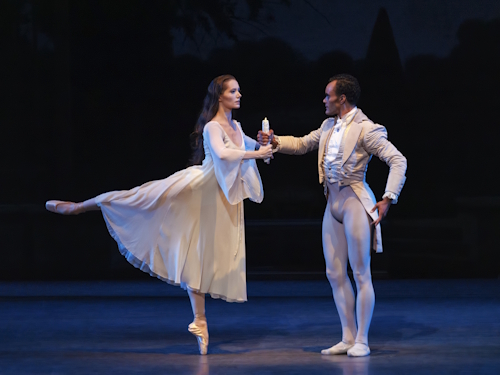
Photo Erin Baiano
The programme opened with La Sonnambula, Balanchine’s 1948 Romantic melodrama set to music from Vincenzo Bellini operas. Located in a masked ball, the ballet tells of a Poet, suitor to a Coquette, who is escorted by the Host. After some ensemble dancing and divertissements, the Poet, now left to himself, sees an apparition in white. Utterly captivated by her, he follows her into a turret. The Host, having been told this by the jealous Coquette, follows and stabs him. The Sleepwalker reappears to carry his body away.
I suspect it felt rather more sinister when made than it does now. The overall scene still has a sense that something not good is going to happen, but menacing it is not. Indeed, the over-the-top reappearance of the dying poet, clutching his stomach, is almost comical.
Naomi Corti was not especially flirtatious or teasing as the Coquette but was quite believable as the woman of the attentions of the Poet (Taylor Stanley). It always feels a shame that the couple sit upstage quietly chatting for much of the dancing and divertissements.
The Pastorale (Lauren Collett, Gabriella Domini, Kennard Henson and Noah McAuslin) was danced with a mix of suitable demeanour and flair, while both Sara Adams and Victor Abreu delivered an arresting pas de deux. As the Harlequin, complete with bad back, Daniel Ulbricht was as entertaining as ever.
Star of the ballet was Unity Phelan’s Sleepwalker, however. She moved with a restlessness as though troubled and looking for something, or someone. Largely on pointe, she was quite ethereal. She bourréed as if a ghost gliding on and through the air. No wonder Stanley was so entranced. I think we all were.
in George Balanchine’s The Unanswered Question (from Ivesiana)
Photo Erin Baiano
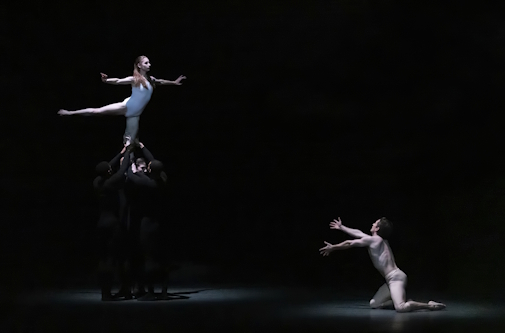
Along with Pithoprakta, the middle ‘act’ of the evening was home to another mysterious dance, The Unanswered Question from Ivesiana. It presents a woman, here Ashley Laracey, effortlessly held and carried throughout by four men. As she’s endlessly lifted, made to dive and otherwise manipulated, she’s beautiful but unattainable. When she stands, held tall above them, she’s like an angel, although is there a hint of power and menace there? All the time, it’s almost as if she’s deliberately tempting Cainan Weber, the man in thrall to her presence. She is delivered to him once, very briefly. After a moment in his arms, she is cruelly eased away once more.
Rounding the programme off, Theme and Variations, Balanchine and Tchaikovsky, brought everyone back to altogether more familiar territory. In this ballet of nothing but classical technique and precision, Indiana Woodward and Joseph Gordon sparked in the lead roles. It was fabulous, but it is Pithoprakta that still lingers in the memory.
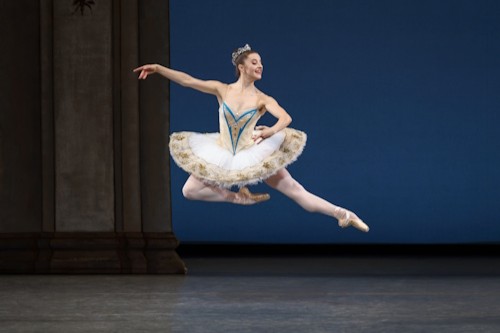
Photo Erin Baiano