
Sadler’s Wells, London
June 24, 2026
I loved it, I hated it. I was amused. I was mesmerised, I was bored. It was profound, it was pretentious. It was loud, you could hear a pin drop.
Calentamiento translates as ‘warm-up’. On an eyeball-meltingly hot night, there was something grimly ironic in that title. True to her word, we were treated to a good ten minutes of her lying on the stage stretching while Spanish pop music blasted out. Dancers performing in excruciating silence as the audience walk in and then sit there squirmingly aware of every creak and breath in the auditorium became passé in ballet long ago. Surely it could not have taken this long to infect flamenco?
It seems not. This was the warm-up to the warm-up. Molina then treated us to a running commentary on the process and physical demands of dancing flamenco and the difficulties facing dancers as they age whilst rapping out zapateado as accurately as a metronome. For 35 minutes. Golpe, planta, planta tacon, tacon, pico. She informed us that she had been doing the same exercise at a steady pace far below her capabilities since she was seven, her mother pushing her to remain in the studio after everyone else had left. It clearly paid off.
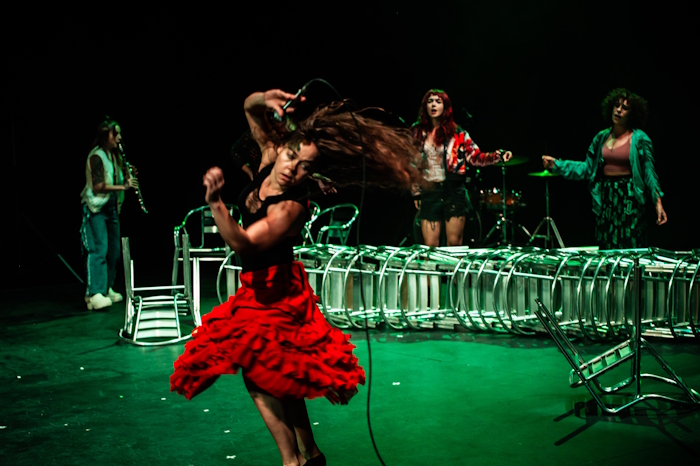
Although Molina spent a great deal of the time holding the stage solo, she was joined by José Manuel Ramos (Oruro) and three female singers, the latter not always as cante flamenco. There was more interesting zapateado with both dancers seated throughout. The chairs were an integral prop too. Not traditional flamenco style but light metal chairs stacked almost into the flies and, at one point, festooned on Molina herself whist she, naturally, carried on with the footwork.
In many ways, Calentamiento has a strong traditional foundation with palmas and cante and braceo. in other ways it strayed into pretentiousness like performance art at a biennale. Flamenco has come a long way in the last few decades and is rightfully also now a theatre art with right to experiment. At the end of the day though, flamenco nuevo can never compete with solid tradition and it must beware of straying too far away from its roots.
I recommend it certainly, but at two hours without an interval, I could have done without quite a lot of it too.