
Theatre Royal Haymarket, London
September 30, 2026
“I didn’t get where I was today without….” said CJ every episode in The Rise and Fall of Reginald Perrin. Well, none of us would be where were this evening without Maynard Keynes. Sadly, that is also true of Friedrich Hayek and Milton Friedman but nowhere near to the same extent.
As author James Graham says, Keynes had fingers in a lot of pies, not least because he was a wealthy man living at a time when the cognoscenti were a relatively small group of people where everyone knew – and bitched about – everyone else. The Bloomsbury group formed their own sect within that milieu. They were pretty awful to each other and it mostly ended in tears, all of which Graham covers with admirable economy.
Like many of London’s fashionable and wealthy arts patrons, Keynes was enchanted by the Ballets Russes, eventually meeting Russian ballerina Lydia Lopokhova and thus initiating his unlikely alliance.

and Luke Cinque White (Frederick Ashton) in The Standard of Living
Photo Manuel Harlan
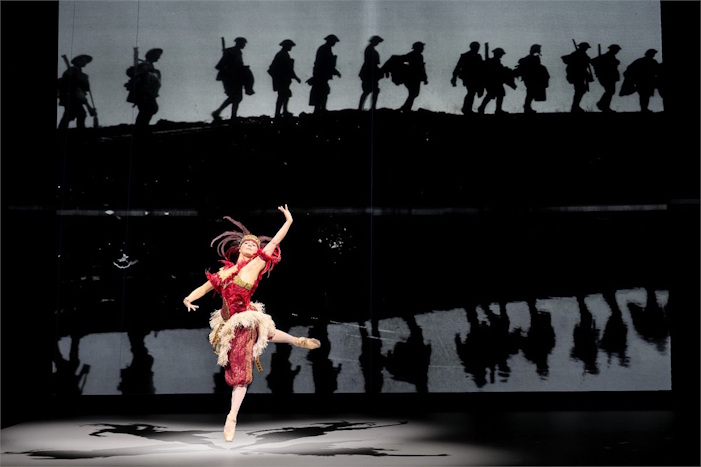
Graham has chosen to weave dance throughout The Standard of Living, hence the choice of Natalia Osipova, who gives a punchy account of the decidedly odd but witty Lopokhova. She flits through the first act as Fokine’s will o’ the wisp Firebird, designer Jenny Beavan choosing to echo the original Bakst costume rather than the modern productions that utilise a tutu. There are also glimpses of Boutique Fantasque, Façade and Les Sylphides. When she switched to dramatic rôles, Keynes built the Cambridge Arts Theatre for her, having returned to being a Cambridge academic after he fell out of favour with the government.
Keynes’ marriage to Lopokhova raised eyebrows all round, not least because he had, up until then, appeared to be a very active homosexual. Graham deals with this in short order, using the opportunity to show how Lopokhova could give as good as she got to the likes of Virginia Woolf, Duncan Grant and Clive Bell.
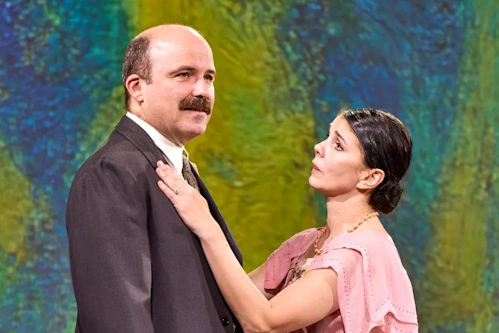
Photo Manuel Harlan
Keynes went on to be one of the chief architects of the International Monetary Fund and the World Bank. During World War II, he also founded the Council for the Encouragement of Music and the Arts, the forerunner of the Arts Council.
He died in 1946. Lopokhova would outlive him by over 30 years, all of which was spent out of the limelight. She died at 1989 in an East Sussex nursing home, a very long way from her beginnings in a poor family in St Petersburg.
Graham suggests that, as the peaks of capitalism flatten and the troughs deepen, we are due a swing back from monetarist economics and that Keynes’ fight to get the country to spend its way out of a slump may have its time again. The audience in the Haymarket theatre may not have known much about Keynes beforehand but the contemporary resonances of his speeches were not lost on them by any means.
Meanwhile, Osipova’s generosity in being part of the ensemble with minimal dancing did not go unnoticed. Her performance is seamlessly integrated into the whole. On this evidence, she could easily slip into a dramatic career once her dancing days are over.