
The Place, London
September 30, 2026
That was the first sentence I wrote in my notes after Charlie Khalil Prince’s the body symphonic at The Place.
Sound dominates the evening from the start. Prince swings a microphone above his head until the amplified rush begins to resemble wind, then something more mechanical as it repeats through the mixer. Later, percussion, processed sound, stamping and calls accumulate into a dense, explosive wall of noise. It is genuinely loud. One audience member in front of me takes earplugs from their bag and puts them in; another reaches up to adjust their hearing aid.
I did not mind the volume. In fact, the music is the strongest part of the work. The percussion has real force, and a later section in which Prince plays electric guitar alongside it is musically convincing.
Movement is present throughout, but rarely develops into what I would call dancing. Prince stamps heavily in repeated rhythms, with the body rising and dropping to the beat and the hands often held open in distinctive sideways-facing positions. Together, these fragments immediately suggested a folk-dance vocabulary to me.
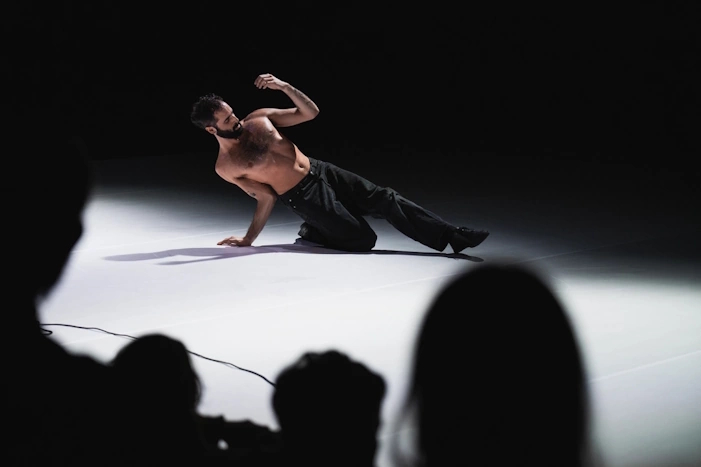
At one point he moves inside a narrow strip of light with his vest pulled over his head. Later, with one arm reaching over his head and the other supporting him against the floor, he travels sideways on three points of contact before falling. At the end, when the stage goes dark, his breathing, calls and footsteps remain audible.
The musical language is much clearer. The problem becomes most obvious when both performers are fully occupied with instruments. The music continues to work, but the physical dimension drops away. I found myself wanting a third performer on stage, another body able to respond physically to the sound while the two musicians played.
The programme gives the work a much larger political and symbolic frame than I found on stage. It speaks of occupation, resistance, erasure, memory, mourning and imagined futures. Without those words, I would not have arrived at most of those meanings from the performance itself. What I could recognise was the musical structure, the physical force of the sound, and movement fragments that suggested a folk-dance source.
The idea can work. I am not convinced it has been fully realised.