
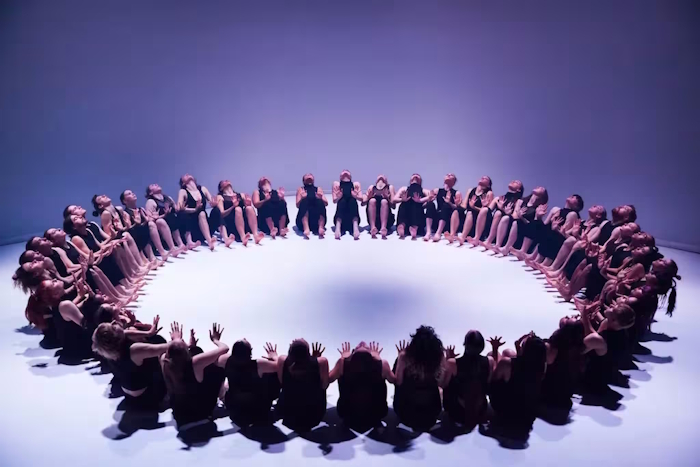
Stephanie Lake’s Colossus comes to London’s Queen Elizabeth Hall at the end of the month. Zoë Hewitt talks to rehearsal director and original cast member Nicole Muscat, and learns how the London Contemporary Dance School’s graduating dancers are shaping the ever-changing work.
Fifty dancers. No exits. Fifty-five minutes of breath, pressure, collision risk and collective force.
For their 2026 Graduation Show, this year’s London Contemporary Dance School’s final-year BA students will take on Stephanie Lake’s Colossus, a work that asks what happens when fifty bodies share the same space, the same time and the same rules.
Created in 2018, Colossus has since travelled internationally, performed by casts of students and professionals across different countries and cultures. The performances with the LCDS students mark its UK debut.
Speaking to Nicole Muscat, I learned that students have always been central to Colossus. Muscat was part of the original Melbourne cast when Lake began creating the work with dancers from Transit Dance and the Victorian College of the Arts.
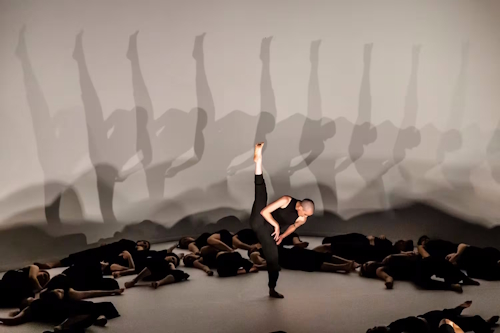
Photo Bryony Jackson
The scale shaped the making of the work from the start: fifty performers, limited resources, and an independent choreographer looking for a way to build something too large for the usual model.
The students became the solution. They also became part of the work’s identity.
More than a decade later, Muscat still believes there is something special about performing the work with dancers at the beginning of their careers.
Professional performers, she suggests, arrive with established habits and identities. Students bring something different. They are still discovering who they are as artists. They are hungry, curious and willing to throw themselves fully into the process. That energy becomes part of the work itself.
The challenge is considerable. Fifty dancers share the stage almost continuously. No one can simply focus on their own movement.
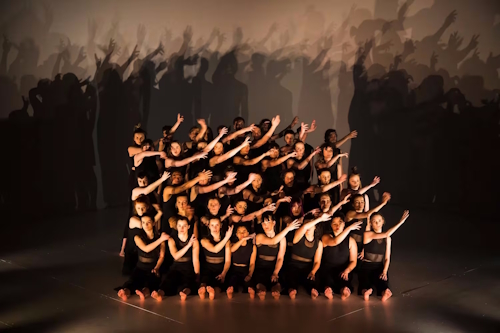
Photo Mark Gambino
“Trust” is a word Muscat returns to repeatedly.
The dancers must know exactly where one another will be. Consistency creates confidence. Confidence allows risk. They avoid collisions through shared precision and mutual awareness, learning to navigate the space by trusting that everyone around them will do what they are supposed to do.
Listening to Muscat describe the process, it becomes clear why she says, “Basically, Colossus is a giant social experiment.”
The work explores manipulation, conformity, leadership, protest and resistance. Individuals emerge from the mass before being absorbed back into it. Groups form, dissolve and reform. Power shifts constantly between the collective and the individual.
What makes the piece particularly fascinating is that each cast changes it.
Muscat has restaged Colossus internationally, including in South Korea, Germany, Canada and Argentina. The choreography remains the same, while the social dynamics inside it shift.
One scene requires a performer to be isolated and pursued by the group. In South Korea, where strong hierarchies between senior and junior performers remain culturally significant, the dancers found the situation unexpectedly difficult when the role was assigned to a senior male student. Some became emotional during rehearsals. The task of challenging or humiliating someone they had been taught to respect felt deeply uncomfortable.
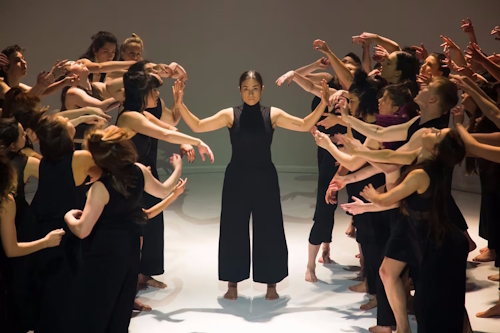
Photo Mark Gambino
Elsewhere, different aspects of the work came to the foreground. In Germany, Muscat observed stronger associations with protest and collective resistance.
In that sense, Colossus works like a choreographic container. The score may remain fixed, but the behaviour it reveals changes with the people inside it.
For audiences encountering Colossus for the first time, Muscat suggests watching the relationship between the mass and the individuals who break out from it. At times, the dancers appear to move as one organism, guided by breath, vocal cues and body percussion. At other moments, solos, duets and small groups push through the collective texture.
That pressure is part of the point. Muscat describes the work as a pressure cooker: the dancers remain on stage throughout, breathing heavily, vocalising, headbanging, rushing forward and sometimes confronting the audience directly. There is no formal audience participation, but she is clear that spectators are still involved. The boundary between those on stage and those watching does not remain entirely comfortable.
For this year’s London Contemporary Dance School graduates, that question now becomes their own.
This cast brings together dancers from different countries, backgrounds and training experiences. According to Muscat, today’s students also arrive with a greater awareness of mental wellbeing, emotional needs and personal identity than previous generations. Those concerns enter the rehearsal room with them, and will inevitably colour the performance.
If Colossus is a social experiment, this year’s graduating dancers are its newest test case. They will bring their training, instincts, anxieties and hunger into the structure. The choreography may already exist. The society inside it will be theirs.
A co-production with London Contemporary Dance School at The Place and the Southbank Centre, Colossus is at the Queen Elizabeth Hall, London from June 25-27, 2026. Click here for details.