
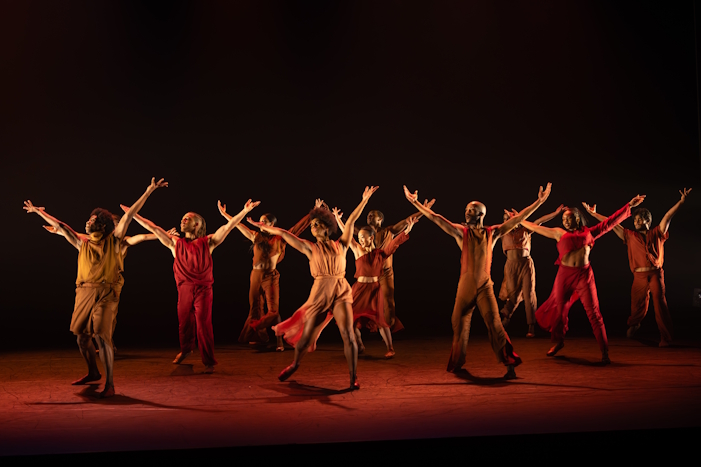
Established to provide opportunities for professional ballet dancers of Black and Asian descent, and to open ballet to a more culturally diverse audience, Ballet Black this year celebrates 25 years of pushing at barriers and making innovative new work, David Mead talks to founder and artistic director, Cassa Pancho.
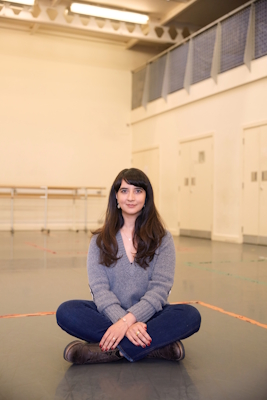
Photo Ollo Weguelin
It’s been quite a journey, I suggest to Cassa Pancho, just 21 when she founded the company in 2001. “It has,” she agrees. “I wasn’t really aware of just what was involved, how much work it would actually be.”
The idea for Ballet Black sprung out of Pancho’s 1999 dissertation, All Things Black and Beautiful, for her degree in The Art and Teaching of Classical Ballet. Anorexia, Pilates and the dancer, and nutrition were all popular subjects, but were not for her. She wanted to look at Black women in ballet in the UK. The issues became immediately apparent when she couldn’t find any to interview.
She concluded that something needed to be done. “It’s really important that, if a young Black child goes to see a show, the people they see on stage are reflective of them. It really is a simple idea. If your cast is diverse then your audience will be diverse. And it’s true. I see it all the time. And it’s the same at ballet school. Children need to see teachers they can relate to.”
That was a prime driver for Pancho also establishing a school almost immediately, with relatable, all-important role models teaching the youngsters. From its beginnings in a church hall in Shepherds Bush, it now operates in three locations offering both non-syllabus and examination classes for 3 to 18-year-olds with some 250 dancers attending regularly. There was always the hope that it might feed the company one day. It has taken a while but finally, this year, Ballet Black has its first student dancer who came through the school.
The early days were not easy. “I was unknown, not a famous ballet person. I had no backing although the Royal Academy of Dance gave me six months of free studio space. Denzil Bailey, who had just left English National Ballet and who was looking to start teaching, became our Ballet Master. But, as she observes correctly, back in 2001 there wasn’t really anyone to turn to for advice. “All the people who had founded their own companies were dead. It was a massive learning curve. You just learned how to deal with problems as they came up.”
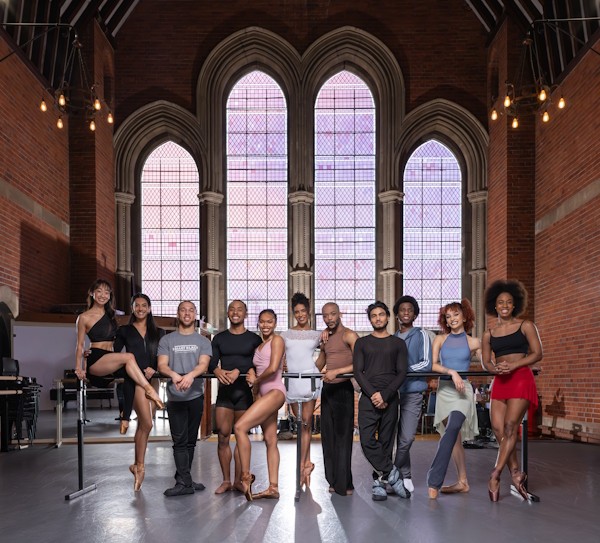
(l-r: Megan Chiu, Mikayla Issacs, Ebony Thomas, Elijah Peterkin, Taraja Hudson,
Helga Paris Morales, Bhungane Mehlomakulu, Love Kotiya, Acaoã De Castro,
Ruby Runham, Isabela Coracy)
Photo ASH
The company’s first show was at the Academy too, in the Genée Studio. “Denzil choreographed a piece to electric cello, I choreographed a jazz ballet, and Daniel Jones let us have a piece he had made for an ENB choreographic workshop. I’m not sure how good it was,” she says laughing, “but we charged £100 a ticket, and sold out.”
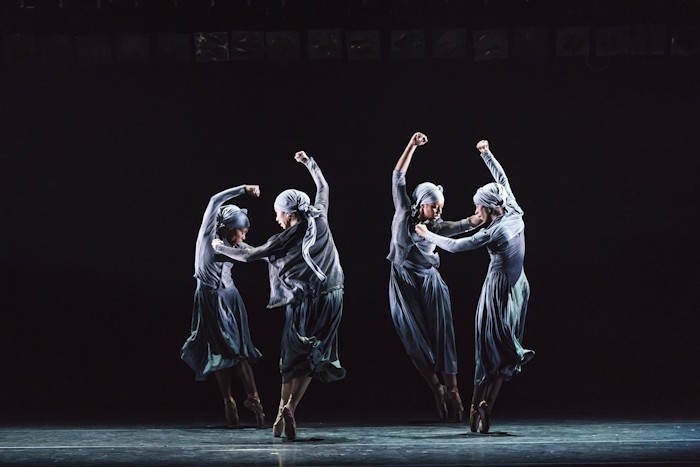
which returns for the 25th anniversary programme
Photo Bill Cooper
Audiences were supportive almost immediately but many in the arts and dance establishment were more resistant, Pancho remembers. Obtaining funding proved particularly difficult, although a big step was achieving registered charity status in 2004, which enabled the company to get more donations. That in turn allowed more shows.
But regular funding proved elusive for many years. Despite winning the Outstanding Company award at the 2009 National Dance Awards, then Best Independent Company in 2012, it was twelve years, ten years after the first request, before Arts Council England started to take notice. “The critics were starting to openly question why we weren’t getting funded,” she recalls. Finally, in 2018, Ballet Black became a National Portfolio Organisation, so at last receiving regular, multi-year funding.
Pancho pays tribute to the flexibility and creativity of the company’s dancers. The repertory is certainly bold and wide-ranging. She has commissioned more than 70 new dance works for the company including by established choreographers such as Richard Alston, Cathy Marston, Arthur Pita and Will Tuckett. But she has always steered clear of well-known ballets and even excerpts of the classics. “We couldn’t stage a Swan Lake or a Sleeping Beauty, but then I wouldn’t want to. It’s not what the company is about.”
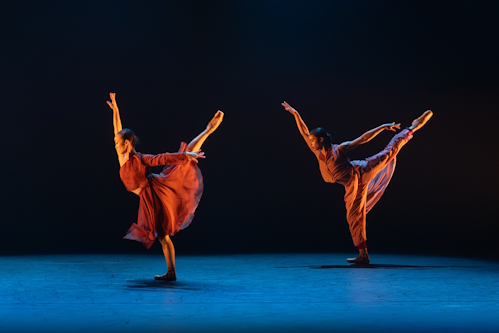
Photo ASH
Being streamlined, being able to go into a small theatre or large opera house is important when it comes to touring, something she believes is essential, and something the larger companies do much less of these days.
But has she ever thought of a Nutcracker, I wonder, a ballet of which there are several cut-down versions staged by smaller ensembles, and which is pretty much guaranteed to bring in audiences and funds. “I’m not saying we would never do one but it would change our whole model. We are about taking risks and experimenting, commissioning of work from different kinds of people. I think the dancers enjoy that as well as audiences. And I really don’t like the idea of a small-scale version that will almost inevitably compare unfavourably with the productions of the major companies.”
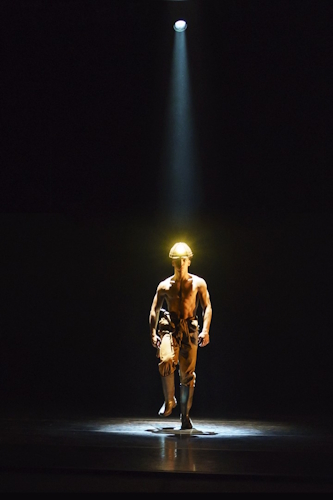
Photo courtesy Ballet Black
Supporting emerging artists has always been important, dancers and dance-makers. It is thanks to Pancho’s support and encouragement that former company dancer Mthuthuzeli November is the well-known and in-demand choreographer that he is in particular.
It seems fitting that his Olivier Award winning Ingoma, which marked his choreographic debut, returns for the company’s 2026 anniversary season. Inspired by the 1946 South African miners’ strike, a precursor to the anti-apartheid movement, and the and connected to the Marikana miners’ massacre, it captures vividly the suffering and resilience of Black miners and their communities.
In very different mood, alongside Ingoma is a celebratory new ballet by two-time Bessie award-winning choreographer, Hope Boykin, …all towards hope. Danced to spoken text by Boykin herself that refers to “moving together,” “pushing back,” and striving for a better day, it feels like a perfect statement piece for the company.
Ballet Black’s onstage successes are certainly impressive, but what, I wonder, does Pancho consider to be the company’s biggest achievement to date? “Skin-toned pointe shoes,” she replies immediately.
Now available from all the major shoe manufacturers, Pancho and senior dancer Cira Robinson initially collaborated with Freed of London to create two new pointe shoe colours that would enable Black and Asian dancers to buy skin-tone pointe shoes ready-made.
Previously, she explains, they had to use foundation that matched the dancer’s skin colour, painting on several coats, each of which has to be allowed to dry before you can do the next one. It was not only laborious and time consuming, but adding anything damp to shoes shortens their life. “The new colours eliminate all of that, which is brilliant.”
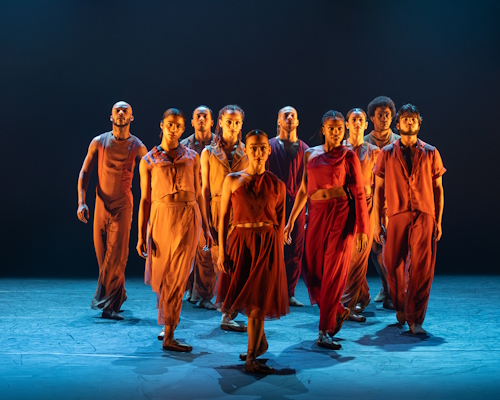
Ballet Black in Hope Boykin’s …all towards hope
Photo ASH
But while the wider range of colours, for tights, ribbons and elastics as well as the shoes themselves, has had a real visible impact on the ballet world, there is still work to do. Skin-toned shoes are still often a special order that can take many weeks to arrive, Pancho explains. It’s a particular problem for younger dancers. “If you’re a child, you can have outgrown them before they arrive.”
Perhaps one of the most important things to come out of the formation of Ballet Black was that it made people think. It made them question. It had a major impact simply by sparking discussion. One of Pancho’s main goals has always been to see a fundamental shift in the number of Black and Asian dancers in ballet companies. There are certainly many more than there ever were previously. But will there ever come a day when Ballet Black becomes unnecessary?
“I doubt it, at least not for a long time.” She explains how the increasing numbers of black dancers is just one step, and how it is essential that, when their dancing careers are over, they graduate into other roles, most importantly artistic directors or choreographers.
There is still work to do, but twenty-five years on, Cassa Pancho feels vindicated. Back in 2001, she recalls hearing comments to the effect that there was little point in what she was trying to do because Black people don’t do ballet. “We’ve proved that is nonsense. It doesn’t matter what colour you are, you can love ballet.”
Click here for details of forthcoming Ballet Black performances.