
David Mead considers the nature of screendance as he looks at four works by Singaporean director Brian Toh.
The Cambridge English Dictionary defines a screen as, “a flat surface in a cinema, on a television, or as part of a computer, on which pictures or words are shown.” It defines dance as “to move the body and feet to music,” a description that is straightforward but that comes with a lot of problems. While everyone has a good idea of what is and is not dance, coming up with a form of words that covers all the possibilities is probably impossible. I suspect Curt Sachs got it right in his World History of Dance in 1937 when he wrote that “it is impossible to define.” When it comes to ‘screendance’, the Cambridge Dictionary is stumped, however.
It’s probably easier to say what screendance is not. It is not simply film of dance. It is rather best seen as a separate genre, wherein the choreography is created especially to be filmed, and the final work is completed in the editing room, where the relationship between the camera and the moving subject is intricately intertwined. It’s dance that would never have the same impact, or at least a very different impact, if it was recreated for the stage. Screendance director and academic Douglas Rosenberg has the best explanation I’ve seen: “Screendance is a literal construction of a choreography that lives only as it is rendered in either film, video or digital technologies.”
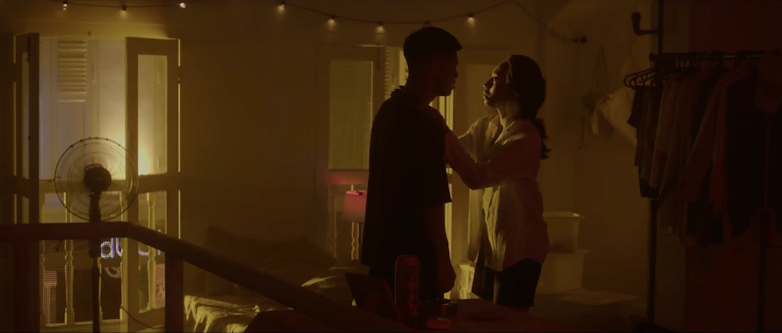
Photo courtesy Brian Toh
Although it was not until the late twentieth century that there was a truly identifiable body of work that might be formally called screendance or ‘dance for the camera’ as it used to be termed, has a long history. Indeed, the relationship between dance and screen has been developing right from the early days of film. From the very beginning, the dance was being manipulated by editors. The Serpentine Dance, a celebrated silent film produced by the Edison Manufacturing Company in 1895 featuring dancer Annabelle Moore was manually hand-coloured frame-by-frame and, the final product engineered in the editing, for example. But what was probably the first film to approach what we now call screendance was Maya Deren’s Meshes of the Afternoon, made in 1943, which redefined cinematic time, space, and movement, treating the camera and editing as choreographic tools. Brian Toh certainly also does all of that in the four films watched, and to impressive effect.
iwishyoustayed, made in 2022, looks at domestic violence, but unusually from the point of view of the male perpetrator and the effect it has on him. Emotive and raw, with super sharp transitions, it’s a powerful piece. The opening scene places the violence at the forefront of the mind when watching everything that follows.
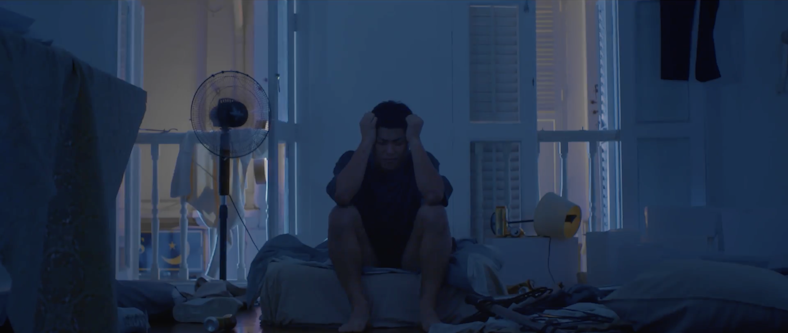
Photo courtesy Brian Toh
Dancers Nur Arianty and Jay Goh are both terrific, as is the directing and editing. The film is at its best in the moments in the couple’s home, where the sepia-like lighting very effectively ramps up the tension, and in the close-ups. The latter is where dance made for the screen really scores. It allows the viewer to quite literally see right into someone’s eyes, here giving the feeling that you have some sort of access to his thoughts. Interestingly, the effect is to paint Goh’s character as human and makes one want to try to understand his actions rather than simply demonise him.
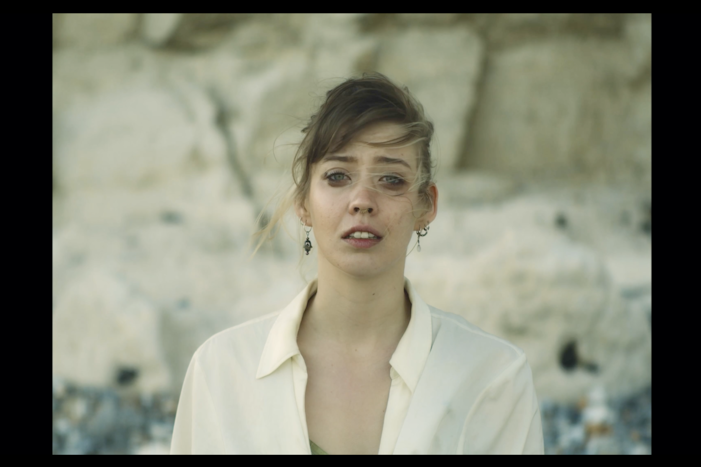
MAKEMECRY, made a year later, opens with the compelling scene of dancer-choreographer Clara Luna Nordahl kneeling in the sea, facing away from land, with Sussex’s Seven Sisters cliffs in in the background. The narrative, a personal exploration of grief, is very raw. The next few minutes sort of tell the viewer how she found herself there. Toh drops clues with a positive pregnancy test but also Misoprostol tablets, used to treat and manage miscarriages, and, as seems more likely here, in combination with Mifepristone, to induce medical abortions.
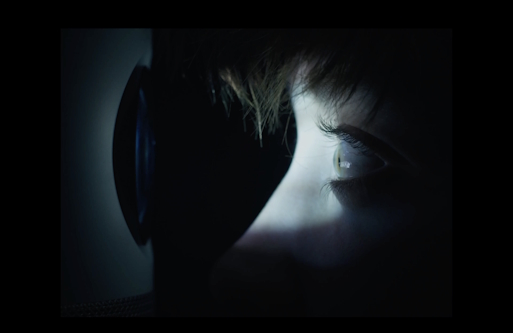
Photo courtesy Brian Toh
Again, the beautifully lit close-ups are more powerful that the shots of Nordahl dancing in the street and fields, although the latter do serve to emphasise the former. The final four minutes or so, in which we return to the seashore, the camera focusing solely on her face as she laughs and cries, are a bit of a test for the viewer but all credit for having the guts to stick with an idea. And since when did dance or screendance have to be an easy watch?
One criticism of screendance, in fact any dance on film, is that the audience’s freedom to look where they want to is taken away. That is undeniably true. The gaze is always ultimately the director’s. But as Toh and his associate creatives demonstrate, as in both iwishyoustayed and MAKEMYCRY, it can equally give things that dance live, viewed at a distance, sometimes great distance, cannot.
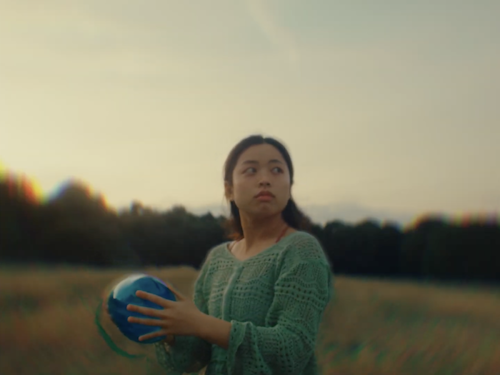
Photo courtesy Brian Toh
Co-directed by Toh and Tan Yu-ning, and choreographed by Tan and Regine Phua, who also dances, TOBURSTYOURBUBBLE (Toh likes running words together in his titles) is rather lighter in tone. Playing on the imagery of a fragile soap bubble popping when touched, it alludes to the fact that one can feel very comfortable in ones surrounding but that a new world can open up once that bubble bursts. As the action shifts easily from reality to a dreamlike state, Toh and Tan again make great use of one colour in particular, this time a turqiouse-blue. as it alludes to how a new world opens up to one once a bubble bursts.
Made in 2024, and perhaps reflecting an increasing confidence, the directing and editing makes much more effective use of the dance sequences, with constantly changing angles and different close-ups mixed in with distance moments. TOBURSTYOURBUBBLE is an easy and very appealing watch.
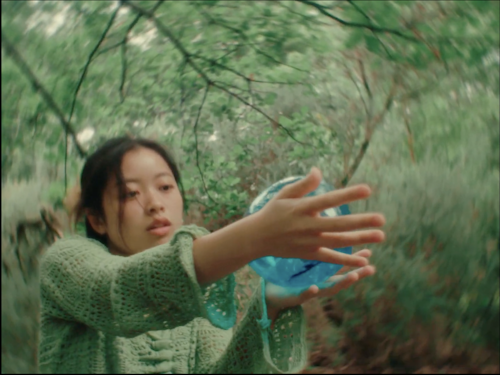
Photo courtesy Brian Toh
Screendance is very broad in the way it is delivered. But what about if there are no humans? Or if they are at least very incidental. Where is the dance in screendance if the human has left the stage? Can non-human movement allied with camerawork and editing still be screendance? This is where things get tricky and where one’s definition of dance comes to the fore. It also brings back memories of Sue Jones’ Sue Jones’ 1999 article, ‘Do rabbits dance?’
Co-directed with Tan Su-yan, CLOCK, also made in 2024 features several such timepieces. They go forwards and backwards, they spin, they are smashed. There is some human involvement. There is also a chicken. It is very cleverly edited, and the music, from Bach’s Brandenburg Concerto No.3 fits it superbly.
But are the clocks dancing? While humans might find reasons to consider something dance, the way fallen leaves gather and swirl in the wind might be an example, if the object or being does not have the capacity for action, or the capacity to consider what it is doing as dance (this is where rabbits come in) can it be dance? And if not, where does that leave the ‘dance’ in ‘screendance’?
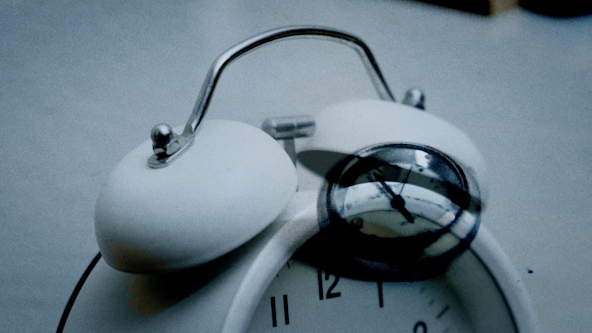
Photo courtesy Brian Toh
I have, in the past, showed both Birds by David Hinton and Yolande Snaith (2000) and Tape Generations by Johan Rijpma (2011) to students. When asked if they regarded them as dance or screendance, they invariably looked at me incredulously, especially when it came to Tape Generations, which simply features rolls of tape.
All the arts are forever changing. Boundaries are forever becoming more blurred. Dance is an increasingly flexible concept, as are different dance forms. One only has to think how much ballet and contemporary dance now overlap. Screendance is not and should not be immune from that. And it is important that directors like Brian Toh experiment and advance their art, and are given the time, space and opportunity to do so.
But a personal view is there does come a point when it stops being screendance, or at least what I consider to be screendance. While artists might revel in the freedom of reconceptualising and reinventing the genre, removing the human (sometimes called ‘radical screendance’) removes the dance. It effectively becomes solely about film-making and editing. Dance, and screendance, lives in the body, the latter also living on film. And that’s where I have a problem with CLOCK, not as a fine piece of art, which it assuredly is, but as screendance. Just like dance, screendance is not ‘anything goes.’ But that’s me and one view of many.