
Sadler’s Wells, London
September 10, 2026
Somewhat remarkably San Francisco Ballet’s first full‑length commission from a female choreographer, Aszure Barton’s Mere Mortals is certainly spectacular. Right from the opening dark scene, the stage enveloped by smoke and red light, it transports the viewer into futuristic, sometimes disconcerting landscape.
The dancing is powerful, the ensemble injecting a sense of great scale while the central duet provides a moment of calm. As befits a work inspired by technological developments. the backing projections by Hamill Industries are impressive. They compete with but never quite overpower the dancers. The score by Sam Shepherd (aka electronic music artist Floating Points) is terrific, at least once it gets past the opening persistent, high-pitched droning.
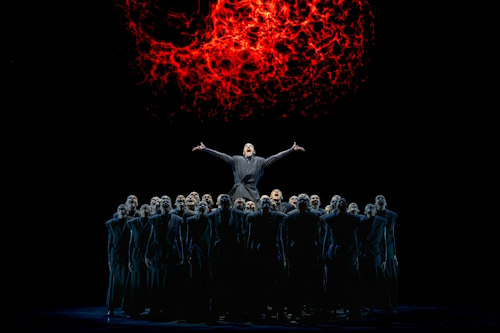
Photo Jane Hobson
The production is inspired by the ancient Greek myth of Pandora’s Jar. And it was a jar, or an amphora to be precise, not a box. The tale starts by referencing the theft of fire by Prometheus. Zeus’ revenge on humanity is to send Pandora as a gift to Epimetheus, Prometheus’ brother. Dazzled by her beauty, and despite warnings, he accepts her. All is fine until that fateful day Pandora opens the jar, allowing all the suffering, misfortune and other ills to escape, leaving only hope inside.
Barton takes all that and reimagines it through the lens of AI. While there are suggestions of what AI might unleash, Barton doesn’t pass judgement, and in fact ends on a note of hope.
And it is Hope, danced here by Luca Ferrò, who is the first figure we encounter (not that you would know who he is without reading the programme), bathed in swirling red mist, presumably reflecting the fire that Prometheus has delivered to humanity.
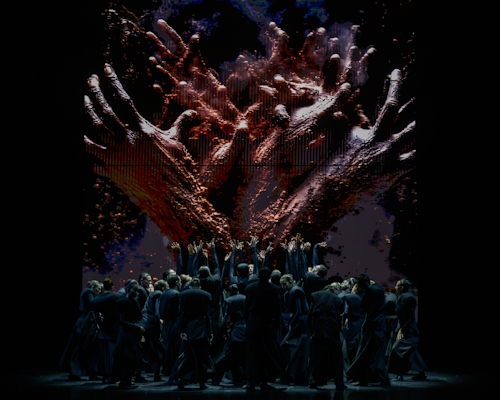
Photo Jane Hobson
When the forty-strong ensemble appear, they carry Prometheus (Fernando Carratalá Coloma) aloft God-like in a sort of ceremony, their dance propulsive, driving, powerful. As they move in repeating patterns, forwards and back, Michelle Janks’s costumes of black jackets and long black skirts swirl dramatically as they twist and turn. The dancers are also indistinguishable one from another, one of many comments one feels on the world, where we are, and where technology may be taking us.
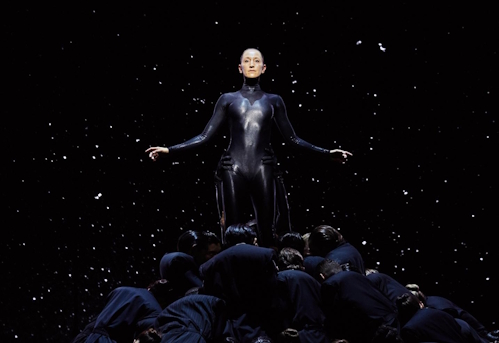
There is a very human duet between Prometheus and Epimetheus, one moment all hugs, another all argumentative push and shove, but at the centre of the ballet is Pandora, danced here by Nikisha Fogo. She appears to come from nowhere, appearing from within a crowd of dancers as if she is something they have created.
(pictured: Jennifer Stahl as Pandora)
Photo Andrew Perry, Edinburgh International Festival
Now the furious non-stop, stamina-sapping dance is replaced by something altogether slower. In skin-tight black, Fogo is humanoid but somehow not human. AI perhaps. Her semi-robotic movement has an intriguing and rather appealing angularity while simultaneously being startlingly fluid. Her shoulders and upper body in particular are so mobile it is scarcely believable.
Barton doesn’t simply present Pandora is the woman responsible for unleashing all the world’s ills, however, but relates her actions to her curiosity, her capacity to make choices, and to technological progress. But one is left with the feeling that those aspects of her could have been developed even further.
There’s also a sense of Pandora’s AI nature in her duet with Epimetheus (Parker Garrison). While choreographically inventive, Barton presents her as very curious but emotionally disengaged.
The moment when she unleashes the contents of the jar is striking in its simplicity. She just stands, her back to the audience, and watches as the visuals suggest, flood, storm and more. It’s one of those lovely moments when simply being still speaks volumes.
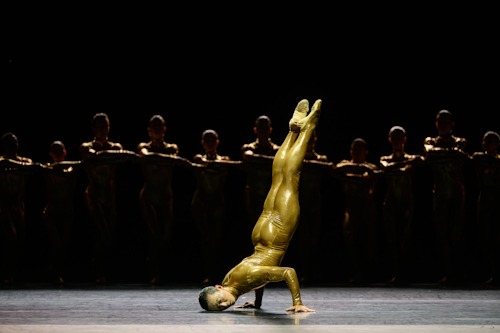
(pictured: Wei Wang as Hope)
Photo Jane Hobson
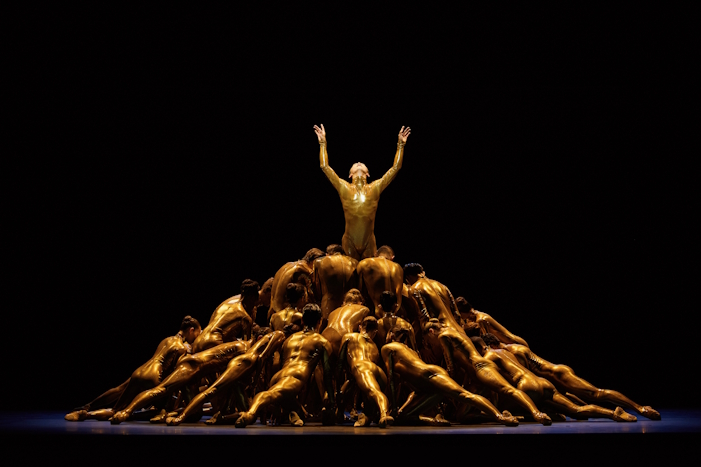
After that, things go dark before bodies re-emerge in shiny gold bodysuits. But while they look different, their movement vocabulary is surprisingly very much the same as previously. It’s almost as if underneath, nothing has changed, which feels strange. It’s just another example of how the whole narrative of the ballet is less developed than any of its other constituent parts.
The music continues to impress. Shepherd’s score, a very easy fusion of electronic sounds and live orchestra, shifts seamlessly between moods, at times delicate, elsewhere filled with tension. It’s especially fabulous when it seems to propel the ensemble forwards. It was played superbly too by the Royal Ballet Sinfonia under the baton of San Francisco Ballet music director Martin West.
Mere Mortals It is a visual feast, although it’s equally true that the narrative and depiction of underlying themes could be clearer. It’s also one of those ballets will have people debating whether it’s classical or contemporary. It certainly suggests the latter in feel and in much of the movement, although Barton does very neatly insert some seriously virtuoso classical steps on numerous occasions. Whatever one’s take on it, it’s definitely a ballet that will get people talking.