
Linbury Theatre, Royal Ballet & Opera, London
September 11, 2026
The title suggests a two-man project. The stage says otherwise.
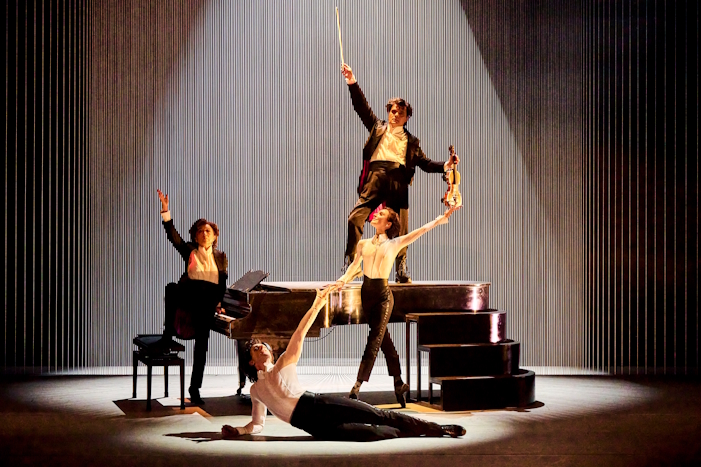
The McRae / Vassilev Project brings together four strikingly different performers: Royal Ballet principals Steven McRae and Sarah Lamb, violinist Vasko Vassilev, and pianist Pamela Tan Nicholson. Sofia-born Vassilev became the Royal Opera House’s first and youngest Concert Master in 1993 and is now Principal Guest Concert Master. Nicholson’s career is harder to summarise neatly: a Singapore-born pianist, former actress and television host, later a corporate lawyer at Baker McKenzie before returning to the arts full-time. She is also Vanessa-Mae’s mother.
Vassilev opens alone in darkness with Johann Sebastian Bach’s Prelude in D minor before McRae and Lamb enter for a pas de deux of remarkable ease. I found myself watching Lamb almost exclusively at first, but McRae’s attention to her became just as absorbing. Their partnership has the ease of people who know both their own craft and each other’s physical language extremely well. Tiny adjustments pass almost unnoticed. At one point, with Lamb unable to see him, McRae places his hand behind her back and lightly taps his fingers, signalling that his support is there before she leans backwards into his hand in arabesque.
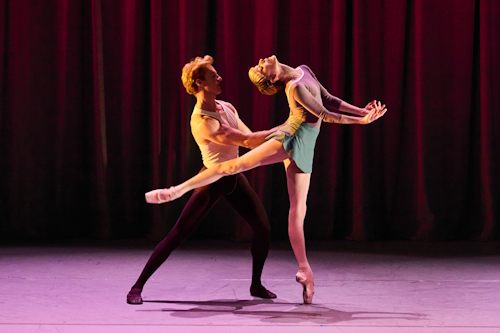
Photo Max Miechowski
The stage then turns into a rehearsal room and the evening loosens into conversation. McRae and Vassilev talk about childhood, parents, training, accidents and the routes that brought them here, with Nicholson joining so naturally that much of it feels almost overheard. Old photographs and film keep the mood affectionate and funny: McRae already dancing with startling energy as a boy, Vassilev joking about being a “mistake”, growing up with his grandparents, and appearing in one gloriously absurd film clip tied to a tree with his violin. For a while, the virtuosi on stage seem very close to the children they once were.
The clearest sense of who they are comes when the talking gives way to performance. Vassilev, occasionally hesitant in conversation, changes completely once he takes up the violin. In a compressed Paganini showpiece, virtuosity becomes almost choreographic: the bow travels in ricochet across the strings, then lifts into the more vertical bounce of spiccato, while his left hand races through shifts, high positions and double stops. Seen at such close range, the physicality of the playing is exhilarating. Bow, wrist and fingers seem to dance as much as McRae does. The quiet storyteller becomes a showman.
Tchaikovsky’s Russian Dance brings another burst of colour and movement. Later, McRae’s account of serious injury gives way to Czardas, tap shoes and a buoyant duet with Lamb. By the interval, one thing is already clear: these are artists who have spent decades training, repeating and recovering, and still take enormous pleasure in what they do.
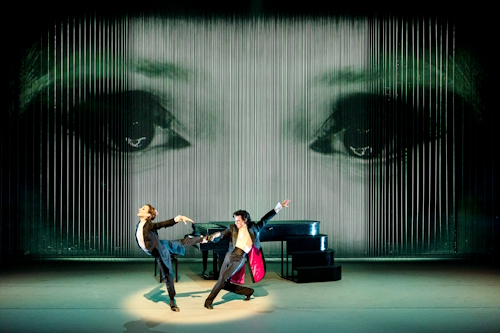
Photo Max Miechowski
After the interval, Paganini takes over.
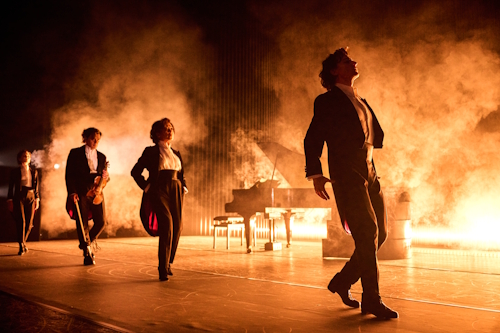
All four return in dark wigs and black tailcoats, each a different version of him. Vassilev stands on top of the grand piano with his back to the audience; McRae waits downstage in tap shoes, violin bow in hand like a sword. McRae moves first. Vassilev turns and answers with gesture and raw sound before launching into the instantly recognisable opening of Caprice No.24. The second half revels in Paganini’s appetite for display, invention and mischief.
McRae taps, dances and ventures onto the piano. He squeezes onto the stool beside Nicholson, then later stretches across the lid to play a brief figure with two rapidly alternating fingers. Nicholson pushes his hand away with perfectly timed irritation to the audience’s delight. He even breaks into tap on top of the piano. A protective board is clearly in place, but I still found myself thinking, please don’t.
Lamb crosses into the musicians’ territory too, plucking at the violin, while her partnership with McRae grows increasingly daring. At one point she climbs onto the piano and dives straight into his hands, tipping into an overhead handstand lift that, for a moment, looks as though her momentum might carry her too far. She never loses her smile. McRae never loses control.
in The McRae / Vassilev Project
Photo Max Miechowski
Vassilev has tremendous fun with Paganini’s virtuoso persona. In the famous one-string display, he loosens the other strings one by one until only a single string remains in play, turning the preparation into theatre. Up close, watching is almost as thrilling as listening: the bow ricochets and rebounds, the wrist releases and recovers, and the left hand moves with astonishing speed and economy along the fingerboard. At times the movements seem too small and too fast to account for the sounds coming from the instrument.
Nicholson is equally difficult to ignore. Her reactions remain part of the comedy even from behind the piano, and later she rises over the keyboard and drives into a passage with the sustaining pedal down, looking every inch the rock star.
By then, the four Paganinis have become something larger than the conceit. McRae’s attack, Lamb’s nerve, Nicholson’s theatrical instinct and Vassilev’s swagger feed off one another. More important is the visible pleasure they take in each other’s craft.
That pleasure keeps spilling outwards. After decades of training, repetition, injury and discipline, all four still seem delighted by the act of doing. That joy is infectious.