
Sadler’s Wells East, London
November 10, 2026
Humanhood’s Vortex, a 55-minute work by the company’s artistic directors, Julia Robert and Rudi Cole is an evening of beautiful dancing, powerful music and, at times, quite spectacular lighting.
The work opens in darkness. Six dancers gradually appear on stage, wearing conical hats and loose grey costumes. Their faces are hidden. There is something reminiscent of tai-chi in the opening movements, particularly in the gentle turns of the body and the way the arms move through the air. As the dancers remove their hats and the music builds, the choreography becomes much more energetic.
There is a lovely freedom in the way Humanhood’s dancers move. They have a particularly good use of the back and upper body, and their floorwork is impressive. They shift through deep bends, turns and changes of direction with apparent ease. The relaxed quality of the body is especially interesting given how physically demanding the choreography is.

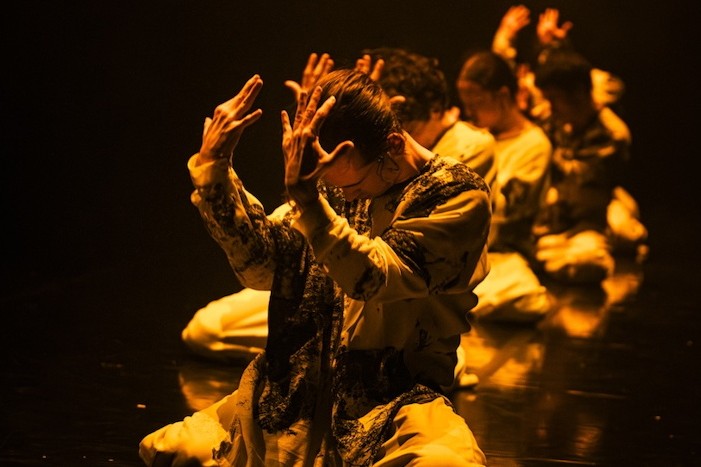
Photo Raul Sasan
The group work is where the company really shines. The dancers come together and separate, moving in circles before breaking into smaller groups. There is a great deal of precision in the choreography, yet the dancing never looks rigid. Each dancer has a slightly different physical quality, which adds interest even when they perform the same steps.
Aiden Bromley’s lighting is one of the highlights of Vortex. The use of small spotlights creates some wonderful stage pictures. At times, it is almost impossible to tell where the next dancer will appear.
Iain Armstrong’s score, with its heavy percussion and layers of human voices, works particularly well with the circular movements of the dancers. Even their breathing becomes part of the music.
The atmosphere changes considerably as the stage takes on a warmer colour. Six dancers sit and kneel in a line, performing a series of upper-body movements in unison. It is a peaceful and visually beautiful section, although it could perhaps have been a little shorter.
For all the beauty of the lighting, there are moments when the stage is simply too dark. The combination of smoke and low lighting makes it difficult to appreciate the details of the dancing. With performers of this calibre, it seems a pity.
There is also a certain familiarity to the choreography towards the end. Some of the movement patterns have already been explored quite extensively, and a little more variety would have been welcome.
Still, what Robert and Cole have achieved with Humanhood is admirable. The company has a very distinctive way of moving, and there is a generosity to the dancing that makes it enjoyable to watch. The physical strength of the performers is evident throughout, but so too is their sensitivity to music and to one another. Vortex is at its best when the choreography is allowed to speak for itself. There is already so much beauty in the movement.