
The Place, London
November 13, 2026
Ram a dis- into your favourite dance terms and you’ll begin making sense of butoh: disease, disability, distaste, disgrace.
Dance usually makes the impressive look effortless. Feats of physicality, taking years of training to master, happen with an invisible nonchalant shrug. No biggie. But butoh is a dance that makes the unimpressive look effortful. That sounds baffling, and butoh often is, but the Japanese dance form sometimes creates astonishing passages of desperate, sickly beauty.
Rebellious Bodies Festival brings the radical ‘dance of darkness’ to the UK. Butoh developed in post-WWII Japan within the wider post-nuclear recovery of Japanese society, shaped by incoming avant-garde influences including French Surrealism. Its founders wanted something without the rigidity of traditional Japanese dance and the refinement of Western dance. Across four performances totalling eighty minutes, Friday evening presented a frequently uncomfortable but sometimes incredible sample of butoh’s contemporary incarnations.

Photo Zoetica Ebb
In The Last Two, the evening’s only duet, half of the duo MUTSUMINEIRO appears on stage as a human bush. Mutsumi crouches topless with white-blossoming branches tied to her back. She’s a contorted slow-mo pixie, the branches rustling with her hunched hops.
Mutsumi leaves and Neiro enters, shattering the delicately spooky atmosphere. He throws an armful of balloons up and does keepy-uppies, like a footballer. Except this footballer has a tall red mohawk, blue eyeshadow, and a fluffy thong. He madly bounces the balloons, a child trapped in an ageing body.
Returning sans branches, Mutsumi carries two bowls of rice. Facing us, she kneels, places one on the floor to her right, and eats from the other. Neiro’s mad frolics continue around her. He gives himself a loud arse slap; she carries on eating, impassive. It’s a baffling mixture of dull, silly and manic.
When he kneels beside her, they both scoff rice as the climax of the grand, rollicking orchestral music washes over them, drawing no response whatsoever. There are gestures to some deeper potential within The Last Two: she the contorted plant with impossible eternal blossom, he the mad-old-man-as-child, together stuck in some mute marital trap… But it doesn’t get that far.

Photo Gen Kasuga
At the end, she sits on his shoulders and he stands up with phenomenal, leg-shaking effort. It’s mock-epic: many ordinary people could do it, but here it’s exhibited as the most amazing acrobatic feat. I didn’t know what to think. My notes simply say ‘grandpa Olympics’. It’s almost funny, almost pitiful, and utterly bemusing.
A Pulse of Absence, the second performance, is my favourite. Seiji Tanaka starts his solo on a unicycle, circling a silver bucket. He wears only tiny black pants on his white-painted body. The soundtrack is a primal voice that hums and jabbers like a didgeridoo. The frantic speedster circles faster, drawing us into his strange shamanic rites, until eventually he falls.
He alternately wrestles and strokes his unicycle, then sits spinning the wheel, looking out at us with a manic grin. The dance excels at channelling the creepy smile of the evil clown archetype–but Tanaka manages to ooze this from his whole body.
Using his unicycle as a wheeled crutch, Tanaka’s walk appears impossibly pathetic, his body impossibly frail. He wheezes. Sisyphus is 1,000 years old and sick of this BS. He stumbles with stunted movements, a body unsure whether to embrace death or rebel against it. Watching him stirs a slightly shameful combination of pity and disgust, like wanting to help someone, but gagging at the sight of their wounds.
Withdrawing a soaked length of fabric from the bucket with his teeth, he shakes it like a dog tugging a toy, human reduced to creature. (Casting directors need look no further for another Gollum.) It’s actually a sodden dress, which he pulls on. As falling water droplets catch the spotlight, an angelic chamber choir sings alongside silky saxophone. Still knock-kneed, he unravels his arms and becomes something delicate and saintly. The stunning re-birth is like watching a demon realise it’s been an angel all along.

Photo Makoto Onozuka
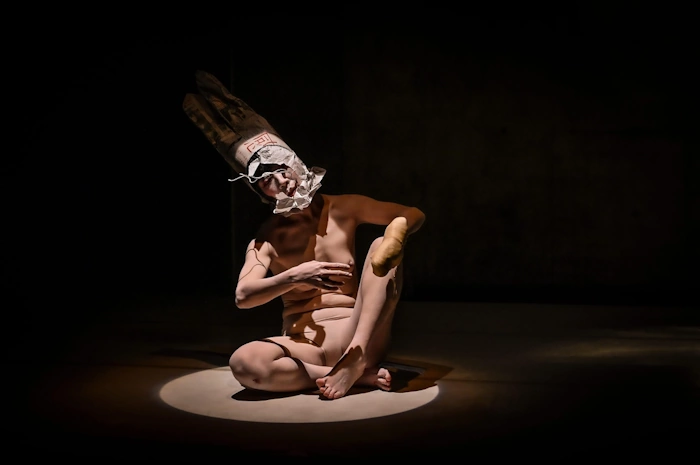
In Naked Rabbit, another solo, Makiko Takamatsu dances with parts of her body wrapped in pink tape, matching pink eye shadow, and her hair in two pointy ponytails (presumably the titular rabbit’s ears).
Images are projected onto the huge screen at the back: a black and white POV film of walking through a dark tunnel, then a slideshow of pictures. An old cartoon of Mickey Mouse reading a ‘HOW TO KILL’ manual appears among photos of natural beauty and footage of a fighter jet flying overhead. There are moments of dark humour and curious incongruity, but often the images are distracting, taking more from the dance than they give.
Takamatsu dances animalistic movements excellently, in probably the evening’s strongest evocation of mainstream contemporary dance (though perhaps that’s not a compliment in a butoh context). When the writhing and thrashing stops and she’s finally still, there’s a moment of release similar to the previous dance, but not as profound. It seems jumbled. The projected visuals fragment our attention a little too much for an already frantic performance.
That said, Naked Rabbit often has an incredible movement quality which the other dances sometimes explore, but never as powerfully: Takamatsu’s limbs twitch faintly. When her arms or legs reach, there’s an internal fluttering trying to break out. The double movement lends a sense of internal battle–perhaps why butoh can captivate with so little external plot.
Closing the evening, A Requiem for Her, a solo by septuagenarian butoh icon Mitsuyo Uesugi, who studied under Kazuo Ohno, one of butoh’s founders. Wearing a black dress, she begins facing a spotlight that slashes diagonally back to upstage right. She labours towards the light as if it’s the most difficult thing in the universe.
Sometimes she’s like an ancient prowling spirit of the dead that’s lost its way. Sometimes her mouth lolls open under a dopey face. Walking backwards in bewilderment, she appears lost not just within the stage, but within her own body. Collapsing later, she balls her limbs up into a grim, bony embryo. When she sits up, she looks empty, as if in total discombobulation after a massive, existential bender. How powerful frailty can be. Like a hunger artist or the performance art of Tehching Hsieh, the sheer force of willpower makes an artform of endurance.
At the end, facing the same diagonal spotlight again, she slowly rises from a crouch to stand with one fist raised in celebration or defiance. Like the Japanese art of kintsugi, where pottery repairs highlight the cracks rather than hiding them, the victory contains a marvellous, fragile beauty.
Enjoyment isn’t really the right word for an evening of butoh. There’s rarely the same unhindered awe or wonder which other dance forms inspire. Butoh doesn’t pull us up, it pushes us down into feelings of fear, discomfort, pity and shame. Yet we keep watching with morbid curiosity. I leave with a wince fixed on my face.
Perhaps it’s dance as memento mori, like the skull in a Renaissance painting, or the Buddhist meditation where you watch a dead body decompose. Butoh feels like dance in crisis. But crisis is too flashy a word: it’s dance decrepit, crumbling, tainted. It’s not what happens if dance has some glorious, stage-worthy end. It’s what happens if you hang around to witness the rigor mortis and to prod its rotting corpse.