
On November 25, the Bayerishes Staatsballett premiere ‘Carpathia – The Myth of the Undead’, a new ballet by, Edward Clug inspired by Bram Stoker’s famous vampire novel Dracula. Midway through the creative process, Jeannette Andersen talks to the Romanian choreographer and director of the Slovenian National Ballet about what inspired him to do a piece on vampires, not a typical theme for a ballet.
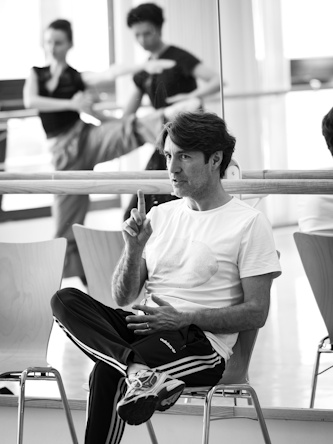
rehearsing his new ballet for Bayerisches Staatsballett,
Carpathia – The Myth of the Undead
Photo Miljana Bernal
In the lift, on my way up to the studio in the Opera House where the Bayerisches Staatsballett rehearses, I was squeezed between a life-size and a baby-size coffin, which I followed into the studio; an appropriate entrance for an interview about a vampire ballet.
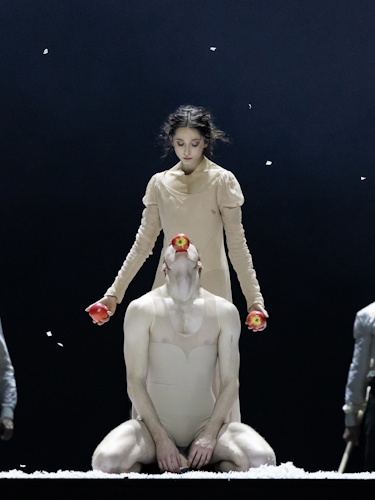
The rehearsal had already begun and the corps de ballet stood with big, red apples in their mouths. They took them out, but held onto them until the end, when Edward Clug took me into an empty studio.
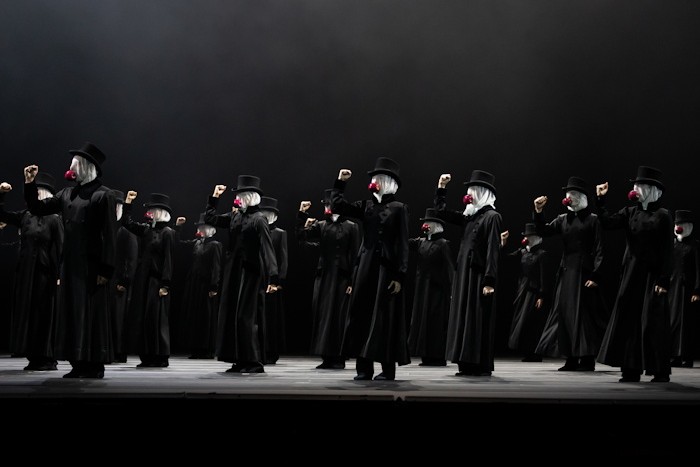
Opening his iPad, and before I could even ask a question, he said, “Look at this scene with the apples. Then you get a better understanding of what we were doing in the studio.” He showed me a picture of the group clad in long, black robes holding the red apples over their heads. It was dramatic and frightening.
Soon, his enthusiasm and willingness to share spilled into the studio and wrapped me up in an intriguing story.
He continued, “It is the beginning of the second act. The arrival of the contamination, that is brought into this city, that does not have a name. The characters in the ballet are also nameless; there is the wife and the friend. But it is theatrical, which I believe, is one of the most important elements in my storytelling ballets.”
The title of the ballet, Carpathia, is taken from the area that, according to myth, Stoker’s vampire Count Dracula lived out his blood sucking existence. The Western Carpathians is also where Clug was born, not far from what today is considered as Count Dracula’s castle.
Carpathia – The Myth of the Undead
Photo Miljana Bernal
He explains, “It kind of marks my destiny, because I happened to be born there. But my concern with this ballet is not to show the stereotypes of vampires with sharp teeth and blood. There will be blood, but not as a consequence of vampire behaviour. We will use this symbol differently. I am trying to reclaim a story based on Bram Stoker’s imagination. His book Dracula was an inspiration to me. In my ballet, I follow its narrative although I am also inspired by F.W. Murnau’s and Werner Herzog’s film adaptations of the book.”
Clug goes on to talk about the origins of the Dracula myth, but also goes beyond that, looking at what it was turned into, and what it means nowadays.
“Today people have become a little bit more arrogant, not about vampires, but about the supernatural. In Carpathia, however, the superstition and the fear of the unknown is present even today. It co-exists with the modernity of the country and the digital era. Even though many people are highly religious in the rural parts, it also plays a role there.”
He continues, “It started after the fall of Nicolai Ceauşescu (the Romanian dictator from 1965-1989). In a way, I experienced a vampire in my childhood, because that was exactly what he was. He sucked up the blood of his own people in order to live out his ambitions and greed, while we were literally starving. After he fell, people became extremely religious. Under his regime it was forbidden. Religion became so important, because the closer you are to the moment of death, the more you have to accept mortality, and the more you need something to assure you that it is not the end.
Clug defines how he sees the vampire. “It is not something constantly hungry, but it is somebody that experienced a rupture, from God, from his love, but not from love itself. So, this character is capable of carrying love for centuries. To me, this is a very interesting aspect of the story, and this rupture gave me the first impulses into the dance and characters, the ritual of this transformation.”
Carpathia – The Myth of the Unded by Edward Clug
Photo Miljana Bernal
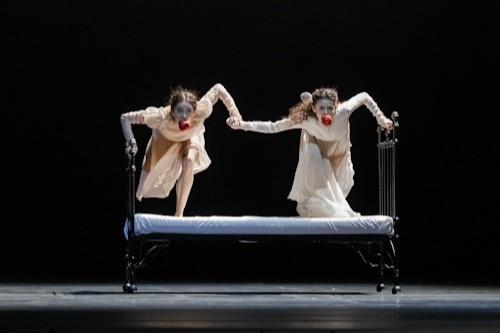
He goes on to explain how this translates into dance and how he passes it on to the dancers. “We start with a character or a certain scene, a direction or a guidance, a thought. And of course, we end up creating material, movement and choreography, which liberates us from the story or the narration. But then we come back to it, when we have enough resources, enough words, meaning steps or material, that we can maybe put together.”
During the two rehearsals I attended, it became clear that Clug is very specific about what he wants the dancers to do. With the corps de ballet, he kept asking them to repeat a phrase, in which they stood tightly in a circle and had to bend forward while lowering their raised arms with small jerks. It did not work the way he wanted, but he just left it at that and said they would work on it at the next rehearsal.
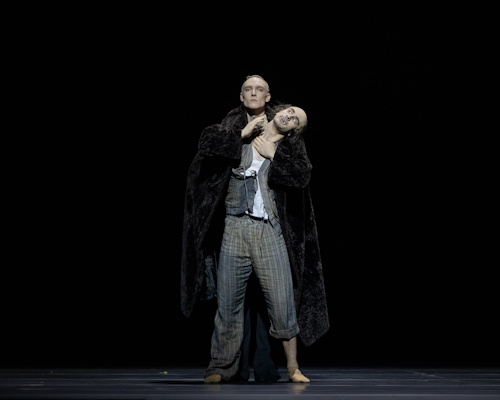
Photo Miljana Bernal
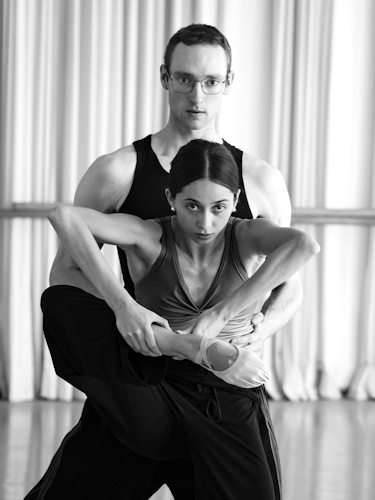
Similar kindness and respect was bestowed on Osiel Gouneo and Elisabeth Tonev, dancing two of the main characters, with whom he rehearsed after the interview. He knew exactly what he wanted, but gave the pair room to find their own way to create movement; and he was open to their suggestions.
Clug has been choreographing for around 30 years. How did he find his own means of expression or body language as a choreographer? He replied simply, “I did not. Did I? I am still doing it. I like to believe that I am always dealing with a topic, and that topic requires a certain behaviour.”
The same goes for the music, which Clug has commissioned from the Slovenian composer Mirko Lazar, whom he has worked with since 2008. Clug says, “The music has to be ready a good half-year before the premiere. It is basically there when I start in the studio.”
Carpathia – The Myth of the Undead
Photo Miljana Bernal
He explains how he and Lazar work together. “Usually, I put together a script, which we shape into a libretto. For Carpathia we really did not want to use Transylvanian music. But we have the sound of an axe and the repetition makes it almost liturgical. We were working on this sound, when I said, ‘Mirko, we need a voice, a Romanian song’. And he discovered one, it is a bocete, a traditional funeral lament. It was recorded in 1905 by Bela Bartok (on one of his expeditions to collect music), in the exact same place where I was born.”
Bubbling with excitement Clug plays an excerpt for me before continuing, “We also use another song. I was visiting an old monastery in Armenia and the guide, a young man named David, also a musician, said to me, ‘This chamber has an incredible acoustic’, and started to sing a 13th-century chant in old Armenic language. It was beautiful, and he allowed me to record it. This we also use in the ballet.”
Again, he plays an excerpt and for a moment it feels like entering a sacred room. Clug interrupts the music. “You can hear a bird from outside, because the cupola had a hole. I do not think anyone will hear it, but I like it.”
Clug is on a tight schedule. He is not only creating Carpathia for the Bayerisches Staatsballett, but a week after we met, he flew to Canada to cast his Peer Gynt for Alberta Ballet. Then, at the beginning of next year, he stages the opera Don Giovanni for the opera in Maribor having directed his first opera, Castor and Pollux, earlier this season for the Grand Theatre de Genève. He is also working on staging the Nutcracker he created for Stuttgart Ballet in 2022 for his company in Maribor, with its costumes and sets by Jürgen Rose. In 2027, he is also creating a new full-length piece for Dortmund Ballett, where he is resident choreographer.
I wonder how he copes with all the work. He says, “I tend to be very disciplined and organised. That is essential because when I create, which is my favourite part of the work, I have to detach myself from the administrative part. Creation requires a lot of advance preparations. So, I do try to avoid undertaking too much, in order to keep the curiosity and pleasure, which I think is essential.”
The Bayerisches Staatsballett premieres Carpathia – The Myth of the Undead at the Nationaltheater, Munich on November 25, 2027.