
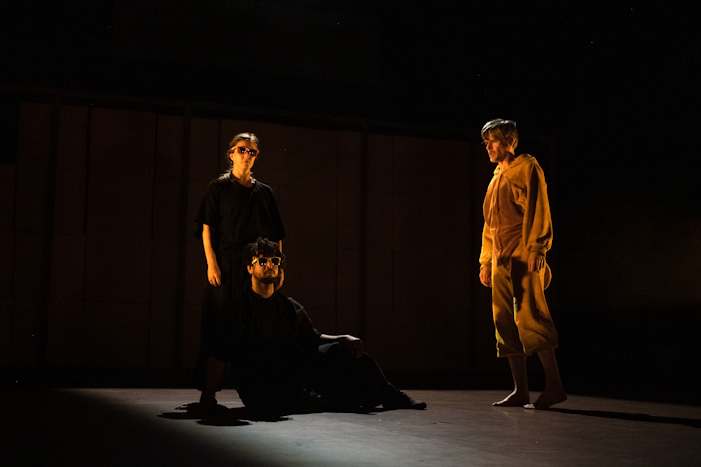
Lost Dog’s new production, ‘The Last Hamlet’, comes to Sadler’s Wells East in early November following performances at the Avignon Festival and in Paris. Ben Duke, who conceived and directs the show, talked recently with Zoë Hewitt.
Gertrude answered with only one word. “No”.
In an early sharing of The Last Hamlet, Ben Duke questioned her again and again. Her answer never changed, but its meaning did. As Duke altered the questions, “no” shifted from rejection towards the answer Hamlet needed.
I remember sitting there wondering whether Duke knew exactly what he was doing. When we met in August, after the work had gone through technical rehearsals in Paris and a run at the Avignon Festival, I finally asked him. He did. For Duke, the changing questions are bound up with how Hamlet gets what he needs from the people around him. “There’s a kind of control, in a way.” Change the question and the same answer can become an affirmation.
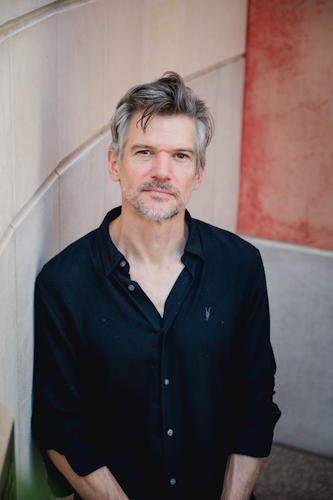
Photo Nora Houguenade
That idea reaches beyond Gertrude, although The Last Hamlet itself has proved difficult to control. Since the sharing I saw in June, even the soft-toy cast has changed: Claudius is now a snake rather than an elephant, while Gertrude remains a rather mournful goose. Scenes have been rewritten, collaborators have altered the material, and audiences have revealed things that rehearsal could not. Duke still does not regard the work as finished. Before Paris in September and London in November, it will surely change again.
More significantly, his own position inside it has shifted. In June, he was still negotiating the distinction between himself as maker and Hamlet as character: was he, Duke, directing Hamlet, or was he Hamlet? By Avignon, that ambiguity had largely gone.
“I am Hamlet,” he told me.
The proposed ‘cancellation’ of Hamlet now carries different stakes. Once Duke places himself inside the role, removal becomes personal. “They want to stop me, my existence.”
That shift also changes the function of the soft toys. Duke had initially been thinking about making theatre with less and less money, and about beginning a work that is not quite a solo with the feeling of one man insisting he can manage alone. Hamlet has limited resources, so the people around him are assembled from what is available.
Family life added another layer. Moving house had surrounded Duke with cardboard boxes, while his daughters reminded him how much memory a soft toy can carry. Once those toys met an audience, their status shifted again: figures standing in for Gertrude or Claudius began to acquire lives of their own in the audience’s imagination. Duke can still throw them or break the illusion, but their meaning is no longer entirely his to control.
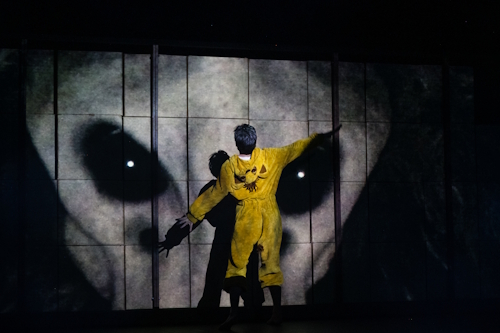
Photo Nora Houguenade
The work also changes through the people Duke brings into it. He has worked with Hannah Shepherd and Miguel Altunaga before, and describes a rehearsal process in which dialogue and ideas move both ways. He may give Shepherd a piece of text, then ask whether it makes sense to her or whether she wants to change it. What interests him is “how we close that gap between them acting and them kind of being.”
Altunaga’s gravedigger offers a particularly clear example. The scene originally contained a substantial amount of Shakespearean text, but shortly before Avignon they decided it did not feel right. Altunaga began performing it in Spanish instead, his mother tongue and, importantly for him, in a way that sounded like how he speaks as a Cuban rather than simply generic Spanish. Duke found that the character changed with the language. He liked the change enough to keep the Spanish for London, where he expects to use surtitles.
The audience introduces another variable. Avignon was the first opportunity to discover what the participatory exchanges really do, because rehearsal cannot reproduce someone who refuses, overcomplicates a simple task or responds in an unexpected way. Duke is particularly alert to refusal. He dislikes participation in which everyone is instructed to stand or dance and collective enthusiasm starts to feel like pressure. In The Last Hamlet, much of what he asks can be done while people remain in what he calls the audience’s ‘territory’, perhaps holding a piece of paper or saying a word without being pulled onto the stage.
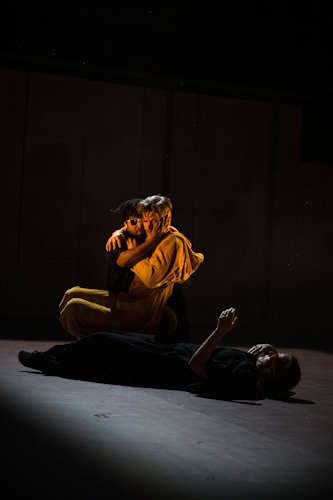
in The Last Hamlet by Ben Duke
Photo Nora Houguenade
“I think they should be allowed not to be,” he said of those who prefer not to take part. For a work in which Hamlet keeps trying to obtain the response he needs, that right to say no matters.
Uncertainty is also built into Duke’s own performance. At an earlier talk, I had heard him describe language and movement as two resources he moves between. When movement cannot say enough, he turns to words. When words are no longer sufficient, he returns to the body. I wanted to know how that works now, with Duke creating, directing and performing the work while moving increasingly inside Hamlet himself.
He gave the example of a phone call from Horatio announcing the death of Hamlet’s father. Language can establish the situation, but speaking about an emotion is different from entering it. “If I talk to you about that emotion, it doesn’t feel quite the same as me falling into it for myself and kind of feeling it.” For Duke, that is where movement becomes necessary, allowing him to live through something the words have already named.
Elsewhere he remains uncertain. There are passages where he still does not know whether he has made the right choice between speaking and moving. Hamlet talks a great deal, and Duke has found himself doing the same. Many of those decisions are made “from the inside”, according to how the material feels. When I remarked that this sounded rather Hamlet-like, he laughed: “A kind of self-obsession.”
That instinctive approach also surfaced in Avignon, where French interviewers repeatedly asked why he used humour. Duke found the question odd. “I don’t really think of humour as a kind of device. I just kind of enjoy humour, and also, I feel like humour is part of life.”
His own question was the reverse. Why would you not use it? Sadness and comedy, he suggested, often sit very close together. I told him I had not realised that might be read as particularly British. He was not sure it was, but wondered whether some of the response came from a perceived Britishness.
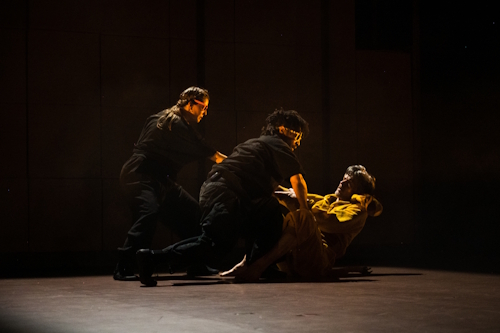
in The Last Hamlet by Ben Duke for Lost Dog
Photo Nora Houguenade
He talks about humour much as he talks about speech and movement: the decision begins with what a moment seems to need. Sometimes an audience is what tells him whether the balance is right. At a sharing in Paris, one person felt that a dance between Hamlet and Ophelia lasted too long; another valued the space it created. Duke does not treat either response as an instruction. Repeated attention to the same moment, however, gives him a reason to look again.
When I asked what he meant by repeatedly saying there was “more work to be done”, the conversation moved towards masculinity. One of the questions present from the beginning concerned the kind of masculinity Hamlet represents.
Hamlet can be sensitive and intelligent. Duke even described him in terms of what we might call emotional intelligence. Alongside that, he sees “a kind of lack of empathy”. The combination interests him because it extends beyond the play. How are boys raised? How do men arrive at a place where sensitivity and intelligence can coexist with behaviour that harms other people?

Photo Nora Houguenade
This brings The Last Hamlet into contact with the theatrical impulse to turn attention towards women pushed to the edges of canonical stories. Duke spoke about Katie Mitchell’s work and the importance of allowing figures such as Ophelia and Gertrude to speak. He then talked about how men might “generate that space” within a patriarchal system.
That was the point where I pushed back. Why, I asked, should I need a man to create the space in which I am allowed to speak? Does my voice depend on his permission?
Duke does not defend the phrase. “It shouldn’t be about granting permission.” The question then becomes what he, as he put it, a white middle-class man, can usefully contribute to that conversation.
His answer returns to Hamlet’s experience of removal. Duke speaks about men struggling with a loss of power or platform, and about Hamlet’s own experience of being pushed aside. In The Last Hamlet, cancellation is felt as an attack on his existence. “We should listen to Ophelia and we should listen to Gertrude,” he said. “There is still that guy.”
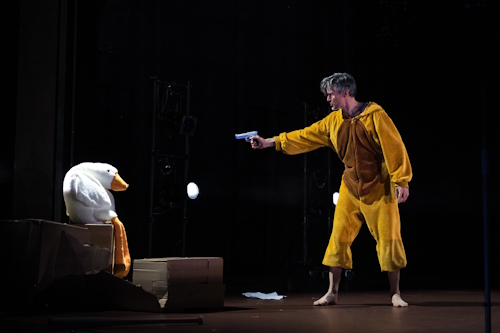
Photo Nora Houguenade
If ‘that guy’ is silenced, Duke argues, he does not disappear. He hesitates over what should happen instead. “He has to be somehow…” he begins, before offering, “Reformed somehow.” I suggest ‘re-educated’. Neither of us had an answer ready.
That difficulty has become central to the work. The Last Hamlet began with the provocation of removing Hamlet, but the consequences of that removal have become harder to untangle. So, I returned to something Duke has been asked from the beginning. Why Hamlet? More precisely, I wanted to know whether his answer had changed after making the work and putting it in front of audiences.
It had not. The question was still the same, although his understanding of it had changed. “I maybe underestimated how complicated a question it was.”
At the beginning, removing Hamlet may have seemed comparatively direct. What happens if this particular man is taken out of the centre? The deeper Duke went into the work however, the harder Hamlet became to extract. “He’s kind of everywhere.”
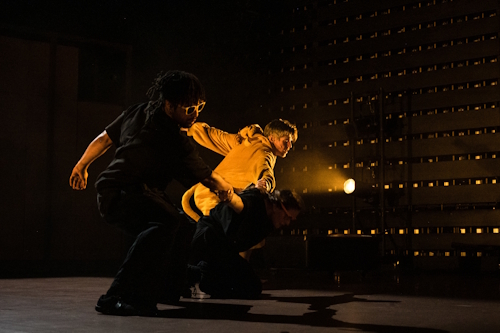
in The Last Hamlet by Ben Duke
Photo Nora Houguenade
Hamlet runs through plays, novels, poems, films and cartoons. People who have never seen Shakespeare’s play may still know the skull, the soliloquy or Ophelia. More important to Duke is the attachment people form to the character. Hamlet has given language to thoughts and experiences that some people recognise intimately. “He says some amazing things, and he puts into words these kind of profound thoughts.”
Proposing his removal makes that attachment easier to see. Questioning Hamlet’s position does not automatically tell us what should replace him, while declaring him obsolete does little to erase the cultural memory already attached to him.
Duke’s attraction to Shakespeare seems to lie in that difficulty. This is the second Shakespeare work he has taken apart and rebuilt, and when I asked why he keeps returning, he spoke about complexity rather than reverence. Shakespeare, he said, is a “master of complexity” and of the grey area. His plays resist binaries and keep opening questions.
They also give performer and audience something they already share. Shakespeare exists, Duke said, in “our shared imagination”. When an audience sits down for Juliet and Romeo or The Last Hamlet, it rarely begins from nothing. Familiar images, school encounters and personal attachments are already in the room.
That may be one reason The Last Hamlet remains unfinished in Duke’s mind. The question that started the work has survived, while each stage of making it has made the answer more difficult. For now, that difficulty remains part of the work as it continues towards Paris in September and London in November.
Conceived and directed by Ben Duke, ‘The Last Hamlet’ by Lost Dog is at Theatre des Abbesses, Paris from September 22-30, 2026; then at Sadler’s Wells East, London from November 4-7.
For a full list of forthcoming Lost Dog performances, including ‘Juliet & Romeo’, ‘Paradise Lost (lies unopened beside me)’, and ‘Ruination: The True Story of Medea’, visit www.lostdogdance.co.uk.