
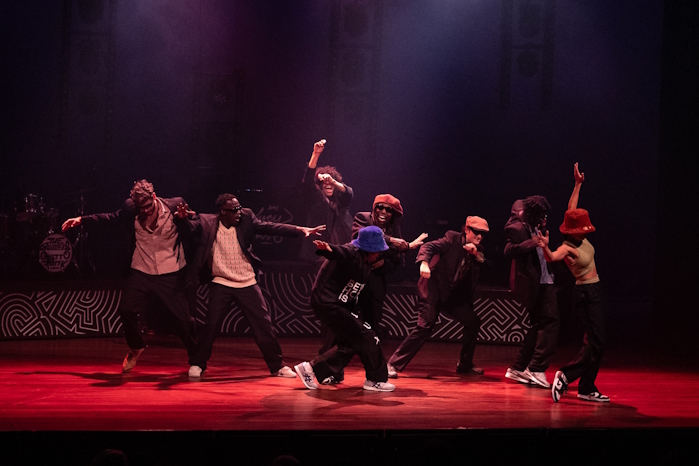
Queen Elizabeth Hall, Southbank Centre, London
June 6, 2026
There is no easing gently into Groove. From the start, The Ruggeds and Ghetto Funk Collective bring a high-energy fusion of hip-hop, breaking, street dance and live funk music to the stage.
As much concert as dance performance, and presented as part of the Southbank Centre’s 75th anniversary year, Groove takes its audience back to the sounds and spirit of James Brown, Nina Simone and Herbie Hancock, but without ever becoming a museum piece. This is a show that looks backwards in order to move forwards, using funk, soul, hip-hop and house as the engine for a lively, skilful and exhilarating evening.
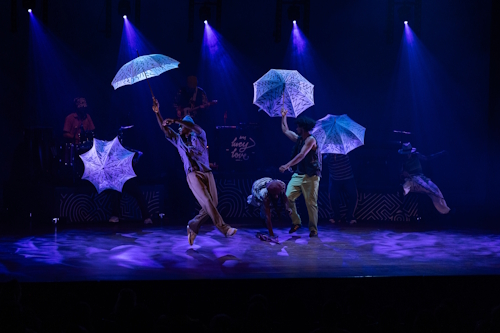
Photo Emile Vrolijk
Produced by The Ruggeds, with choreography by Ruben ‘Chi’ Verhoeven and music by Jessy ‘FORTBEIGE’ Kemper and Alexander ‘Shield Beats’ Henriksen, the production has a loose cabaret frame. Verhoeven acts as a kind of maître d’, introducing the performers, guiding the audience through moments of participation, and signing the evening off with easy charm. It is an effective device, creating informality without allowing the show to lose shape.
The versatility of the performers is immediately striking. This is not a case of dancers accompanied by musicians, or musicians decorating a dance show. The cast are dancer-musicians and musician-dancers: playing keyboard, drums, guitar and brass, then moving into dance with the same assurance, attack and musicality. Lucinda Wessels, Rico ‘Griimsen’ Coker, Sammy Huijts, Virgil ‘Skychief’ Dey, Roche Apinsa, Alexander ‘Shield Beats’ Henriksen, Jessy ‘FORTBEIGE’ Kemper and Verhoeven form an ensemble whose collective skill is obvious, but where individual personalities are also allowed to shine through.
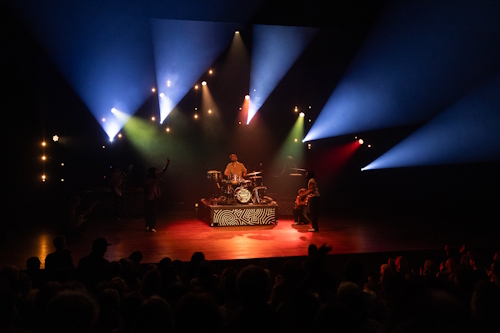
Photo Emile Vrolijk
The dance is delivered in sections but the sequences do not feel merely placed one after another. They link, develop and respond to changes in musical style, creating a sense of flow through different grooves, rhythms and textures. Breaking, hip-hop and street dance vocabularies dominate, with their familiar drops, freezes, spins, footwork and isolations, but Verhoeven’s choreography keeps finding ways to refresh the material. There is inevitably some repetition, as there often is in any highly codified dance form, but the pacing, musical variety and sheer technical command prevent it from becoming static.
Some of the most absorbing sections come when the relationship between music and dance is showcased. In a series of improvised duets, a dancer and an instrumentalist meet in a kind of exchange. Sometimes the dancer leads and the musician follows; and then the reverse happens, with the music provoking, interrupting and directing the dance. These moments have a faint air of indulgence, in that each performer is playing to their strength, but they are also riveting. They reveal the live intelligence of the show: rhythm not as background, but as conversation. The musicians also get their own space in the spotlight. A drum solo, in particular, is exceptional, not merely as display, but as a reminder of how deeply the whole show is rooted in rhythm. The longer instrumental solos are fully justified too. They do not interrupt the dance so much as expand the world in which it exists.
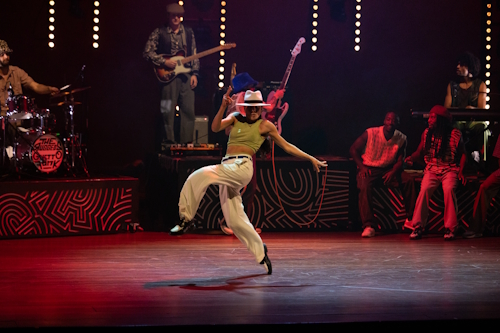
Photo Emile Vrolijk
Among the dancers, Wessels brings a notably different quality during her improvisation. Her movement has a liquid, flowing texture, with arms, torso and lower body drawing on what appears to be a more classical or neo-classical line. Against the sharper attack and grounded power elsewhere, her phrasing adds welcome contrast and widens the choreographic palette.
Ido Koppenaal’s lighting also deserves mention. The stage is alive with effects and atmosphere, but crucially the dancers remain observable. That should be a given, yet too many dance productions lose bodies in dim washes, dark tones and black costumes. Here, even when the cast appear in black suits, the white shirts underneath keep the physical detail fully visible. The result is a production that looks good without sacrificing clarity.
There are moments when Groove might have benefited from a little tightening. At almost ninety minutes, its abundance is both part of its charm and its slight weakness. Yet the generosity of the performers, and the obvious pleasure they take in sharing the stage, carry the evening through. This is not a cool, detached display of street dance virtuosity. It is warmer than that: a communal, music-driven celebration of skill, rhythm and personality.
The almost sold-out Queen Elizabeth Hall responded accordingly, with a standing ovation that felt earned rather than automatic. The Ruggeds are one of the world’s leading breakdance crews, and Groove shows why. Technically excellent, visually engaging and musically alive, it is an infectious evening of dance and live music that sends its audience out still tapping to the beat.