
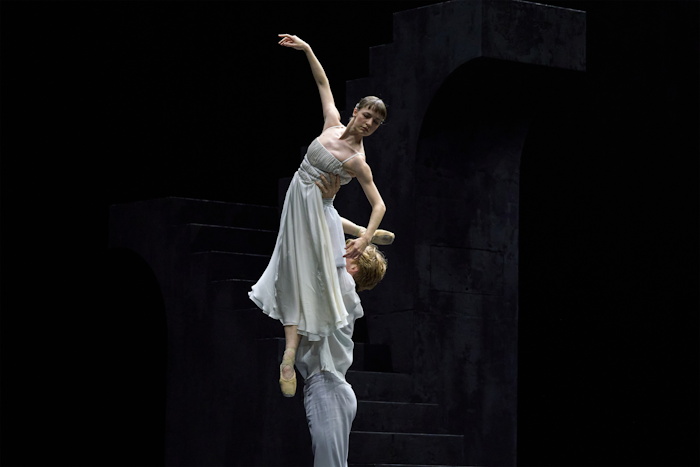
Opera House, Zurich
November 20, 2026
With Romeo und Julia, which premiered last season, choreographer and director of Ballett Zürich, Cathy Marston, proves again that she is a fabulous storyteller. With the omission of some characters and changes to some others, she has created a contemporary story full of the thrilling emotions of forbidden love and the anguish of death that hits like a fist into solar-plexus.
The first act opens with Julia and Angelica, a slightly older cousin who takes care of her, and who replaces the Nurse. They dance playfully around a flower selling woman on a piazza in Verona. Tybalt, Julia’s cousin, lurks in the background, and soon it becomes clear that he and Angelica are having an affair.
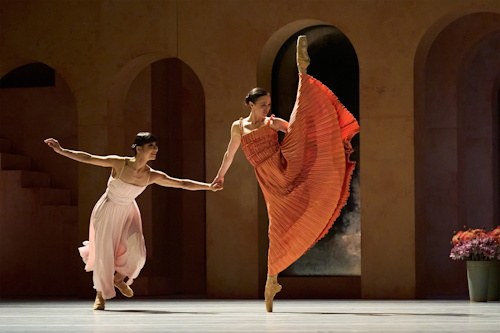
(pictured: Ayaha Tsunaki as Julia and Inna Bilash as Angelica)
Photo Carlos Quezada
Upon their egress, Romeo enters. Pensive, he kneels down, elbow on knee, hand on forehead; a foreboding of his mood shifts between this and his elation, when being with Julia. His family, the Montagues, are absent throughout. Of his two companions, Mercutio and Benvolio, Marston has turned Benvolio into a woman, Benvolia, danced wonderfully by Breanna Foad. She is smaller than the men, swift and delicate, and with her tomboy behaviour she takes the nobleness out of the trio and turns them into adolescents of today.
Romeo and his friends are dressed in blue; Julia and her family, the Capulets, in red, but they do not only distinguish themselves by colour. While the choreography is all very much ballet-based, Romeo’s group dance with a flowing softness. Hips rotate and arms curve. In contrast, the Capulets use angular movements. An arm is placed on top of the head like a board, or an elbow raised straight to the side with the hand on the chest, which creates a martial look. Marston found these differences in Shakespeare’s language. The Montagues talk using a lot of images from nature, the Capulets with short precise, commanding sentences.
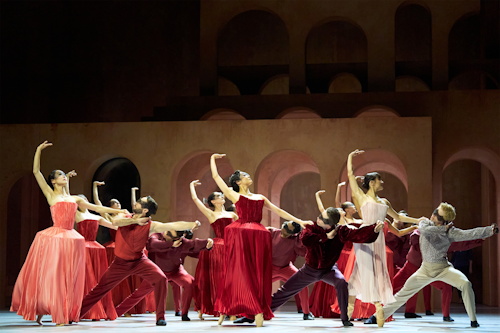
Photo Carlos Quezada
Nancy Osbaldeston embodies Julia with sweetness, stubbornness and more maturity than in other versions. She seems to know something about love and does not resist Paris, Sean Bates, but embraces him courteously by lowering her arms in fifth position around him. In the pas de deux in which Julia rejects him, he turns aggressive and insists on his rights to her.
The sets by David Fletscher, who also designed the costumes, do not offer a balcony but what looks like a roof terrasse. When Julia decides to walk down the stairs to embrace Romeo, Chandler Dalton, it is a deliberate choice. Dalton excels with high jumps. In their first duet, he turns Julia around in complicated and intricate lifts with ease, and that at times make them look as if united not only in soul but also in body.
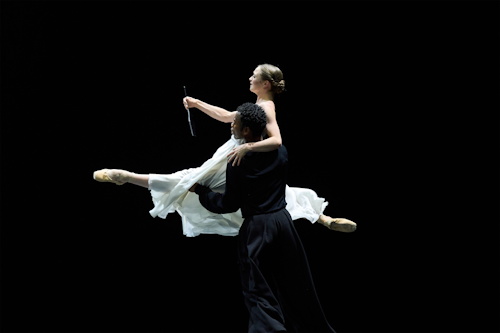
in Cathy Marston’s Romeo and Julia
Photo Carlos Quezada
The fight scene, during which Tybalt, a noble Joel Woellner, kills fun-loving and vivacious Mercutio, Pablo Octávio, is a flurry of bodies in blue and red. No épées, but a lot of arms raised like swords and physical pushing and punching. It is fast and feels like the whole city of Verona is participating. Mercutio is not stabbed; Tybalt just smashes his head against a mirror.
In stark contrast to the bright and colourful first act, the second sees the dancers dressed in black, with only a black staircase leading nowhere for the set. It opens with Romeo cutting Tybalt’s throat, with both Julia and Angelica, Yu-Su Park, watching. They are both grief-stricken. Park changes superbly from being Julia’s intimate and amicable friend to become a grieving and cold servant. Unlike the usual Nurse, she feels no unconditional love. When Julia first meets Romeo after the incident, she is angry and punches his chest, but eventually she gives in to his pleas.
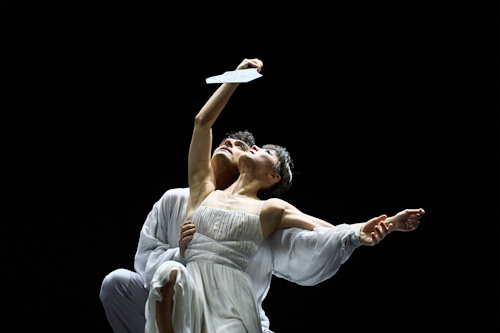
(pictured: Karen Azatyan as Romeo and Ayaha Tsunaki as Julia)
Photo Carlos Quezada
Marston has also taken religion out of the ballet, although Lorenzo, a monk, is present, danced very expressively by Brandon Lawrence. Dressed in dark, wide pants rather than a cowl, he does not refer to God, instead using hand signs to convey his secret messages to the young couple; messages that were unintelligible to me. He teaches Julia to hypnotize herself with a shard from the broken mirror. That same fragment is later used by Romeo to slice open his artery from hand to elbow. An indelible image. Julia on realizing Romeo is dead, then uses it to stab herself to death.
The supporting cast were all excellent too, with everyone carried along by Prokofiev’s music played by the Orchester der Oper Zürich under Dmitry Matvienko’s baton. They played out every emotion making them quite palpable.
Marston’s Romeo und Julia shows how timeless Shakespeare is. With her changes, few but significant, she has turned the drama into a story of today; one full of people we can easily identify with. It just shows that human emotions and relationships change little through time.