
Sadler’s Wells, London
September 15, 2026
By the end of Alvin Ailey American Dance Theater’s New Works programme, I felt less as though I had watched an evening of dance than somehow wandered into a service. The feeling had been building all night, through awakening, spiritual searching, visions of heaven and the complications of human desire, before Revelations arrived with sorrow, water, sinners, salvation and enough gospel energy to get much of the audience moving in their seats.
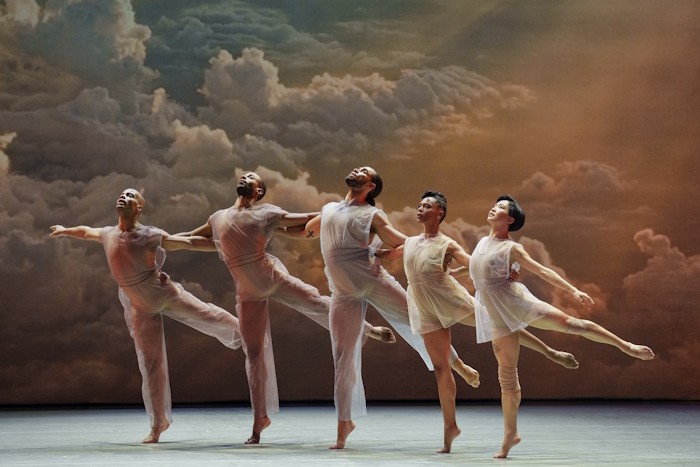
Medhi Walerski’s Blink of an Eye begins with a line of dancers. As the light rises, one remains, then another replaces them, followed by another. In this first section, bodies pass through the same space largely alone, arriving and disappearing without forming sustained relationships. After the first blackout, the stage returns in warmer yellow light and dancers begin appearing in pairs. A second blackout leads into a third section in which the full group occupies the stage together and partnering becomes part of the texture. By the end, the dancers have returned to the line with which they began, giving the work a clear circular structure.
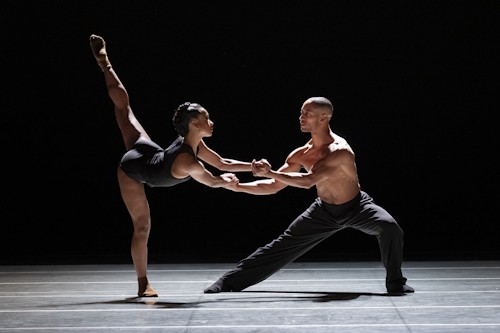
Photo Paul Kolnik
Set to Bach played by Itzhak Perlman, the choreography listens closely to the violin. A recurring phrase sends the leg forward before sweeping it behind into attitude or arabesque as the body changes direction, making the musical phrasing almost visible. Across the work, quick redirections, altered spotting, sudden stillness and deep pliés establish a broader movement language that recurs throughout the evening. The dancers have an especially fluent relationship with weight and the floor. They sink, release and rise without making the transitions feel like separate tasks. Blink of an Eye is polished, musical and structurally clear, though its physical logic proves more tangible than its ideas of presence and absence.
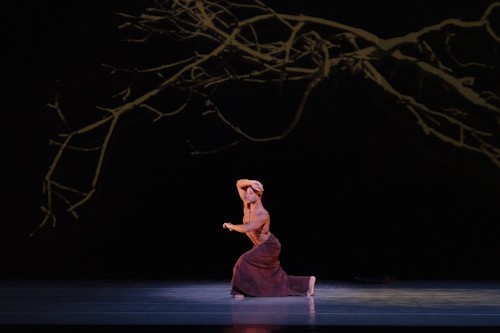
If Blink of an Eye builds outward, Jamar Roberts’ Song of the Anchorite turns sharply inward. Yannick Lebrun, in loose earth-coloured trousers with narrow bands crossing his bare torso, immediately suggests an ascetic figure. Avishai Cohen’s interpretation of Ravel’s Adagio assai gives the score an unexpectedly jazzy, lived-in quality, with trumpet, double bass, drums and piano entering one by one. The choreography occasionally catches individual sounds from each instrument clearly enough for Lebrun’s body to seem to be listening its way through the music.
(pictured: Donnie Duncan Jr)
Photo Paul Kolnik
For much of the first half, he barely stops moving. He turns, redirects, drops, rises, balances and releases, with phrases tumbling rapidly into one another. Stillness feels difficult to reach. Eventually, a green robe appears. Lebrun holds it, dances with it, then puts it on, and the movement changes. Phrases become longer, the pace eases and the body seems to acquire more time inside each action. The spirituality here stays close to ordinary human life. It has sweat, weight and rhythm, with something almost urban in the jazz-inflected sound world. The search for quiet unfolds while life continues moving around it.
Lar Lubovitch’s Many Angels then lifts the evening straight into the clouds. Five dancers move against an enormous changing sky, dressed in pale translucent costumes that make the title immediately believable. The whole thing resembles looking out of an aeroplane window at sunlight hitting distant clouds and imagining mysterious creatures are up there having a dance.
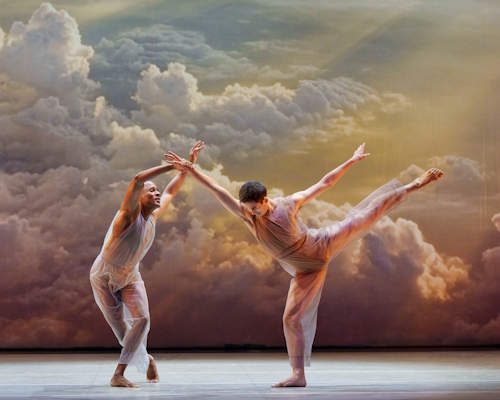
Photo Paul Kolnik
The choreography is strongly formal, built from symmetry, repeated gestures, varying levels and broad windmill-like sweeps of the limbs. With five dancers, someone is often left slightly outside the group, creating a small imbalance inside otherwise carefully organised tableaux. Against the shifting cloudscape, the dancers frequently settle into poses with the composed beauty of a religious painting. Limbs curve and fan out, bodies frame one another, and the pale costumes catch the changing light like figures in some celestial canvas. The image is complete almost as soon as it appears. What remains less certain is whether the choreography develops that heavenly vision much further. The clouds change colour, Mahler supplies grandeur and the bodies produce one beautiful picture after another. It is gorgeous, though its beauty feels more resolved than its ideas.
Judith Jamison’s A Case of You brings the evening firmly back to earth. Caroline T. Dartey and Christopher Taylor move through attraction, resistance, testing and demand, with the sense that both want something from the other and are trying to shift the balance between them. The choreography shares the programme’s appetite for speed, with movement often arriving in a rush, stopping abruptly, then setting off again. Taylor’s solo has the quality of private struggle becoming briefly visible, while the duet that follows is strikingly intense against the slowness of the music. In the final image, Dartey is held horizontally between Taylor’s legs, suspended well above the floor as he folds towards her and both open their arms into an embrace. After heaven, human beings are back to making life difficult for each other.
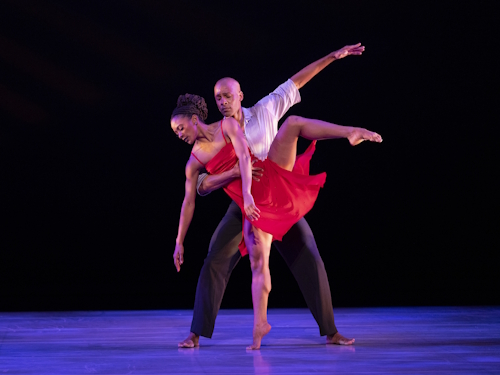
(pictured: Jacquelin Harris and Yannick Lebrun)
Photo Paul Kolnik
After the complications of two people, Revelations expands the frame to an entire community. Alvin Ailey’s 1960 work is divided into ‘Pilgrim of Sorrow’, ‘Take Me to the Water’ and ‘Move, Members, Move’, and its religious structure is impossible to miss.
What stayed with me most strongly in ‘Pilgrim of Sorrow’ was the hands: open palms repeatedly rising into the air, arms spreading wide like wings. The shape returns often enough to become part of the section’s visual language, suggesting birds, perhaps even the dove associated with the Holy Spirit. In brown and earth tones, the dancers sink deeply through the knees, fold forward and open again, their bodies pressing into the floor even as the arms reach upwards. A duet brings intimacy into the picture, while elsewhere the movement becomes more percussive and grounded, with African diasporic qualities emerging through rhythm, weight and group pulse.
‘Take Me to the Water’ shifts everything into white. Flowing fabric stretches across the stage and a single parasol rises above the dancers, giving the scene the brightness of baptism and renewal. Hips pulse through travelling steps, the pelvis leads the body forward and waves move through the torso and upper body, keeping the dancing grounded and rhythmically alive.
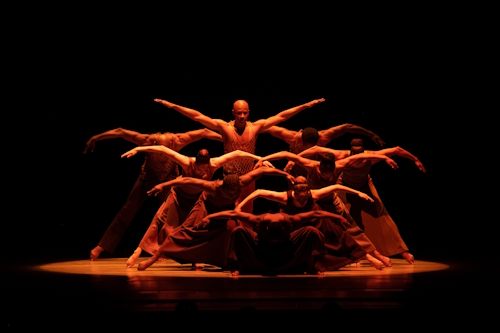
Photo Paul Kolnik
Then comes ‘Move, Members, Move’. Against a red background, bare-chested men in black trousers appear for ‘Sinner Man’. My first thought was, “Hell?” The lyrics soon confirmed that I was not imagining things. By this point, subtlety has pretty much packed its bag and gone home.
After that comes the final yellow burst. Women in bright dresses and hats enter carrying fans and stools, joined by men in yellow shirts and dark waistcoats. The atmosphere opens fully into gospel celebration, with the buoyancy of a church social and the confidence of a show that knows it has the audience. The women sit, stand, fan themselves and play with rhythm and attitude, while the men join with equal theatrical ease.
What changes here is scale. In the new works, spirituality often appears as an individual condition: one body searches, struggles, turns inward or drifts towards transcendence. In Revelations, it becomes communal, carried by rhythm, memory and the group. The African American church tradition is present in the spirituals, song-sermons, gospel songs and holy blues, as well as in call and response, grounded movement and the collective energy of the performers.
The audience responds immediately. People clap, move, dance in their seats and pull out their phones. After the first bow, the dancers return to the final section and dance part of it again, turning the ending into a mixture of performance, encore, curtain call and communal celebration. The energy onstage and the response in the auditorium begin feeding each other, until sitting still starts to feel oddly conspicuous.
Looking back across the evening, the progression feels almost liturgical: awakening, inward searching, angels, earthly desire, then sorrow, water, sin, salvation and collective joy. For a little while, Sadler’s Wells feels less like a theatre than Sunday service, just with much better dancers.